What Is Artificial Intelligence? How It Works, Types, Uses, and Examples
Published: 4 Nov 2026
Have you wondered how your phone understands your voice, how YouTube suggests videos, or how a computer can answer your questions? These things may seem like magic, but they use a smart technology called Artificial Intelligence (AI). AI is changing the way we live, work, learn, and use technology. Today, many people use AI without even knowing it.
Don’t worry if you are new to this topic. You don’t need any technical skills to understand it. Artificial intelligence is easier to learn than you might think. With simple words and real-life examples, anyone can understand how this technology works.
We will explore what artificial intelligence is, how it works, its main types, everyday examples, benefits, and risks. You will also learn how AI helps people in daily life and why it matters for the future.
Let’s explore it together!
What Is Artificial Intelligence
Artificial Intelligence (AI) is a type of technology that helps computers and machines do tasks that usually need human intelligence. These tasks include learning, solving problems, understanding language, recognizing pictures, and making decisions. AI uses data and smart computer programs to learn patterns and give useful answers.
For example, when you ask Siri or Google Assistant a question, AI helps them understand your words and respond. When YouTube suggests videos you may like, AI studies what you watch and recommends similar content. In simple words, AI helps machines learn from information and perform tasks in a smart way.
How Does Artificial Intelligence Work?
Artificial intelligence works by using data, computer programs, and special instructions to help machines learn and solve problems. First, AI collects information from different sources, such as text, pictures, videos, and numbers. Then, it studies this information to find patterns and understand how things work. It uses these patterns to make predictions, answer questions, and complete tasks.
For example, when you watch videos on YouTube, AI studies your watch history and the videos you like. It then suggests other videos that may interest you. Similarly, AI chatbots like ChatGPT study language patterns to understand your questions and create helpful answers.
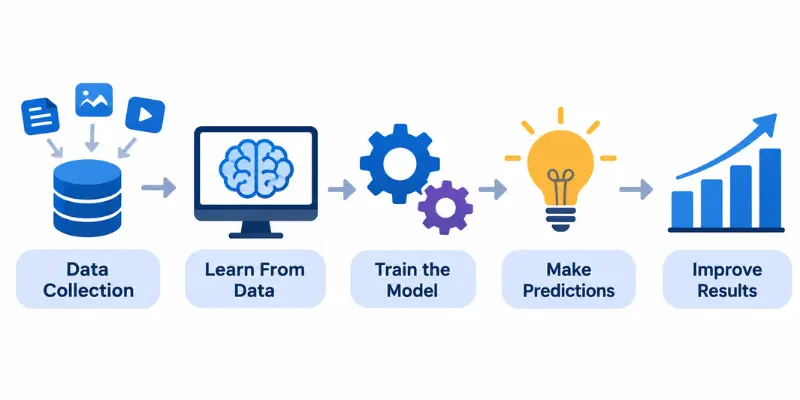
Here are the basic steps that explain how AI works:
- Collect Data: AI collects information, such as text, images, and numbers.
- Learn From Data: It studies the information and finds useful patterns.
- Train the Model: Developers train an AI model to perform a specific task.
- Make Predictions: AI uses what it has learned to answer questions or predict results.
- Improve Results: Developers test the system and improve its performance with more data and feedback.
What Are the Main Types of Artificial Intelligence?
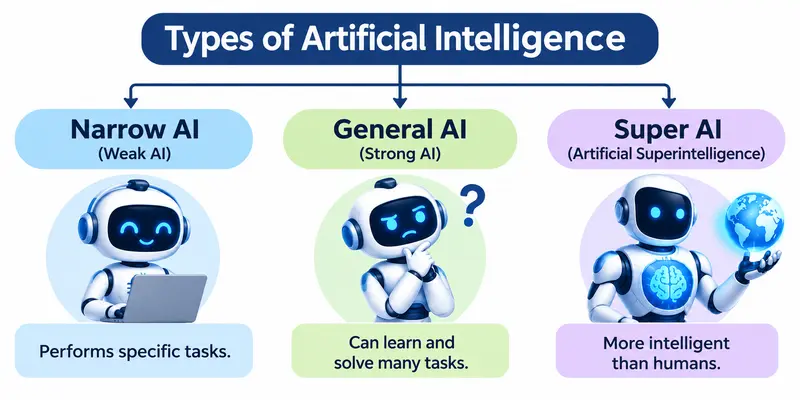
Artificial intelligence has different types. Each type has its own abilities and uses. Some AI systems can perform simple tasks, while others can learn from data, solve problems, and make decisions. Experts commonly divide AI into three main types based on its abilities.
1. Narrow AI (Weak AI)
Narrow AI is the most common type of AI we use today. It can perform specific tasks, but it cannot think or work like a human in every situation.
Examples of Narrow AI:
- Siri and Google Assistant.
- YouTube video recommendations.
- Face recognition on smartphones.
- Chatbots that answer questions.
- Google Maps route suggestions.
2. General AI (Strong AI)
General AI is a type of AI that could learn, understand, and perform many different tasks like a human. It could solve problems, learn new skills, and use its knowledge in different situations.
Examples of General AI:
- Learning new skills without task-specific training.
- Solving different types of problems.
- Understanding different subjects.
- Making decisions in new situations.
General AI does not exist in a fully developed form today. Scientists are still working to understand and develop this type of AI.
3. Super AI (Artificial Superintelligence)
Super AI is a future idea in which machines could become more intelligent than humans. It could solve complex problems, learn new things, and make decisions faster than people.
Possible examples of Super AI:
- Finding solutions to major world problems.
- Making advanced scientific discoveries.
- Solving complex problems faster than humans.
- Developing new ideas and technologies.
Super AI does not exist today. It remains a theoretical concept that scientists and researchers discuss.
What Are the Different Branches of Artificial Intelligence?
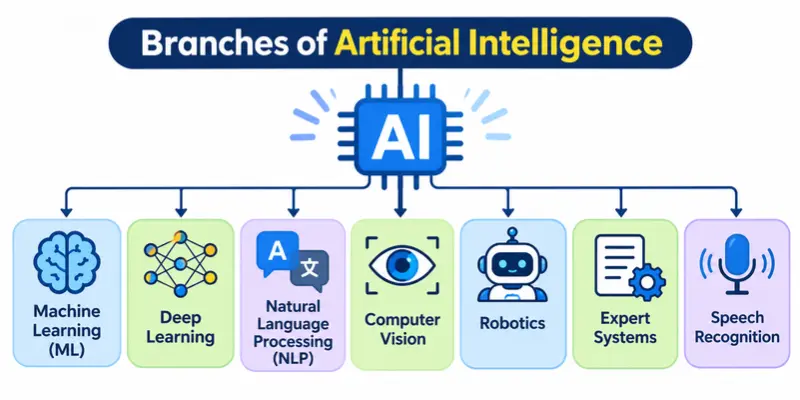
Artificial intelligence has several branches. Each branch helps computers and machines perform different tasks. Some branches help machines understand human language, while others help them recognize pictures, learn from data, and solve problems.
Let’s explore the main branches of AI with simple explanations and real-life examples.
1. Machine Learning (ML)
Machine learning is a branch of AI that helps computers learn from data and improve their results. It allows machines to find patterns and make predictions without following instructions for every small task.
Examples:
- YouTube video recommendations.
- Email spam filters.
- Online shopping suggestions.
- Weather predictions.
2. Deep Learning
Deep learning is a part of machine learning. It uses computer systems called neural networks to learn from large amounts of data. These systems work in a way that is loosely inspired by the human brain.
Examples:
- Face recognition.
- Voice assistants.
- Self-driving cars.
- Image recognition.
3. Natural Language Processing (NLP)
Natural language processing helps computers understand, read, and respond to human language. It allows people to communicate with machines using normal words.
Examples:
- ChatGPT.
- Google Translate.
- Voice assistants.
- Grammar and spelling checkers.
4. Computer Vision
Computer Vision helps computers understand and study images and videos. It allows machines to identify objects, faces, and other details in pictures.
Examples:
- Face recognition.
- Medical image scanning.
- Security cameras.
- Object detection in self-driving cars.
5. Robotics
Robotics combines AI with machines to help robots perform tasks. AI helps robots understand their surroundings, make decisions, and complete different activities.
Examples:
- Factory robots.
- Robot vacuum cleaners.
- Medical robots.
- Warehouse robots.
6. Expert Systems
Expert systems use stored knowledge and rules to solve problems or give advice. They work like computer-based experts in a specific field.
Examples:
- Medical support systems.
- Financial analysis tools.
- Technical troubleshooting systems.
- Business decision support tools.
7. Speech Recognition
Speech recognition helps computers understand spoken words and turn them into text or commands. It allows people to control devices using their voices.
Examples:
- Siri.
- Google Assistant.
- Voice typing.
- Automatic subtitles.
What Are Some Real-Life Examples of Artificial Intelligence?
Artificial intelligence is already part of our everyday lives. We use AI when we unlock our phones, watch videos, shop online, or search for information. Many apps and devices use AI to make our daily tasks easier, faster, and smarter. Let’s look at some common examples of AI in real life.
AI in Smartphones
Smartphones use AI to make different tasks easier. AI helps phones recognize faces, understand voice commands, and improve photos. It also learns from how people use their devices.
Common examples include:
- Face Unlock: AI helps your phone recognize your face and unlock the screen.
- Voice Assistants: Siri and Google Assistant use AI to understand your voice commands.
- Smart Photo Editing: AI improves photo quality, removes unwanted objects, and adjusts lighting.
AI in Social Media
Social media platforms use AI to understand what users like and show them interesting content. AI studies user activity, such as likes, comments, searches, and watch history.
Common examples include:
- Personalized Feeds: AI shows posts based on your interests.
- Content Recommendations: It suggests videos, photos, and accounts you may enjoy.
- Face Filters: AI helps add filters and effects to faces in photos and videos.
AI in Online Shopping
Online shopping websites use AI to help customers find products. AI studies shopping history, searches, and interests to suggest useful items. It also helps businesses provide better customer support.
Common examples include:
- Product Recommendations: AI suggests products based on your interests.
- Personalized Offers: Shopping websites show offers based on customer activity.
- Customer Support Chatbots: AI chatbots answer common questions and help customers.
AI in Healthcare
Healthcare professionals use AI to study medical information and support patient care. AI can help doctors examine medical images, monitor patients, and support medical research.
Common examples include:
- Medical Image Analysis: AI helps doctors study X-rays, CT scans, and MRI images.
- Patient Monitoring: AI systems help track patient information and notice unusual changes.
- Medical Research: AI helps researchers study large amounts of medical data.
AI in Education
AI is changing the way students learn and study. It helps students understand difficult topics, practice new skills, and get learning support. Teachers can also use AI to prepare lessons and learning materials.
Common examples include:
- Personalized Learning: AI suggests lessons based on a student’s learning needs.
- AI Study Assistants: Tools like ChatGPT help students understand topics and practice questions.
- Language Learning Apps: Apps like Duolingo use AI features to support language practice.
AI in Transportation
AI helps people travel more safely and easily. It studies traffic information, road conditions, and vehicle data to support better travel decisions. Many navigation apps and modern vehicles use AI-powered features.
Common examples include:
- Traffic Prediction: AI studies traffic patterns to predict busy roads.
- Navigation Apps: Google Maps uses AI and other technologies to suggest suitable routes.
- Driver Assistance Systems: AI-powered systems can help detect nearby vehicles, warn drivers, and support safer driving.
What Are the Benefits of Artificial Intelligence?
Artificial intelligence offers many benefits in daily life, education, and business. It helps people complete tasks faster, save time, and make better decisions. AI can also handle repeated work and support people in solving different problems. Let’s explore some important benefits of artificial intelligence.
Saves Time:
AI helps people save time by doing repeated tasks automatically. It can sort data, answer common questions, write simple reports, and manage other routine work. This allows people to focus on more important tasks.
Reduces Human Errors:
People can make mistakes when working with large amounts of information. AI can help find patterns, check data, and identify possible errors. It can also support more accurate results in tasks like data analysis.However, AI is not perfect. It can also make mistakes, so people should check important results.
Works Around the Clock:
Many AI systems can work 24 hours a day, seven days a week. They do not need regular breaks like human workers. This makes AI useful for services that need continuous support or monitoring.
Improves Productivity:
AI helps people and businesses complete more work in less time. It can organize information, manage simple tasks, and provide useful suggestions. This helps teams focus on planning, problem-solving, and other important work.
Supports New Ideas:
AI gives people new ways to create, learn, and explore ideas. It can help writers create content, help students understand difficult topics, and support researchers in studying large amounts of information. It also helps developers and businesses explore new products and solutions.
What Are the Disadvantages of Artificial Intelligence?
Artificial intelligence has many benefits, but it also has some disadvantages. AI can make work easier, but it can create problems when people depend on it too much. It may affect jobs, create privacy risks, and sometimes provide incorrect information. Let’s look at the main disadvantages of artificial intelligence.
Job Loss and Unemployment:
AI can perform many tasks that people used to do. Some businesses use AI systems to automate customer support, data entry, and other repetitive jobs. This may reduce the need for workers in certain roles.
High Development Costs:
Building and maintaining AI systems can be expensive. Businesses may need powerful computers, special software, skilled workers, and large amounts of data. Small businesses may find these costs difficult to manage.
Privacy and Security Risks:
AI systems often use large amounts of data to work. This data may include personal details, photos, messages, and user activity. If companies do not protect this information properly, it can create privacy and security risks.
Lack of Human Emotions:
AI can understand words and respond to questions, but it does not have human feelings or real-life experiences. It cannot replace human care, kindness, and emotional understanding.
Wrong Information and Mistakes:
AI does not always provide correct answers. It can misunderstand questions, use incorrect data, or create false information that sounds real. People should check important answers before using them.
Overdependence on Technology:
Some people depend too much on AI for writing, learning, decision-making, and daily tasks. This can reduce their effort to think, solve problems, and learn new skills independently.
What Is the Difference Between Artificial Intelligence and Human Intelligence?
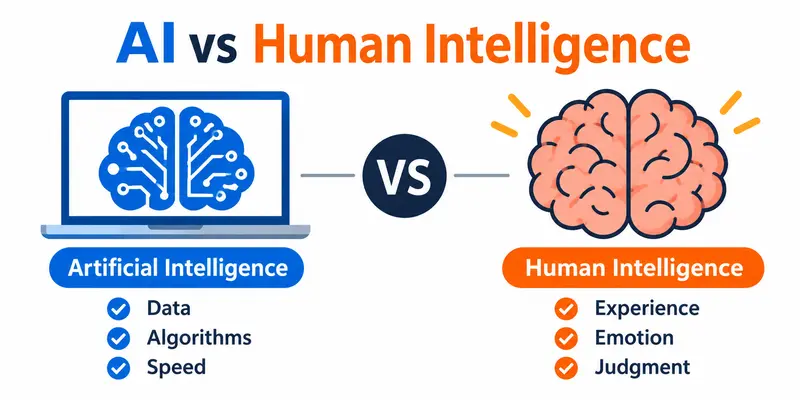
Artificial intelligence and human intelligence both help solve problems, learn new things, and make decisions. However, they work in very different ways. Artificial intelligence uses computers, data, and algorithms to perform tasks, while human intelligence comes from the human brain, life experiences, and natural thinking. Let’s understand the main differences.
| Feature | Artificial Intelligence | Human Intelligence |
| Learning | Learns from data and examples. | Learns from experience and practice. |
| Creativity | Generates content using learned patterns. | Creates ideas using imagination and experiences. |
| Emotions | Does not have real feelings. | Experiences real emotions. |
| Decision-Making | Uses data and algorithms. | Uses knowledge, judgment, and experience. |
| Speed | Processes large amounts of data quickly. | Usually takes more time to process large datasets. |
| Accuracy | Can make mistakes or give incorrect results. | Can also make mistakes but uses judgment. |
| Adaptability | Often works best within specific tasks. | Can adapt to many new situations. |
| Common Sense | May struggle with everyday situations. | Uses common sense and real-life understanding. |
| Problem-Solving | Finds patterns and follows learned methods. | Uses logic, creativity, and experience. |
| Dependence | Depends on data, software, and computers. | Depends on the human brain and senses. |
What Is the Future of Artificial Intelligence?
The future of artificial intelligence looks promising. AI is growing quickly and changing how people live, work, and learn. In the coming years, it may create new opportunities in healthcare, education, business, and technology.
- AI in Healthcare: AI may help doctors detect diseases earlier, study medical reports, and support medical research.
- AI in Education: AI may make learning easier through personal study plans, AI tutors, and practice tools.
- AI in Business and Jobs: Businesses may use AI to automate tasks, improve customer service, and increase productivity. Some jobs may change, while new roles may emerge.
- AI in Transportation: AI may improve traffic management, navigation, and vehicle safety.
- AI in Everyday Life: AI may make smart homes and digital assistants more useful for daily tasks.
- AI in Scientific Research:AI may help scientists study data, test ideas, and make new discoveries.
How Can Beginners Start Learning Artificial Intelligence?
Beginners can learn artificial intelligence without having advanced technical skills. Start with basic concepts, explore free AI tools, and practice simple projects. Here are some easy steps to get started.
- Learn AI Basics: Understand what AI is, how it works, and its main types. Learn basic concepts like machine learning and generative AI.
- Explore Free AI Tools: Try tools like ChatGPT, Google Gemini, and Canva AI. Use them for writing, learning, and creating content.
- Learn Basic Programming:Learn Python because it is widely used in AI and machine learning. Start with variables, loops, functions, and basic coding.
- Study Mathematics:Learn basic math, especially algebra, statistics, and probability. These topics help you understand how AI models work.
- Practice Small Projects:Start with simple projects, such as a chatbot, spam email detector, or basic image classifier. Practice helps you improve your skills.
- Take Free Online Courses:Use beginner-friendly courses on platforms like YouTube, Coursera, and Google to learn AI step by step.
Conclusion
Artificial intelligence is changing the way we live, work, and learn. From smartphones and online shopping to healthcare and education, AI helps people complete many tasks faster and more easily. It also brings new opportunities and challenges that everyone should understand.
Now that you know what artificial intelligence is, how it works, its types, benefits, disadvantages, and future uses, you can start exploring this technology yourself. I recommend trying beginner-friendly AI tools like ChatGPT and Google Gemini to see how they can help with your daily tasks, learning, and work.
Ready to explore AI? Try a free AI tool today, practice with simple tasks, and discover what you can create. You can also explore more AI guides on our website to build your knowledge and skills.
FAQs
No, beginners can learn artificial intelligence without advanced technical knowledge. Start with basic AI concepts and explore free tools like ChatGPT and Google Gemini. You can learn more advanced topics, such as Python and machine learning, as your skills improve.
No, current AI systems do not think or understand the world like humans. They use data, patterns, and algorithms to generate answers and solve problems. They can perform some tasks that require human intelligence, but they do not have human feelings or personal experiences.
Artificial intelligence makes many daily tasks easier and faster. It helps people find information, navigate roads, shop online, and communicate with digital assistants. Many people already use AI through smartphones, social media, and online services.
AI may replace some tasks and change certain jobs, especially those that involve repetitive work. However, it can also create new opportunities in AI development, data analysis, and other technology fields. Learning digital skills and understanding AI can help people prepare for these changes.
Businesses can start using AI when they want to save time, improve customer service, or manage daily tasks more efficiently. They can begin with simple tools for writing emails, organizing data, and answering customer questions. Start with one small task and check whether AI improves the results.
Artificial intelligence is important for businesses because it helps them save time, study data, and improve customer service. It can also help teams make better decisions.
For example, an online store can use AI to suggest products, answer common customer questions, and study buying patterns. This helps the business understand its customers and improve its services.
Generative AI creates new content, while traditional AI analyzes data and makes predictions.
- Generative AI: Creates text, images, music, and code. Example: ChatGPT.
- Traditional AI: Finds patterns and detects problems. Example: Spam filters and fraud detection systems.
People can use artificial intelligence safely by following these tips:
- Never share passwords or private details.
- Check important facts.
- Do not trust every AI answer.
- Review AI-generated content.
- Use trusted AI tools.
Python is one of the best languages for beginners learning artificial intelligence. Start with these basics:
- Variables and data types.
- Loops and functions.
- Basic maths.
- Simple AI projects.
Learn basic Python before moving to advanced AI topics.
Yes, some AI tools work offline, such as:
- Face recognition.
- Voice typing.
- AI photo editing.
- Offline translation apps.
However, many AI tools need the internet to work.

- Be Respectful
- Stay Relevant
- Stay Positive
- True Feedback
- Encourage Discussion
- Avoid Spamming
- No Fake News
- Don't Copy-Paste
- No Personal Attacks
- Be Respectful
- Stay Relevant
- Stay Positive
- True Feedback
- Encourage Discussion
- Avoid Spamming
- No Fake News
- Don't Copy-Paste
- No Personal Attacks
