How AI Works: A Simple Guide for Beginners
Published: 5 Nov 2026
Have you ever wondered how AI tools like ChatGPT answer questions, create content, or help you complete daily tasks? Artificial Intelligence may seem complex, but its basic working process is easier to understand than you think. You do not need technical knowledge to learn the basics.
In this guide, you will discover how AI learns from data, finds patterns, understands information, and generates results. We will also explore machine learning, deep learning, real-life AI examples, benefits, limitations, and the future of artificial intelligence.
By the end, you will have a clear understanding of this technology and how people use it in everyday life. Whether you are a student, beginner, or simply curious about technology, this easy guide will help you understand how AI works with confidence.
What Is Artificial Intelligence?
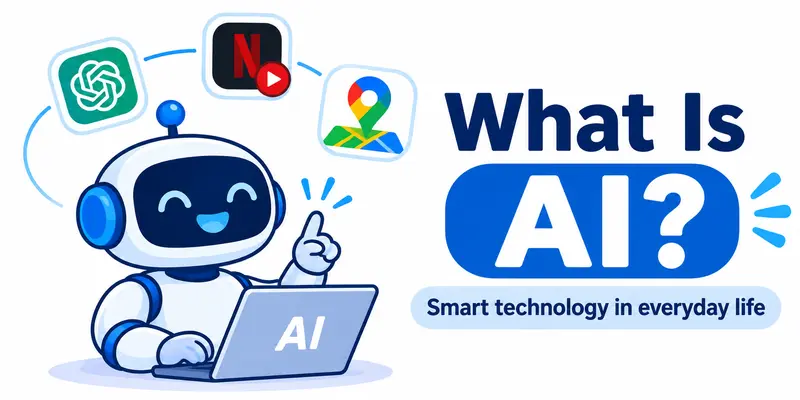
Artificial Intelligence (AI) is a technology that allows computers and machines to do tasks that usually need human intelligence. These tasks include learning, solving problems, understanding language, recognizing images, and making decisions.
For example, when you ask ChatGPT a question, get movie suggestions on Netflix, or use Google Maps to find the best route, you are using artificial intelligence.
How Does AI Work?
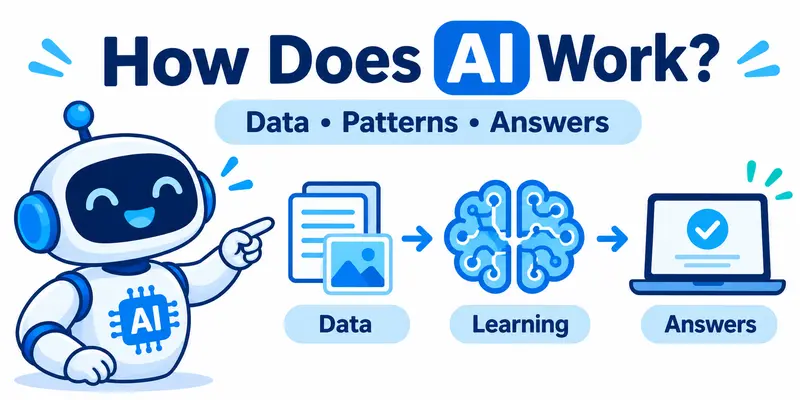
Artificial Intelligence (AI) helps computers perform tasks that usually need human intelligence. It can answer questions, recognize faces, understand speech, and make predictions.
But have you ever wondered how AI does all these things?
AI works by collecting data, finding patterns, learning from examples, and using that knowledge to produce results. It follows a process that helps machines perform smart tasks.
For example, when you ask ChatGPT a question, it studies your words and uses patterns learned during training to create an answer.
What Are the Main Components of AI?
Artificial intelligence uses different components to learn from information and complete tasks. Each component has an important role in helping AI systems work properly.
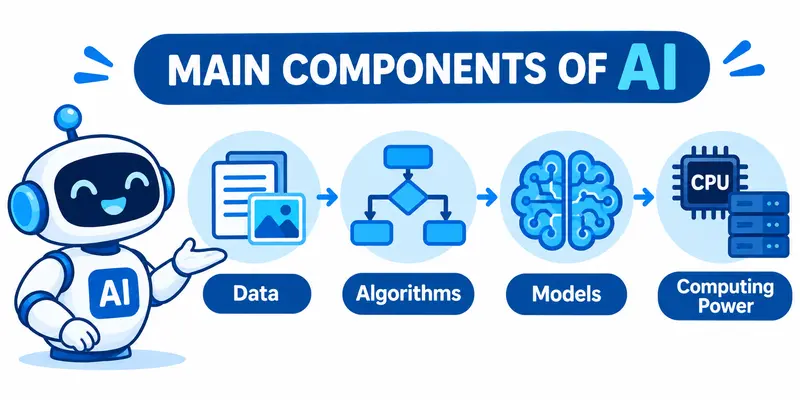
Four main components of AI are data, algorithms, machine learning models, and computing power. Let’s understand how each one works.
Data
Data is the information that AI systems use to learn and perform tasks. It helps AI find patterns, understand information, and produce useful results.
AI systems use different types of data, such as:
- Text: Articles, emails, messages, and books.
- Images: Photos of people, animals, and objects.
- Audio: Human voices, music, and other sounds.
- Numbers: Prices, sales records, and weather information.
Algorithms
Algorithms are sets of instructions that tell computers how to solve problems and process information. They help AI systems find patterns in data and complete different tasks.
AI algorithms use mathematical steps to study information, compare results, and find useful patterns.
Algorithms help AI systems:
- Process large amounts of data.
- Find patterns and connections.
- Make predictions.
- Solve different problems.
- Produce useful results.
In simple words, algorithms tell AI how to work with information.
Machine Learning Models
A machine learning model is a trained computer system that learns patterns from data. It uses these patterns to make predictions, recognize information, or complete tasks.
During training, the model studies examples and adjusts its internal settings to improve its results.
For example, imagine you want to create an AI system that identifies spam emails.
- Give the system examples of spam and normal emails.
- The model studies the words and patterns in those emails.
- It learns which patterns often appear in spam.
- It checks new emails and predicts whether they are spam.
After training, the model can use what it has learned to check new emails.
Machine learning models power many popular AI tools, including chatbots, recommendation systems, and image recognition software.
Computing Power
Computing power refers to the ability of a computer to process information and perform calculations. AI systems need computing power to train models, analyze data, and generate results.
Small AI tasks can run on normal computers. However, large AI models need more powerful hardware because they process huge amounts of data and perform billions of calculations.
Two important parts of AI computing are
- GPUs (Graphics Processing Units): These computer chips can perform many calculations at the same time. They help train large AI models faster.
- Powerful Computers: High-performance computers and servers provide the memory and processing power needed to run complex AI systems.
How Does AI Understand Human Language?
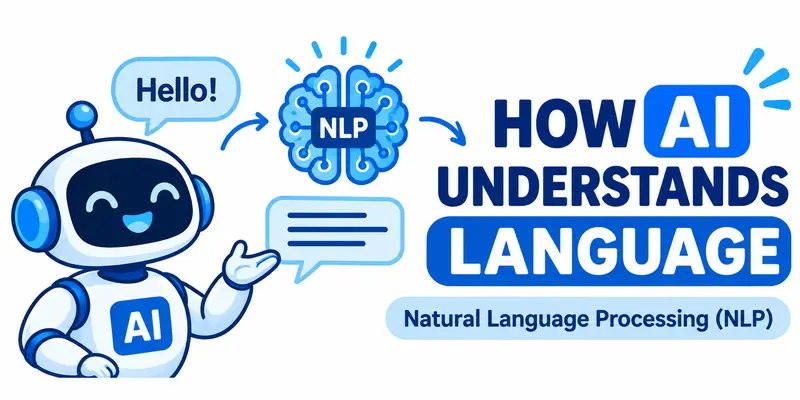
AI understands human language using a technology called Natural Language Processing (NLP).
It processes words, identifies language patterns, understands the context of sentences, and generates relevant responses.
For example, when you ask ChatGPT a question, it analyzes your words and creates an answer based on patterns learned from large amounts of data.
AI uses this technology in:
- Chatbots: Answering questions.
- Translation tools: Translating languages.
- Voice assistants: Understanding spoken commands.
- Grammar checkers: Finding writing mistakes.
In simple words, NLP helps computers communicate with humans using everyday language.
What Are the Benefits of AI?
Artificial Intelligence (AI) offers many benefits in our daily lives. It helps people save time, complete tasks faster, reduce mistakes, and make better decisions. AI is used in education, healthcare, business, transportation, and many other fields.
Some major benefits of AI include:
- Saves Time: AI completes many tasks quickly and reduces manual work.
- Improves Accuracy: AI can help reduce human errors in data analysis and other tasks.
- Works 24/7: AI tools can provide services at any time.
- Automates Tasks: AI handles repetitive tasks, giving people more time for important work.
- Supports Better Decisions: AI analyzes data and helps people make informed decisions.
- Improves Healthcare: AI helps doctors analyze medical images and support disease detection.
- Personalized Learning: AI provides learning support based on students’ needs.
- Boosts Productivity: AI helps businesses and individuals complete more work in less time.
What Are the Limitations of AI?
Although Artificial Intelligence (AI) offers many benefits, it also has some limitations. AI can make mistakes, produce incorrect information, and struggle with tasks that require human judgment.
Some common limitations of AI include
- Lack of Human Emotions: AI cannot feel emotions or understand human experiences like people do.
- Incorrect Information: AI can sometimes generate wrong or misleading answers.
- Limited Creativity: AI creates content based on learned patterns, not human experiences.
- Data Dependency: AI needs large amounts of data to learn and perform well.
- High Costs: Developing and maintaining advanced AI systems can be expensive.
- Privacy Risks: AI systems may create privacy concerns when handling personal data.
- Job Displacement: Automation may reduce the need for people in some jobs.
- Bias: AI can produce unfair results if its training data contains bias.
Real-Life Examples of How AI Works
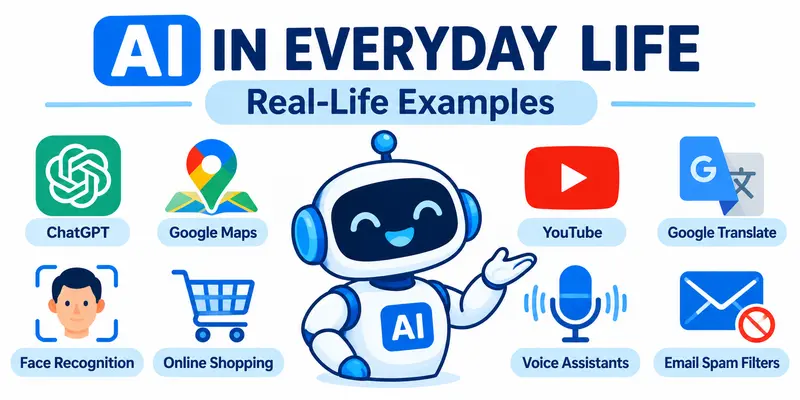
AI is part of our daily lives. It helps people search for information, watch videos, shop online, and complete many tasks. From smartphones to smart homes, AI makes everyday activities faster and easier. We use AI when we ask questions, get video recommendations, translate languages, or use voice assistants. Many businesses also use AI to improve their services and save time.
Here are some common examples of how AI works in real life:
- ChatGPT: Understands questions and generates human-like answers.
- Google Maps: Uses AI and traffic data to suggest faster routes.
- YouTube: Recommends videos based on your interests and viewing history.
- Google Translate: Uses AI to translate text between different languages.
- Face Recognition: Identifies faces to help unlock smartphones.
- Online Shopping: Recommends products based on your searches and interests.
- Voice Assistants: Understand spoken commands and perform tasks.
- Email Spam Filters: Identify unwanted or suspicious emails.
What Is the Future of Artificial Intelligence?
Artificial intelligence is growing rapidly and changing many industries. In the future, AI may help people learn faster, improve healthcare, support businesses, and create new job opportunities. Let’s look at how AI may shape different areas.
AI in Education
AI will make learning more personal and easier for students. AI study assistants can explain difficult topics, answer questions, and provide quick feedback. Students may also get lessons based on their learning needs.
AI in Healthcare
AI may help doctors detect diseases by analyzing medical images and patient data. It can also support medical research and help healthcare professionals make better decisions.
AI in Business
Businesses will use AI to automate customer support, analyze data, and manage daily tasks. These tools can save time, reduce manual work, and improve productivity.
AI and Future Jobs
AI will change the way people work. It may create new career opportunities in AI development, data science, and automation. Some existing jobs may also change as businesses use more AI tools.
Learning AI skills, problem-solving, and technology will help people prepare for future careers.
Conclusion
Now you have a clear idea of how AI works and how it makes everyday tasks easier. AI collects data, learns patterns, processes information, and generates useful results. It uses technologies like machine learning, deep learning, and natural language processing to perform different tasks.
AI is changing many industries, including education, healthcare, business, and transportation. It offers many benefits, such as saving time, improving productivity, and automating tasks. However, it also has limitations, so people should use it carefully and check important information.
My recommendation is to explore AI tools and practice using them in your daily life. Start with simple tools like ChatGPT and discover how they can help you learn, work, and solve problems. Want to learn more about artificial intelligence? Explore more beginner-friendly guides on AIGuideTest.com and take your first step toward understanding the world of AI!
FAQs
AI learns from data by finding patterns and connections. Developers train AI models with examples, such as text, images, or numbers. The model studies these examples and improves its ability to make predictions or give answers. More useful and accurate training data can help an AI model perform better.
Yes, some AI systems can work without an internet connection.
- Offline AI: Runs directly on a device, such as a phone or computer.
- Online AI: Uses internet servers to process information and provide results.
For example, some phone features can recognize faces or improve photos offline.
AI is the broader technology that helps machines perform tasks that usually need human intelligence. Machine learning is a part of AI that allows systems to learn patterns from data.
For example:
- AI: A computer system that can answer questions.
- Machine Learning: A system that learns to recognize spam emails from examples.
No, AI does not think or understand the world exactly like a human. It uses data, patterns, and mathematical calculations to produce answers. It does not have human feelings or personal experiences. This is why AI can sometimes give incorrect or confusing responses.
AI can give wrong answers because it may use incomplete data, misunderstand a question, or identify incorrect patterns. It can also produce information that sounds correct but is not true.
To get better results:
- Ask clear and specific questions.
- Provide useful context.
- Check important facts from trusted sources.
- Do not depend on AI alone for important decisions.
Python is one of the most popular programming languages for AI development. Developers also use other languages depending on the project.
- Python: Used for machine learning and data analysis.
- Java: Used in large software systems.
- C++: Used for high-performance AI applications.
- R: Used for statistics and data analysis.
Training time depends on the model size, amount of data, computer power, and task. A small AI model may take minutes or hours to train, while a large model can take weeks or longer. Developers also test and improve models after training.
Yes, beginners can use many AI tools without knowing how to code. These tools offer simple interfaces where users can type questions or upload files.
Some examples include:
- ChatGPT for writing and learning.
- Canva AI for design.
- Google Translate for language translation.
- Grammarly for writing support.
No, AI is not always accurate or reliable. Its results depend on the quality of its training data, design, and the information it receives. Always check important answers, especially when dealing with health, money, education, or legal matters.
Start with basic computer skills, logical thinking, and simple mathematics. Then learn the basics of programming and machine learning.
A beginner-friendly learning path includes:
- Understand basic AI concepts.
- Learn Python programming.
- Study basic mathematics and statistics.
- Explore machine learning.
- Practice with simple AI tools and projects.


- Be Respectful
- Stay Relevant
- Stay Positive
- True Feedback
- Encourage Discussion
- Avoid Spamming
- No Fake News
- Don't Copy-Paste
- No Personal Attacks
- Be Respectful
- Stay Relevant
- Stay Positive
- True Feedback
- Encourage Discussion
- Avoid Spamming
- No Fake News
- Don't Copy-Paste
- No Personal Attacks
