Applications of AI: Real-Life Uses of Artificial Intelligence
Published: 18 Nov 2026
Artificial Intelligence (AI) is changing the way we live, work, learn, and do business. From smartphones and online shopping to healthcare and self-driving cars, AI helps people complete many daily tasks faster and more easily. But how does AI work in these areas, and how do people use it in real life?
You will discover how AI works in different fields and how it makes everyday tasks easier. We will explore its uses in healthcare, education, business, banking, transportation, entertainment, and more.
You will also learn about the benefits of AI, its common challenges, and real-life examples that show how people use this technology. Whether you are a student, business owner, or curious beginner, this guide will help you understand the application of AI and how it is changing our world.
What Are the Applications of AI?
The applications of AI mean the different ways people use artificial intelligence in daily life and different industries. In simple words, AI helps machines do tasks that usually require human thinking and skills. For example, AI uses techniques such as machine learning to study information, find patterns, understand language, and recognize pictures. People use AI to make their work easier, save time, and solve problems.
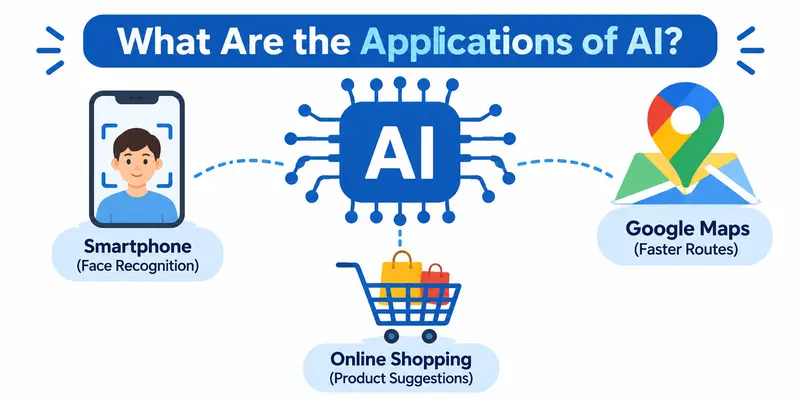
A smartphone uses AI to recognize your face, Google Maps uses AI to suggest faster routes, and online shopping websites use AI to recommend products based on your interests. These examples show how applications of AI help people complete everyday tasks more easily.
Top Applications of AI in Different Industries
Artificial Intelligence (AI) is changing the way different industries work. It helps people complete tasks faster, reduce mistakes, save money, and make better decisions. Many companies, hospitals, schools, and businesses now use AI to improve their services.
AI works by studying data, finding patterns, and providing useful results. For example, doctors can use AI to study medical images, teachers can use it to support students, and farmers can use it to monitor crops.
Let’s explore some of the most common applications of AI across different industries.
1. AI in Healthcare
AI is helping doctors, nurses, and hospitals provide better healthcare services. It can study medical images, find possible signs of diseases, and help medical staff make informed decisions. AI can also process large amounts of patient information and support medical research. These applications of AI help medical staff review information and support patient care.
Doctors often need to examine X-rays, CT scans, and MRI images to find health problems. AI systems can study these images and highlight areas that may need attention. This helps doctors review medical reports more quickly. However, doctors still need to check the results and make the final decisions.
AI also helps hospitals manage patient records, schedule appointments, and organize daily tasks. Some healthcare systems use AI chatbots to answer basic patient questions and provide general health information.
Example: An AI system can examine a chest X-ray and highlight signs that may be linked to lung disease. A doctor can then review the image and decide whether more tests are needed.
2. AI in Education
AI is making education more flexible and personal for students. It helps teachers prepare lessons, create quizzes, check assignments, and understand student progress. Students can also use AI tools to learn difficult subjects and get answers to their questions. These applications of AI make learning more flexible and help teachers support their students.
One important use of AI in education is personalized learning. Every student learns at a different speed. AI tools can study a student’s answers and identify topics that need more practice. They can then suggest suitable lessons and exercises.
AI can also help students improve their writing, practice English, learn mathematics, and understand science topics. Teachers can use AI to save time when preparing classroom materials.
Example: A student may find algebra difficult. An AI learning tool can explain a math problem step by step, provide another example, and suggest practice questions. This allows the student to learn at their own speed.
3. AI in Finance and Banking
Banks and financial companies use AI to manage transactions, detect fraud, and improve customer service. Every day, banks process thousands or even millions of transactions. AI helps them study this activity and identify unusual patterns. These applications of AI help financial companies protect accounts and manage transactions.
AI systems can compare new transactions with normal spending behavior. If a transaction looks unusual, the system can flag it for further review. This helps banks respond to possible fraud and protect customer accounts.
Banks also use AI chatbots to answer common questions about account balances, payments, and banking services. Some financial companies use AI to study financial data and support risk assessment.
Example: Imagine you usually make small purchases in your home city. Suddenly, your bank card is used for a large purchase in another country. An AI system may identify this unusual activity and alert the bank. The bank can then check the transaction to help protect your money.
4. AI in Transportation
AI helps people and businesses make transportation safer and more efficient. It can study traffic conditions, suggest faster routes, predict travel times, and support the development of self-driving vehicles. These applications of AI help improve road safety and make travel more efficient.
Navigation apps use AI to analyze traffic data and find better routes. This helps drivers avoid busy roads and save time. Delivery companies also use AI to plan routes for their drivers. Better routes can reduce fuel use and improve delivery times.
AI is also used in modern vehicles. Some cars have smart features that can detect nearby vehicles, recognize road signs, and warn drivers about possible dangers. Self-driving technology uses cameras and sensors to understand the road and respond to different situations.
Example: Google Maps uses AI and traffic data to estimate travel times and suggest suitable routes. If a road becomes crowded, it may recommend another route to help you reach your destination faster.
5. AI in Agriculture
AI is helping farmers improve crop production and manage their farms more effectively. Farmers can use AI to study weather conditions, check soil quality, monitor crops, and find signs of plant diseases. These applications of AI help farmers make better decisions and manage their crops.
In traditional farming, checking large fields can take a lot of time. AI-powered cameras, drones, and sensors can help farmers monitor crops over large areas. These systems can identify areas that need water, fertilizer, or special care.
AI can also help farmers predict crop production by studying weather information, soil conditions, and past farming data. This allows farmers to plan their work and use resources more carefully.
Example: A farmer can take a picture of a plant leaf using an AI-powered mobile app. The app can study the leaf and identify possible signs of disease. The farmer can then take steps to protect the crop before the disease spreads.
6. AI in Manufacturing
Manufacturing companies use AI to improve production, check product quality, and reduce mistakes. Factories often produce thousands of products every day. Checking every item manually can take time and may lead to human errors. These applications of AI help factories improve product quality and reduce production problems.
AI-powered cameras can inspect products and find scratches, cracks, or other defects. This helps factories identify damaged items before they reach customers. AI can also monitor machines and detect signs of possible equipment problems.
Another important use is predictive maintenance. It means using data to predict when a machine may need repair. This helps factories fix problems early and avoid unexpected breakdowns. Many factories also use AI automation to handle repeated tasks and improve production.
Example: A factory uses AI cameras to check mobile phone screens during production. If the camera finds a crack or scratch, the system marks that phone for further inspection. This helps the company maintain product quality.
7. AI in Retail and E-commerce
Retail stores and online shopping websites use AI to understand customer needs and improve the shopping experience. AI can recommend products, manage stock, study buying habits, and answer customer questions. These applications of AI help online stores improve customer experience and manage their products.
Online stores collect information about customer searches, clicks, and purchases. AI studies this information to suggest products that may interest each customer. This makes online shopping easier and helps businesses connect customers with suitable products.
AI also helps stores manage inventory. Inventory means the products a business keeps in stock. AI can study sales records and estimate which products may be needed in the future. This helps stores avoid running out of popular items or keeping too much stock.
Example: When you buy a pair of shoes from an online store, the website may recommend socks, bags, or other shoes. These suggestions are based on your shopping activity and the interests of similar customers.
8. AI in Business and Marketing
Businesses use AI to understand customers, improve services, and plan marketing campaigns. AI can study customer data, prepare reports, find market trends, and help business owners make better decisions.
Marketing teams use AI to understand which products customers like and what type of content gets more attention. They can use this information to create better advertisements and reach the right audience.
AI tools can also help businesses write emails, prepare social media posts, organize customer information, and answer common questions. Small businesses can use these tools to complete everyday tasks with less effort.
Example: A clothing business can use AI to study customer reviews and feedback. The system may find that many customers like comfortable shoes but want more color choices. The business can use this information to improve its products.
9. AI in Cybersecurity
AI plays an important role in protecting computers, networks, websites, and personal information. Cybersecurity means protecting digital systems from online threats such as hacking, malware, and data theft.
AI security systems can monitor network activity and look for unusual behavior. They can study login attempts, file access, and online traffic to find possible threats. When the system detects suspicious activity, it can alert security teams for further investigation.
AI can also help companies detect malware, identify phishing emails, and respond to cyberattacks. This allows security teams to find some threats faster and protect important information.
Example: Imagine an employee usually logs in to a company account from one location. Suddenly, someone tries to access the account from another country using unusual login activity. An AI security system can flag this attempt and alert the security team.
10. AI in Entertainment
AI makes entertainment services more personal and enjoyable. Video platforms, music apps, and gaming companies use AI to understand user interests and recommend suitable content.
Streaming platforms collect information about the videos, movies, and music people watch or listen to. AI studies this information to suggest content that matches their interests. This helps users discover new entertainment without searching for everything themselves.
Game developers also use AI to create smarter game characters and more realistic gaming experiences. AI can help these characters respond to player actions and make games more interesting.
Example: YouTube studies your watching history and the types of videos you enjoy. It then recommends similar videos on your home page. This helps you find content that matches your interests.
Benefits of AI Applications
Artificial intelligence offers many benefits in different industries and everyday life. It helps people complete tasks faster, save time, reduce mistakes, and make better decisions. Businesses, students, teachers, doctors, and many other people use AI to improve their work. One of the biggest benefits of AI applications is that they help people complete daily tasks with less time and effort.
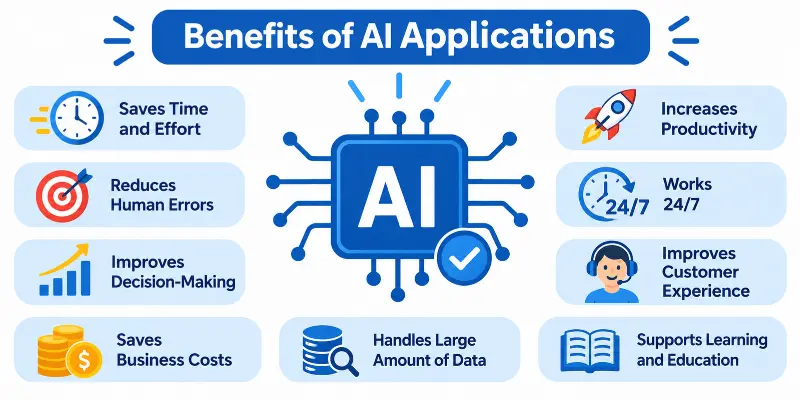
Here are some major benefits of AI applications:
- Saves Time and Effort: AI completes repeated tasks quickly and helps people save time.
- Reduces Human Errors: AI checks information and helps reduce mistakes in different tasks.
- Improves Decision-Making: AI studies data and provides useful suggestions for better decisions.
- Increases Productivity: AI helps workers complete more tasks in less time.
- Works 24/7: AI systems can provide services day and night without breaks.
- Improves Customer Experience: AI offers quick support and recommends products based on customer interests.
- Saves Business Costs: AI automates tasks and helps businesses reduce operating costs.
- Handles Large Amounts of Data: AI processes large amounts of information and finds useful patterns.
- Supports Learning and Education: AI helps students understand difficult topics and learn new skills.
Challenges and Limitations of AI Applications
Although artificial intelligence offers many benefits, it also has some challenges and limitations. AI can make tasks easier, but it cannot solve every problem on its own. It needs data, proper training, human support, and regular updates to work well. Understanding these challenges is important for using applications of AI safely and responsibly.
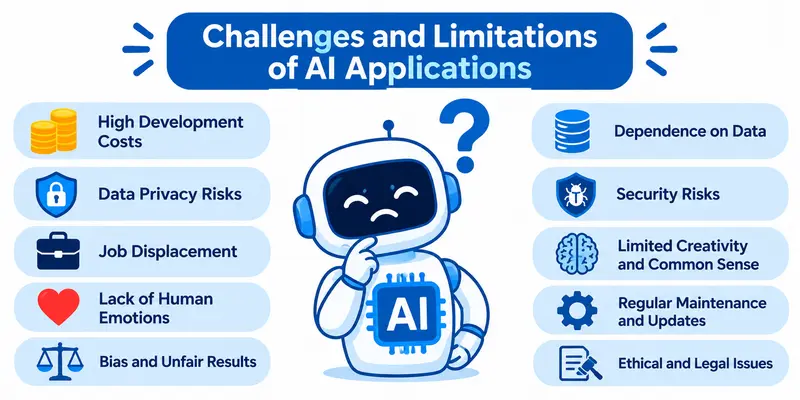
Here are some common challenges and limitations of AI applications:
- High Development Costs: AI systems require expensive computers, software, and skilled workers.
- Data Privacy Risks: AI can put personal information at risk without proper data protection.
- Job Displacement: AI automation may reduce the need for workers in some jobs.
- Lack of Human Emotions: AI cannot fully understand human feelings, care, and emotions.
- Bias and Unfair Results: AI can produce unfair results because of biased or incorrect training data.
- Dependence on Data: AI needs accurate and complete data to provide reliable results.
- Security Risks: Hackers can attack AI systems and misuse private information.
- Limited Creativity and Common Sense: AI cannot think, understand, or create ideas like humans.
- Regular Maintenance and Updates: AI systems need regular updates and testing to work properly.
- Ethical and Legal Issues: AI can create concerns about privacy, copyright, fairness, and responsibility.
Future Applications of AI
Artificial intelligence is growing rapidly, and its role in our lives will become even more important in the future. New AI technologies may help people solve complex problems, improve daily activities, and complete tasks more easily. Many industries are already exploring new ways to use AI to improve their services and find better solutions. Future applications of AI may create new opportunities and change how people work and live.
In the future, AI may bring major changes to healthcare, education, transportation, agriculture, business, and many other fields. For example, AI could help doctors detect diseases earlier, support students with personal learning plans, and help farmers grow healthier crops. Self-driving cars and smart robots may also become more common.
These developments show that AI has great potential to improve our lives. However, people must use this technology carefully and make sure it supports human needs.
How Can Beginners Start Using AI?
Starting with Artificial Intelligence (AI) is easier than many people think. You do not need advanced computer skills or programming knowledge to use AI. Many beginner-friendly tools can help you learn new things, write content, find information, and complete daily tasks. Tools like ChatGPT, Google Gemini, and Microsoft Copilot are good places to start. Exploring these applications of AI is a simple way to understand how this technology works in real life.
The best way to learn AI is through practice. Begin with simple tasks, ask clear questions, and explore different features. You can use AI to improve your English, understand difficult subjects, create ideas, or save time on everyday work.
Here are some simple ways beginners can start using AI:
- Start with Basic AI Tools: Explore beginner-friendly tools like ChatGPT, Google Gemini, and Microsoft Copilot.
- Ask Simple Questions: Use AI tools to find information, understand topics, and solve everyday problems.
- Use AI for Learning: Practice English, learn new skills, and understand difficult subjects with AI support.
- Try Content Creation: Use AI to write emails, create ideas, prepare notes, and generate content.
- Practice Regularly: Start with small tasks and try different AI tools to understand how they work.
- Learn to Write Good Prompts: Give clear instructions so AI tools can provide more useful answers.
- Check AI Results: Review AI-generated information because it can sometimes contain mistakes.
- Explore New Uses: Try AI for studying, writing, research, and managing daily tasks.
Conclusion
Applications of AI are becoming an important part of our daily lives and many industries. They help people save time, reduce mistakes, improve services, and make better decisions. From healthcare and education to banking, agriculture, transportation, and entertainment, AI is changing how people work and solve problems.
My recommendation is to start exploring simple AI tools and use them in your daily tasks. Try tools like ChatGPT or Google Gemini to learn new skills, find information, and improve your work. Remember to check AI-generated results before using them.
AI offers many useful opportunities for beginners, students, and businesses. Which application of AI do you find most useful? Share your thoughts in the comments and explore more beginner-friendly AI guides on our website.
Frequently Asked Questions About the Application of AI
Artificial Intelligence (AI) is growing quickly, and many people have questions about how it works and how they can use it. You may want to know which AI tools are best for beginners, whether AI can replace human workers, or how AI can help small businesses. In this section, we answer some common questions about the application of AI in simple words to help you understand its uses, benefits, and limitations.
The main purpose of AI applications is to help people solve problems and complete tasks more easily. They use data to learn patterns, answer questions, and provide useful results. People and businesses use AI to save time, improve work, and make better decisions.
AI works by studying data, finding patterns, and using those patterns to provide results or suggestions.
For example, when you use a shopping website, AI may study your searches and previous purchases to recommend products. It can also learn from new data and improve its results over time.
Some of the most useful AI applications for beginners include:
- ChatGPT: Helps with writing, learning, and answering questions.
- Google Gemini: Helps with research, ideas, and understanding topics.
- Microsoft Copilot: Supports writing, research, and everyday tasks.
- Grammarly: Helps improve spelling, grammar, and writing.
- Canva AI: Helps create designs and other visual content.
No, AI applications cannot replace all human workers. They can handle repetitive tasks, process information, and support decision-making, but many jobs still need human skills.
People provide creativity, emotional understanding, communication, and judgment. In many workplaces, AI works as a tool that helps employees complete their tasks more efficiently.
AI applications are common in smartphones, websites, online shopping, banking, and entertainment.
Some everyday examples include:
- Face recognition to unlock smartphones.
- Spam filters to block unwanted emails.
- Google Maps to suggest travel routes.
- Netflix to recommend movies and shows.
- Voice assistants to answer questions.
AI can be useful, but you should use it carefully. Some AI tools collect user data, and their answers may contain mistakes.
Follow these simple safety tips:
- Do not share passwords or private information.
- Check important information before using it.
- Use trusted AI tools and services.
- Review privacy settings before sharing data.
Small businesses can use AI applications to save time, understand customers, and improve daily work.
Here are some practical uses:
Marketing and Customer Support
- Create social media posts and marketing ideas.
- Answer common customer questions.
- Write product descriptions and emails.
Business Planning
- Study customer feedback.
- Organize sales information.
- Find useful trends in business data.
AI applications are important because they can help people solve complex problems and improve services. They may support better healthcare, smarter transport, faster research, and more personal learning.
As AI technology develops, more industries may find new ways to use it. Learning basic AI skills can help people prepare for future work and business opportunities.
You can use AI when a task involves repeated work, large amounts of information, or tasks that need quick suggestions.
For example:
- Use AI to create a first draft of an email.
- Use AI to summarize long documents.
- Use AI to organize information.
- Use AI to generate ideas for a project.
However, review the results and use your own judgment before making important decisions.
AI applications have some limitations that users should understand. They can provide incorrect information, show bias, and struggle with tasks that need human emotions or common sense.
Other limitations include:
- Privacy Risks: Some tools collect personal information.
- High Costs: Advanced AI systems can cost money to develop and maintain.
- Limited Understanding: AI may misunderstand questions or context.
- Human Dependence: Important decisions still need human review.
Understanding these limits helps you use AI more carefully and effectively.

- Be Respectful
- Stay Relevant
- Stay Positive
- True Feedback
- Encourage Discussion
- Avoid Spamming
- No Fake News
- Don't Copy-Paste
- No Personal Attacks
- Be Respectful
- Stay Relevant
- Stay Positive
- True Feedback
- Encourage Discussion
- Avoid Spamming
- No Fake News
- Don't Copy-Paste
- No Personal Attacks
