History of Artificial Intelligence: From Early Ideas to Modern AI
Published: 13 Nov 2026
Artificial Intelligence (AI) is now part of our daily lives. It helps us use search engines, talk to chatbots, create images, and even drive cars. But have you ever wondered where AI started and how it became so powerful? Its journey began many years ago, long before modern AI tools became popular.
You will explore how AI started, who developed its early ideas, and how it changed over time. You will also learn about important events, major AI breakthroughs, different stages of AI development, and the people who helped shape this technology.
Whether you are a student, a beginner, or simply curious about AI, this article will make the topic easy to understand. By the end, you will have a clear understanding of the history of artificial intelligence, from its early beginnings to modern AI systems.
What Is Artificial Intelligence?
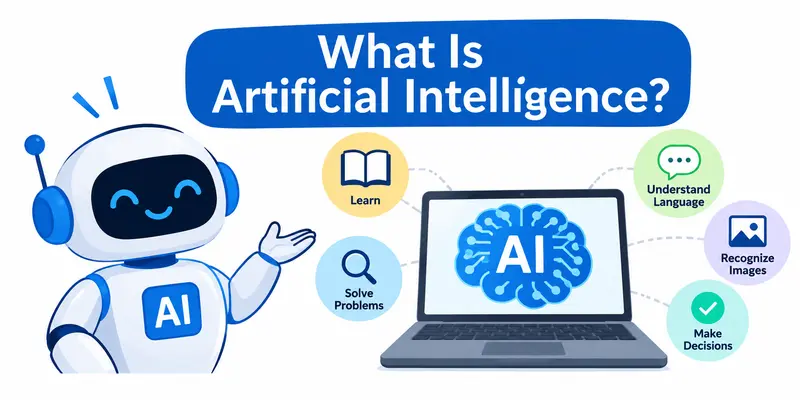
Artificial Intelligence (AI) is a type of technology that helps machines perform tasks that usually need human intelligence. These tasks include learning, solving problems, understanding language, recognizing images, and making decisions. AI allows computers to learn from data and use that information to give useful results.
For example, when you ask ChatGPT a question, it understands your words and creates an answer. When YouTube recommends videos based on your interests, it uses AI to suggest content you may like. These are simple examples of how AI works in everyday life.
AI does not think or feel like a human. Instead, it uses data, computer programs, and special methods to complete tasks. Today, businesses, schools, hospitals, and many other industries use AI to save time, solve problems, and improve their work.
The Early Ideas Behind Artificial Intelligence
The idea of artificial intelligence started long before modern computers existed. For centuries, people dreamed of creating machines that could think, learn, and solve problems like humans.
Here are some important early ideas that helped shape AI:
- Ancient Times: Ancient stories described artificial beings that could move and act on their own. These stories showed people’s interest in creating intelligent machines.
- 1600s and 1700s: Scientists and thinkers began studying human thinking, logic, numbers, and rules. These ideas later helped researchers develop computers that could follow instructions and process information.
- 1940s: Scientists started building early electronic computers. These machines could perform complex calculations and handle tasks that once required human effort.
- 1950 – Alan Turing: British mathematician Alan Turing asked an important question: Can machines think? He also introduced the Turing Test to explore whether a machine could show human-like intelligence during a conversation.
The Birth of Artificial Intelligence (1940–1956)
The period between 1940 and 1956 marked the beginning of modern artificial intelligence. During these years, scientists started exploring ways to make computers solve problems and perform tasks that required human intelligence. They developed early computer models and tested new ideas about machine learning and human thinking.
Here are some important events from this period:
- 1943 – First Artificial Neuron Model: Warren McCulloch and Walter Pitts introduced a simple mathematical model of artificial neurons. Their work showed how machines could copy some basic functions of the human brain.
- 1950 – Alan Turing’s Test: British mathematician Alan Turing published a paper called Computing Machinery and Intelligence. He introduced the Turing Test to explore whether machines could show human-like intelligence through conversation.
- 1951 – Early AI Programs: Christopher Strachey and Dietrich Prinz developed early computer programs for playing games such as checkers and chess. These programs showed that computers could follow rules and solve problems.
- 1955 – Logic Theorist: Allen Newell and Herbert A. Simon, with programmer Cliff Shaw, developed the Logic Theorist. This program could solve mathematical problems and prove some logic statements.
- 1956 – Dartmouth Conference: John McCarthy, Marvin Minsky, Nathaniel Rochester, and Claude Shannon helped organize the Dartmouth Summer Research Project on Artificial Intelligence. During this event, John McCarthy used the term “artificial intelligence” for the first time in this research setting.
The Early Development of AI (1956–1970)
After the 1956 Dartmouth Conference, artificial intelligence became an important area of research. Scientists started building computer programs that could solve problems, understand language, play games, and follow human instructions. During this period, researchers made several important discoveries that shaped the future of AI.
Here are some major developments from this period:
- 1957 – Perceptron: Frank Rosenblatt developed the Perceptron, an early type of artificial neural network. It could learn simple patterns from data and became an important step in machine learning.
- 1958 – LISP Programming Language: John McCarthy created LISP, a programming language designed for AI research. It helped scientists develop programs that could handle symbols, logic, and complex information.
- 1961 – Industrial Robot: Unimate, the first industrial robot, started working at a General Motors factory. It helped perform tasks such as moving heavy metal parts and showed how machines could support factory workers.
- 1966 – ELIZA Chatbot: Joseph Weizenbaum developed ELIZA, an early chatbot that could respond to human messages. It used simple language patterns to create conversations with users.
- 1966 – Shakey the Robot: Researchers at Stanford Research Institute began developing Shakey, an early mobile robot. It could study its surroundings, plan actions, and move around its environment.
- 1969 – Shakey’s Progress: Shakey demonstrated how robots could combine computer vision, problem-solving, and movement to complete simple tasks.
The First AI Winter (1970s)
During the 1970s, artificial intelligence faced its first major setback, known as the First AI Winter. In the early years, many scientists believed that computers would soon think and solve problems like humans. However, AI technology could not meet these high expectations. Computers had limited memory, slow processing power, and difficulty handling complex tasks.
Here are some important reasons behind the First AI Winter:
- High Expectations: Scientists and researchers made big promises about AI. They expected machines to understand language, solve difficult problems, and perform human-like tasks. However, the technology was not ready.
- Limited Computer Power: Early computers had very little memory and slow processing speeds. They could handle simple tasks but struggled with larger and more complex problems.
- Lack of Data: AI systems needed enough information to learn and give accurate results. At that time, researchers had limited access to large amounts of digital data.
- Poor Results: Many AI projects failed to produce the expected results. Some programs worked in small tests but could not handle real-world situations.
- Reduced Funding: Governments and research groups became disappointed with AI progress. They reduced financial support for many AI research projects.
What Was the Impact of the First AI Winter?
The First AI Winter slowed down AI research and development. Many researchers faced funding problems, and some projects stopped completely. However, scientists did not give up on AI.
This period taught researchers an important lesson: building intelligent machines takes time, better technology, and realistic goals. It also prepared the way for new AI developments in the following years.
The Rise of Expert Systems (1980–1987)
After the First AI Winter, artificial intelligence started gaining attention again in the 1980s. During this period, scientists developed expert systems that could solve problems by using knowledge and rules from human experts. These systems helped computers make decisions in specific fields, such as medicine, business, and engineering.
Here are some important developments from this period:
- 1980 – XCON System: Digital Equipment Corporation (DEC) started using an expert system called XCON. It helped the company configure computer systems and choose the right parts for customers.
- 1981 – Japan’s Fifth Generation Computer Project: Japan launched a major project to develop advanced computers that could use AI, logic, and knowledge processing. It encouraged other countries to invest more in AI research.
- 1982 – Rise of Expert Systems: More businesses started using expert systems to solve specific problems. These systems followed rules created by human experts to provide advice and support decisions.
- 1984 – Expert Systems in Business: Companies began using AI systems for tasks such as equipment repair, financial planning, and technical support. This showed that AI could provide value outside research labs.
- 1986 – Neural Network Progress: Researchers brought new attention to neural networks through the popular use of the backpropagation method. This method helped networks learn by reducing errors in their results.
What Made Expert Systems Important?
Expert systems became popular because they could store and use knowledge from skilled professionals. For example, a medical expert system could study a patient’s symptoms and suggest possible health problems.
These systems helped businesses save time, reduce mistakes, and make better decisions. However, they also had limits. They followed fixed rules and struggled with new situations that their developers had not included.
The rise of expert systems marked an important step in AI history. It showed that computers could support human experts and solve real-world problems.
The Second AI Winter (Late 1980s–1990s)
After the success of expert systems in the 1980s, people expected artificial intelligence to grow quickly. Many businesses invested money in AI technology. However, these systems soon faced several problems. They were expensive to build, difficult to maintain, and could not handle many new situations. As a result, interest in AI started to fall again. This period became known as the Second AI Winter.
Here are some major reasons behind the Second AI Winter:
- High Development Costs: Expert systems needed skilled developers and large budgets. Many companies found it too expensive to build and maintain them.
- Limited Abilities: Most AI systems could only perform specific tasks. They struggled when they faced problems outside their programmed rules.
- Hardware Problems: Special computers used for AI became costly. Regular computers also lacked the power needed to run advanced AI programs.
- Reduced Business Interest: Many companies did not get the results they expected from AI. They started spending less money on AI projects.
- Lower Research Funding: Governments and businesses reduced their support for some AI research projects. This slowed down the development of new AI technologies.
What Was the Impact of the Second AI Winter?
The Second AI Winter reduced interest in artificial intelligence during the late 1980s and early 1990s. Many AI companies struggled, and some expert system projects ended.
However, AI research did not stop completely. Scientists continued exploring machine learning, neural networks, and other methods. These efforts helped prepare AI for a new period of growth in the 1990s and 2000s.
The Growth of Artificial Intelligence (1990–2010)
After the Second AI Winter, artificial intelligence started gaining attention again. During the 1990s and 2000s, computers became faster, digital data increased, and researchers developed better ways to train AI systems. These improvements helped AI move beyond simple rule-based programs and solve more complex problems.
Here are some important developments from this period:
- 1997 – IBM Deep Blue: IBM developed Deep Blue, a chess-playing computer that defeated world chess champion Garry Kasparov. This event showed that computers could compete with top human players in complex games.
- 1998 – Google Search and AI Research: Search engines began using advanced computer methods to organize information and improve search results. AI research also gained attention in areas such as language and image recognition.
- 2002 – AI-Powered Robots: iRobot introduced the Roomba robot vacuum cleaner. It could move around homes, detect obstacles, and clean floors with little human help.
- 2006 – Deep Learning Progress: Researcher Geoffrey Hinton and his team helped bring new attention to deep learning. This approach used multiple layers of artificial neural networks to learn patterns from data.
- 2009 – Self-Driving Car Research: Google started its self-driving car project. The project used cameras, sensors, and computer systems to help vehicles understand roads and their surroundings.
- 2010 – Growth of Big Data: More people started using smartphones, websites, and digital services. This created large amounts of data that researchers could use to train and improve AI systems.
The Deep Learning Revolution (2010–2016)
Between 2010 and 2016, artificial intelligence made major progress. Faster computers, large amounts of digital data, and better learning methods helped AI systems perform tasks more accurately. During this period, deep learning became one of the most important areas of AI research.
Deep learning is a type of machine learning that uses artificial neural networks with many layers to learn patterns from data. It helped computers recognize images, understand speech, and process human language.
Here are some important developments from this period:
- 2011 – IBM Watson: IBM Watson defeated two former champions on the TV quiz show Jeopardy!. It showed how computers could understand questions, search information, and provide answers.
- 2012 – AlexNet: Researchers developed AlexNet, a deep learning model that achieved a major success in an image recognition competition called ImageNet. It showed how deep learning could improve image recognition.
- 2014 – Generative Adversarial Networks (GANs): Researcher Ian Goodfellow and his team introduced GANs. This technology allowed AI systems to create new images and other types of data that looked realistic.
- 2014 – Virtual Assistants: Apple, Google, and other technology companies improved voice assistants such as Siri and Google Now. These tools helped people search for information and complete tasks using voice commands.
- 2015 – Growth of Deep Learning: Technology companies and researchers started using deep learning for image recognition, speech recognition, language processing, and other tasks.
- 2016 – AlphaGo: Google’s DeepMind developed AlphaGo, an AI program that defeated Go world champion Lee Sedol. This was a major achievement because Go is a complex game with many possible moves.
Modern Artificial Intelligence (2017–2022)
Between 2017 and 2022, artificial intelligence made huge progress. Researchers developed more powerful AI models that could understand language, create content, recognize images, and answer questions. Technology companies also started bringing AI tools to everyday users.
During this period, AI became more common in education, healthcare, business, entertainment, and many other fields.
Here are some important developments from this period:
- 2017 – Transformer Technology: Google researchers introduced the Transformer model in a research paper called Attention Is All You Need. This technology helped AI understand language and process large amounts of text more effectively. It later became the foundation of many modern language models.
- 2018 – BERT: Google introduced BERT, an AI language model that improved how computers understand the meaning of words in sentences. It helped Google understand search queries more accurately.
- 2020 – GPT-3: OpenAI introduced GPT-3, a powerful language model that could write text, answer questions, translate languages, and create computer code. It showed how AI could produce human-like text.
- 2020 – AlphaFold 2: DeepMind developed AlphaFold 2, an AI system that could predict the 3D shapes of many proteins with high accuracy. This achievement helped scientists study proteins and support biological research.
- 2021 – DALL-E: OpenAI introduced DALL-E, an AI model that could create images from written descriptions. Users could describe an idea in words and get a matching image.
- 2022 – ChatGPT: OpenAI launched ChatGPT in November 2022. It allowed people to ask questions, write content, learn new topics, and solve problems through simple conversations.
- 2022 – Growth of Generative AI: AI tools for creating text, images, and other content started gaining public attention. More people began exploring how AI could support their daily tasks.
The Current Era of AI (2023–2026)
Artificial intelligence has changed rapidly in recent years. From 2023 to 2026, AI moved beyond simple chatbots and became a useful tool for many everyday tasks. People can now use AI to write articles, create pictures, make videos, generate code, and find answers to difficult questions.
AI systems have also become better at understanding different forms of information. Some models can work with text, pictures, sound, and video in one system. This progress has opened new doors in education, healthcare, business, science, and technology.
Let’s look at some major developments that shaped this period.
- 2023 – A New Wave of Generative AI: OpenAI launched GPT-4 in March 2023. It improved the way AI handles questions, writing, and complex tasks. Google also introduced Bard, giving users another way to interact with AI.
- 2023 – The Introduction of Gemini: Google announced Gemini in December 2023. The model was built to work with different kinds of information, including text, images, audio, and video. It helped move AI toward more flexible and multimodal systems.
- 2024 – Better Multimodal Models: AI models made progress in understanding and creating different types of content. OpenAI released GPT-4o, which brought text, image, and voice features into one model. Other developers also improved their multimodal systems.
- 2024 – AI Enters Video Creation: Video generation became an exciting area of AI development. OpenAI introduced Sora, a system that can turn written descriptions into video clips. This technology gave creators new ways to produce visual content.
- 2025 – Smarter AI Reasoning: Developers focused more on models that can work through difficult questions and problems. DeepSeek-R1 attracted attention for its reasoning abilities. Other AI systems also improved in areas such as coding, research, and problem-solving.
- 2025 – AI Agents Gain Attention: AI development started moving toward systems that can do more than answer questions. AI agents can use digital tools, gather information, and follow a series of steps to complete tasks. This created new possibilities for workplace automation.
- 2026 – More Advanced AI Agents: AI agents continued to develop as an important part of the AI industry. They can help plan tasks, use connected tools, and manage multi-step activities. For example, an agent may collect information about a topic and turn it into an organized report.
- 2026 – AI Becomes More Common: AI continued to spread across different areas of life and work. Students used it to understand lessons, businesses used it to support customers, and developers used it to write and check code. Researchers also explored new ways to use AI in science and medicine.
Popular AI Tools in the Modern Era
AI tools have become part of everyday life. People use them to write content, create images, edit videos, write code, and complete many other tasks. These tools save time and make difficult work easier.
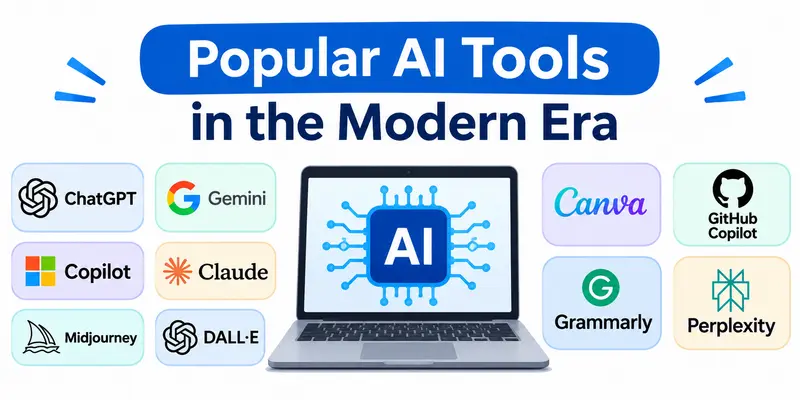
Some AI tools are designed for general tasks, while others focus on specific areas such as design, research, writing, and software development. Here are some popular AI tools used in the modern era.
1. ChatGPT
ChatGPT is an AI assistant developed by OpenAI. It can answer questions, explain difficult topics, write content, summarize information, and help with coding. Students, writers, developers, and businesses use it for different tasks.
Example: A student can use ChatGPT to understand a difficult science topic or prepare study notes.
2. Google Gemini
Google Gemini is an AI assistant developed by Google. It can help users write, research, understand information, and work with different types of content. It also supports multimodal tasks, such as understanding text and images.
Example: A user can share an image and ask Gemini to explain what it shows.
3. Microsoft Copilot
Microsoft Copilot is an AI assistant from Microsoft. It helps users find information, create content, and complete everyday tasks. It also works with Microsoft products and services to support writing, planning, and productivity.
Example: A user can use Copilot to draft an email or create a summary of a document.
4. Claude
Claude is an AI assistant developed by Anthropic. It is useful for writing, reading long documents, analyzing information, and helping with coding tasks. It can also explain complex ideas in simple language.
Example: A business owner can use Claude to review a long report and create a short summary.
5. Midjourney
Midjourney is an AI image-generation tool. It creates images from written descriptions called prompts. Users can describe a scene, style, or subject, and the tool generates visual results.
Example: A designer can create a concept image for a website or advertising campaign.
6. DALL·E
DALL·E is an AI image-generation model developed by OpenAI. It can turn text descriptions into images and help users explore different visual ideas.
Example: A blogger can create an original illustration for an article by describing the image they need.
7. Canva AI
Canva includes AI-powered features that help users create and edit visual content. These features can support presentations, social media posts, designs, and marketing materials.
Example: A small business can use Canva to prepare a social media design for a new product.
8. GitHub Copilot
GitHub Copilot is an AI coding assistant. It helps developers write code, understand programming ideas, and complete common coding tasks. It can suggest code while a developer works in an editor.
Example: A beginner programmer can use it to understand a code suggestion or create a basic function.
9. Grammarly
Grammarly is an AI-powered writing assistant. It checks grammar, spelling, punctuation, and writing clarity. It also offers suggestions to improve tone and sentence structure.
Example: A student can use Grammarly to check an assignment before submitting it.
10. Perplexity AI
Perplexity is an AI-powered search and answer tool. It helps users research topics and find information from online sources. It also provides source references that users can check.
Example: A researcher can use Perplexity to explore a topic and review the sources behind an answer.
Important Milestones in the History of Artificial Intelligence
Artificial intelligence did not develop in a single day. It took many years of research, experiments, and new inventions to reach its current level. Scientists, researchers, and technology companies made important discoveries that helped machines perform tasks that once required human intelligence.
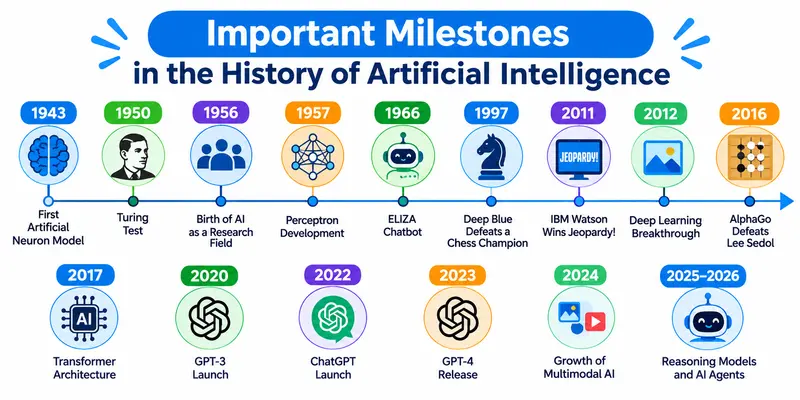
Some milestones changed the direction of AI research, while others introduced AI to everyday life. Here are some of the most important milestones in the history of artificial intelligence.
| Year | Important Milestone | Description |
| 1943 | First Artificial Neuron Model | Warren McCulloch and Walter Pitts introduced a mathematical model of an artificial neuron. Their work helped lay the foundation for neural networks. |
| 1950 | Turing Test | Alan Turing proposed a test to explore whether a machine could communicate like a human. |
| 1956 | Birth of AI as a Research Field | Researchers met at the Dartmouth Summer Research Project. John McCarthy introduced the term “artificial intelligence.” |
| 1957 | Perceptron Development | Frank Rosenblatt introduced an early neural network that could learn to recognize simple patterns. |
| 1966 | ELIZA Chatbot | Joseph Weizenbaum developed ELIZA, an early program that could imitate human conversation using text patterns. |
| 1997 | Deep Blue Defeats a Chess Champion | IBM’s Deep Blue defeated Garry Kasparov, showing the power of computers in complex strategic games. |
| 2011 | IBM Watson Wins Jeopardy! | IBM Watson defeated two former champions by processing natural language clues and finding answers. |
| 2012 | Deep Learning Breakthrough | AlexNet achieved a major success in image recognition and increased interest in deep learning. |
| 2016 | AlphaGo Defeats Lee Sedol | Google DeepMind’s AlphaGo defeated a top Go player by combining machine learning and strategic planning. |
| 2017 | Transformer Architecture | Researchers introduced the Transformer design, which later became the foundation of many modern language models. |
| 2020 | GPT-3 Launch | OpenAI introduced GPT-3, a powerful language model that could generate text, answer questions, and summarize information. |
| 2022 | ChatGPT Launch | OpenAI launched ChatGPT, making conversational AI widely accessible to the public. |
| 2023 | GPT-4 Release | OpenAI introduced GPT-4, improving AI performance on complex tasks and adding image-input capabilities. |
| 2024 | Growth of Multimodal AI | Models such as GPT-4o improved AI’s ability to work with text, images, and audio. Video generation also advanced. |
| 2025–2026 | Reasoning Models and AI Agents | AI development focused on advanced problem-solving, coding, research, and systems that can complete multi-step tasks. |
How Has Artificial Intelligence Changed Over Time?
Artificial intelligence has changed greatly over the years. Early AI systems followed fixed instructions and could perform only simple tasks. Modern AI can understand language, recognize images, create content, and solve complex problems.
Let’s look at the major changes in AI.
- From Simple Rules to Machine Learning: Early AI followed rules written by humans. Machine learning later allowed computers to learn patterns from data and improve their results.
- From Limited Data to Big Data: Early AI used small amounts of information. Today, AI can process huge datasets from websites, apps, and digital services.
- From Basic Computers to Powerful Systems: Early computers had limited speed and memory. Modern processors and GPUs help AI systems process information and train larger models.
- From Basic Programs to Deep Learning: Deep learning uses multi-layered neural networks to learn complex patterns. It has improved image recognition, speech recognition, and language processing.
- From Text to Multimodal AI: Modern AI can work with different types of information, including text, images, audio, and video.
- From Simple Responses to Generative AI: Generative AI can create new content, such as articles, images, music, videos, and computer code.
- From Instructions to AI Agents: Modern AI agents can plan steps, use digital tools, and complete multi-step tasks with less human guidance.
How AI Has Changed: Then vs. Now
| Area | Early AI | Modern AI |
| Working Method | Followed fixed rules | Learns from data |
| Data | Limited information | Large datasets |
| Computing | Slow computers | Powerful processors and GPUs |
| Language | Basic text processing | Advanced language understanding |
| Images | Limited recognition | Recognizes and creates images |
| Content | Performed fixed tasks | Creates text, images, and videos |
| Automation | Needed direct instructions | Can handle multi-step tasks |
What Is the Future of Artificial Intelligence?
The future of artificial intelligence looks exciting. AI is becoming more advanced and useful in everyday life. In the coming years, it may help people solve difficult problems, improve services, and complete tasks faster.
Researchers and technology companies are working on smarter AI systems that can understand information, make better decisions, and work with less human guidance.
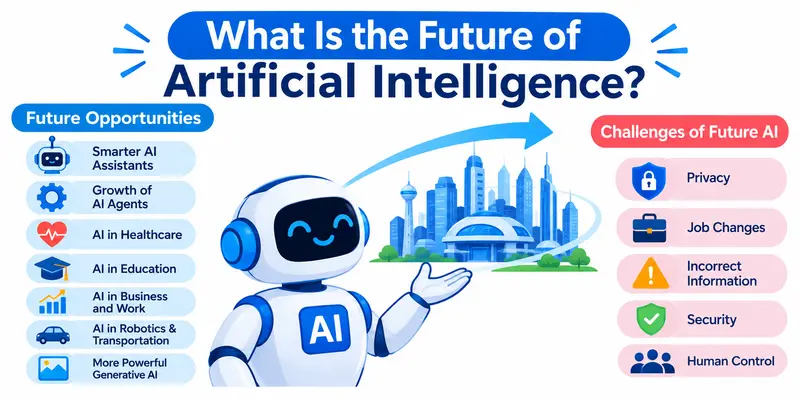
Here are some important areas that may shape the future of AI.
- Smarter AI Assistants: Future AI assistants may understand user needs better and handle more complex tasks. They could help with planning, writing, research, and daily activities.
- Growth of AI Agents: AI agents may become better at completing multi-step tasks. They could collect information, use digital tools, and manage work with less human help.
- AI in Healthcare: AI may help doctors study medical images, find health patterns, and support early disease detection. It could also help researchers develop new treatments.
- AI in Education: AI-powered learning tools may provide lessons based on each student’s needs. Students could get personal explanations, practice questions, and learning support.
- AI in Business and Work: Businesses may use AI to improve customer service, analyze data, manage routine tasks, and support decision-making. This could save time and improve productivity.
- AI in Robotics and Transportation: AI may make robots more useful in factories, hospitals, and homes. It could also improve self-driving technology and help transportation systems work more efficiently.
- More Powerful Generative AI: Generative AI may become better at creating realistic images, videos, music, and other digital content. These tools could give creators more ways to develop new ideas.
Challenges of Future AI
Although AI offers many benefits, it also creates important challenges.
- Privacy: AI systems may use personal data, so protecting user information is important.
- Job Changes: Automation may reduce the need for some tasks while creating demand for new skills.
- Incorrect Information: AI can produce false or misleading answers.
- Security: AI tools may be misused for scams, fraud, and harmful activities.
- Human Control: People must remain responsible for important decisions made with AI support.
Conclusion
The history of artificial intelligence shows how far technology has come over the years. From simple computer programs to modern AI tools, every new development has changed the way people work, learn, and solve problems. Today, AI plays an important role in education, healthcare, business, and many other fields.
Learning about the history of artificial intelligence helps us understand how AI started, how it developed, and what makes modern AI so powerful. My recommendation is to explore popular AI tools, try their features, and learn how they can help you in your daily life or career.
Now it’s your turn! Which AI development do you find most interesting? Share your thoughts in the comments. Also, explore more beginner-friendly AI guides on our website to learn about AI, discover useful tools, and stay updated with the latest technology trends.
Frequently Asked Questions (FAQs)
Do you still have questions about the history of Artificial Intelligence? Here are some common questions and answers to help you understand how AI started, who developed it, and how it changed over time. These FAQs also explain important AI milestones and what we can expect from this technology in the future.
John McCarthy is known as the father of artificial intelligence. He introduced the term “artificial intelligence” in 1956 at the Dartmouth Conference. He also helped develop LISP, a programming language used in early AI research.
Artificial intelligence became a formal research field in 1956. However, scientists had already started working on ideas related to AI during the 1940s and early 1950s.
The Logic Theorist is widely recognized as one of the first AI programs. Allen Newell, Herbert Simon, and Cliff Shaw developed it in 1955. It could solve mathematical problems by using logical rules.
AI research slowed down during two major periods known as AI winters.
The main reasons included the following:
- Limited technology: Early computers lacked enough power to handle complex tasks.
- High expectations: AI systems failed to meet many promises.
- Reduced funding: Governments and businesses cut their support for AI research.
The internet helped AI grow by providing access to large amounts of digital data. This data helped researchers train and improve machine learning models.
For example, search engines use AI to understand search queries, find useful information, and show relevant results.
Yes, artificial intelligence is older than the modern internet. AI became a formal research field in 1956, while the internet developed later. Early AI researchers worked with computer programs long before people started using the internet.
The 2012 success of AlexNet had a major impact on modern AI. It showed how deep learning could improve image recognition. This achievement encouraged more research and investment in AI.
No, current AI does not think or understand the world exactly like humans. It can process information, find patterns, answer questions, and complete tasks. However, it does not have human feelings, personal experiences, or human-like awareness.
Traditional AI mainly followed fixed rules, while modern AI can learn patterns from data.
- Traditional AI: Used simple rules to solve specific problems, such as playing chess.
- Modern AI: Uses machine learning and deep learning to handle tasks like writing, image creation, speech recognition, and data analysis.
AI agents could become one of the next major developments in artificial intelligence. They can handle multi-step tasks with less human guidance.
Future AI systems may also improve in areas such as healthcare, education, robotics, and scientific research. However, privacy, safety, and human control will remain important challenges.



- Be Respectful
- Stay Relevant
- Stay Positive
- True Feedback
- Encourage Discussion
- Avoid Spamming
- No Fake News
- Don't Copy-Paste
- No Personal Attacks
- Be Respectful
- Stay Relevant
- Stay Positive
- True Feedback
- Encourage Discussion
- Avoid Spamming
- No Fake News
- Don't Copy-Paste
- No Personal Attacks
