AI Regression Testing: How It Works, Benefits, Tools, and Best Practices
Published: 10 Nov 2026
Software updates often bring new features and improvements, but they can also create unexpected problems in existing features. How can you make sure your software still works correctly after every change? This is where AI regression testing can help. It uses artificial intelligence to make software testing faster, smarter, and more efficient.
You will learn what AI regression testing is, how it works, and why it matters. We will also explore its key benefits, common use cases, popular AI testing tools, and how it compares with traditional regression testing.
Whether you are a beginner, software tester, developer, or business owner, this guide will help you understand the basics, explore useful tools, and make better testing decisions. By the end, you will have a clear understanding of AI regression testing and how it can improve your software testing process.
What Is AI Regression Testing?
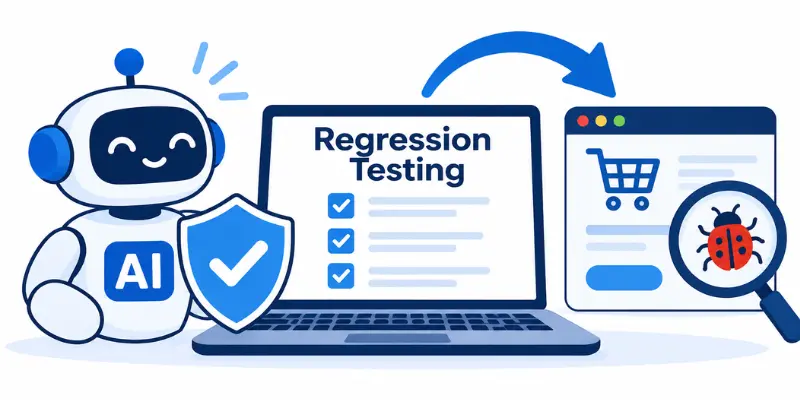
AI regression testing is a software testing method that uses artificial intelligence (AI) and machine learning to check whether new software changes affect existing features. It helps testers find bugs and errors after developers update code, add new features, or fix problems.
In simple words, AI regression testing checks that old features still work correctly after developers make changes to the software.
For example, imagine you own an online shopping website. A developer adds a new payment option. This update may affect other features, such as the shopping cart, login page, or checkout process. AI-powered testing tools can check these features and help find problems before customers face them.
Unlike traditional regression testing, AI-powered tools can learn from past test results, identify risky areas, and help select the most useful test cases. This saves time and reduces manual work.
How Does AI Regression Testing Work?
AI regression testing uses artificial intelligence and machine learning to check software after developers make changes. It studies past test results, finds areas that may have problems, and helps testers choose the right tests.
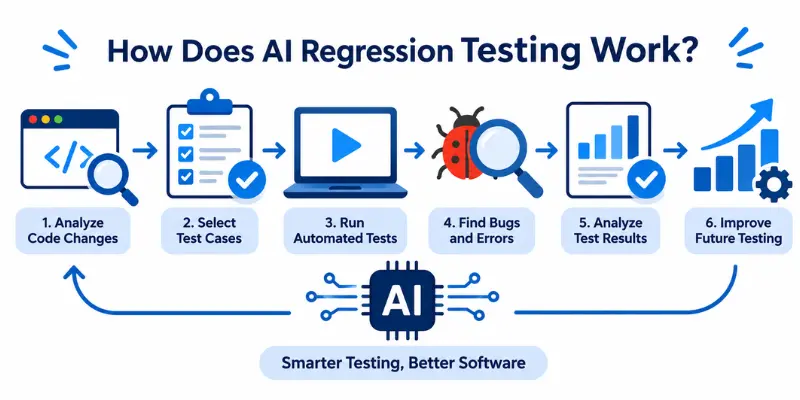
This process reduces manual work and helps teams find bugs faster. AI tools also help testers focus on important features instead of checking everything manually. But how does it work? Let’s look at the main steps.
1. Analyze Code Changes
First, the AI testing tool checks the latest code changes. It identifies which parts of the software developers have updated. It also studies how these changes may affect other features.
For example, if a developer changes the login page, the tool can identify related features that may also need testing. These may include user accounts, password recovery, and user profiles.
This step helps testers understand which areas need more attention. It also helps them find possible risks before running the tests.
2. Select Important Test Cases
Next, AI analyzes previous test results, software changes, and testing history. It helps select test cases that cover updated features and areas at risk.
For example, if a developer changes the payment system, the AI tool may select tests for payment methods, checkout pages, and order confirmation.
This step helps teams avoid running unnecessary tests. It also saves time by giving more attention to features that have a higher risk of failure.
3. Run Automated Tests
After selecting the test cases, the testing tool runs them automatically. It checks important features, user actions, and software functions to make sure everything works correctly.
For example, it may test whether users can log in, add products to a cart, update product quantities, and complete payments.
Some AI testing tools can also adjust test steps when small changes affect the software interface. This helps reduce test failures caused by minor updates.
Automated testing allows teams to check more features in less time. It also reduces the need for repeated manual testing.
4. Find Bugs and Errors
After running the tests, AI helps analyze the results. It can identify unusual behavior, failed tests, and possible bugs. It also helps testers find areas where the software does not work as expected.
For example, if customers cannot complete payments after a software update, the AI tool can highlight the failed payment test and related errors.
Some tools can also group similar test failures and help developers understand the source of a problem.
This step helps teams find issues early and fix them before they affect users.
5. Analyze Test Results
Once the tests finish, AI compares current test results with previous results. It helps teams understand what changed and whether an update caused a problem.
For example, a test may pass before an update but fail after a developer changes the checkout page. This difference can help testers identify a possible issue.
AI tools can also create reports that show passed tests, failed tests, and areas that need attention. Testers can use these reports to understand software quality and decide what to fix first.
6. Improve Future Testing
Machine learning allows some AI testing tools to learn from past test results and testing patterns. They use this information to improve future test selection and identify areas that may need more attention.
For example, if a payment feature often fails after updates, the tool may give that feature more attention during future testing.
Over time, these tools can help teams choose better test cases, reduce repeated work, and improve testing efficiency.
Key Features of AI Regression Testing
AI Regression Testing offers useful features that make software testing faster, easier, and more accurate. It helps testers find bugs, select important tests, and reduce manual work. Here are its key features:
- Intelligent Test Case Selection: AI analyzes code changes and past test results to select important test cases. This helps testers focus on areas that may have problems.
- Automated Test Execution: AI tools run test cases automatically and check software features. This saves time and reduces repeated manual testing.
- Self-Healing Test Automation: Self-healing tools adjust automated tests when small changes affect the software interface. This reduces test failures and maintenance work.
- Intelligent Bug Detection: AI analyzes test results to find bugs and unusual behavior. It helps developers identify problems before they affect users.
- Predictive Analysis: AI studies past testing data to identify high-risk areas. This helps teams focus on features that may fail after updates.
- Faster Test Execution: AI tools can run multiple tests at the same time. This reduces testing time and helps teams release updates faster.
- Test Result Analysis and Reporting: AI creates reports that show passed tests, failed tests, and possible issues. These reports help developers fix problems quickly.
- Continuous Learning: Some AI tools learn from past test results and improve future testing. This helps teams make better testing decisions over time.
Benefits of AI Regression Testing
AI Regression Testing offers several benefits that help software teams save time, reduce manual work, and maintain software quality. It makes testing easier by automating repeated tasks and helping testers find problems early.
It also helps developers check important features after every software update. Let’s explore its main benefits with simple examples.
- Saves Time and Effort: AI automates repeated testing tasks. This reduces manual work and helps teams complete tests faster.
- Finds Bugs Early: AI helps detect bugs and unexpected changes after software updates. This allows developers to fix problems before users face them.
- Improves Test Accuracy: AI analyzes test results and identifies unusual behavior. This helps reduce human errors and improve testing quality.
- Reduces Testing Costs: Automation reduces the time and effort needed for repeated tests. This can help businesses lower long-term testing costs.
- Faster Software Releases: AI helps teams test software quickly and focus on important issues. This supports faster and smoother software updates.
- Reduces Test Maintenance: Self-healing features can adjust tests after small interface changes. This reduces the need for frequent manual updates.
- Improves Software Quality: AI helps teams check important features after every update. This keeps software stable and improves the user experience.
- Supports Continuous Testing: AI tools can work with development pipelines to run tests after code changes. This helps teams check software regularly throughout development.
Popular AI Regression Testing Tools
Many AI-powered tools help software teams test applications after code changes and updates. These tools can automate repeated tests, detect bugs, and reduce manual work. Some tools focus on test automation, while others help find visual changes or manage complex testing tasks.
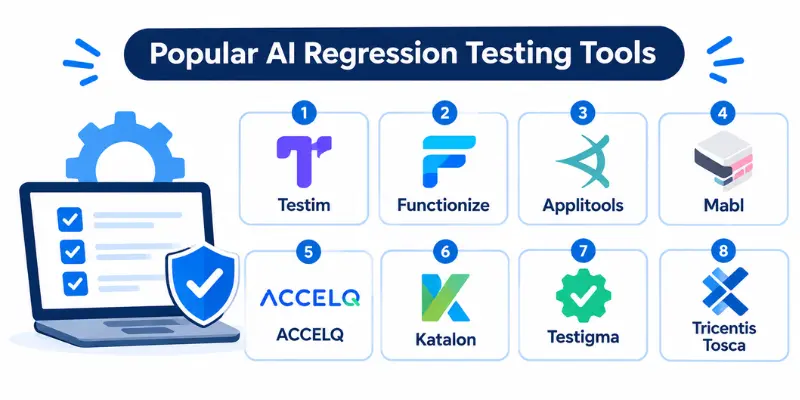
Choosing the right tool can make the testing process faster and easier. Here are eight popular AI-powered testing tools:
1. Testim
Testim uses AI to create and maintain automated tests. Its smart locators help tests handle small changes in website elements. It also helps teams reduce test maintenance and check important features after software updates.
2. Functionize
Functionize uses AI and machine learning to create, run, and maintain software tests. It helps teams automate testing with less manual effort. Its AI features also help testers build tests and find problems more easily.
3. Applitools
Applitools focuses on AI-powered visual testing. It compares website and app screens to find layout changes and visual problems after updates. This helps teams make sure that buttons, images, text, and page designs look correct.
4. Mabl
Mabl is an AI-powered test automation platform. It helps teams create, run, and maintain tests for web applications and APIs. It also helps identify test failures and track problems during software development.
5. ACCELQ
ACCELQ supports automated testing for web, mobile, API, and other applications. It offers codeless test creation and helps teams manage regression tests. Its automation features can reduce repeated testing work and improve test coverage.
6. Katalon
Katalon provides automated testing for web, mobile, API, and desktop applications. It also offers AI-assisted features to support test creation and maintenance. Teams can use it to test different software features and check whether updates cause new problems.
7. Testigma
Testsigma uses AI to help teams create and run automated tests. Testers can write test steps in simple English, which makes test automation easier to use. It also helps teams manage tests and check application performance after updates.
8. Tricentis Tosca
Tricentis Tosca supports automated testing for complex business applications. It helps teams create and manage tests across different systems. Its model-based testing approach allows teams to test important business processes with less manual effort.
AI Regression Testing vs. Traditional Automation Testing
Software testing helps developers make sure an application works correctly. Traditional automation testing and AI regression testing both reduce manual work, but they use different approaches.
Traditional automation testing follows predefined test steps. AI regression testing uses artificial intelligence to analyze test data, identify risky areas, and improve the testing process.
Let’s understand their main differences.
Key Differences Between AI Regression Testing and Traditional Automation Testing
| Comparison | AI Regression Testing | Traditional Automation Testing |
| Testing Approach | Uses AI to support test selection and analysis | Follows predefined test steps |
| Test Case Selection | Can identify important tests based on data and code changes | Usually follows manually selected test cases |
| Test Maintenance | Some tools offer self-healing features. | Often requires manual updates |
| Bug Detection | Can analyze patterns and unusual test results | Finds failures based on programmed checks |
| Learning Ability | Some tools learn from past test results. | Does not learn automatically by default |
| Test Execution | Can prioritize tests and support faster execution | Runs tests according to fixed scripts or schedules |
| Human Effort | Can reduce some manual testing and maintenance work | Often needs more manual script maintenance |
| Best Use | Useful for complex applications and changing software | Useful for stable features and repeated test tasks |
Real-World Examples of AI Regression Testing
AI regression testing is useful in many industries where software receives regular updates. It helps teams check existing features and find problems before users face them.
Here are some simple real-world examples of how businesses can use AI regression testing.
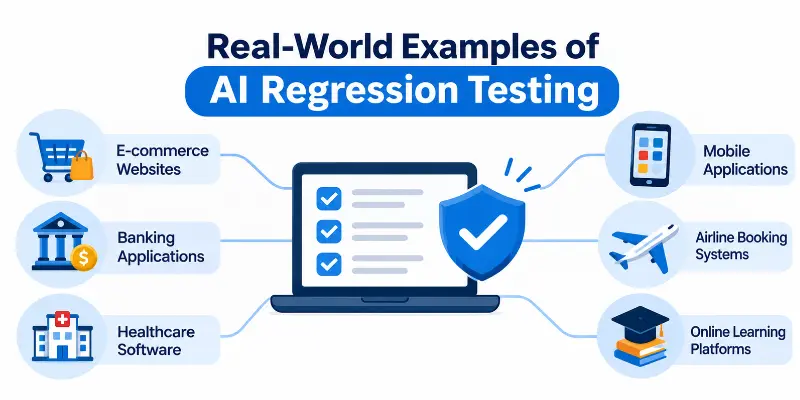
1. E-commerce Websites
Online shopping websites often add new payment methods, update product pages, and improve checkout features.
AI regression testing can check important features such as user login, product search, shopping carts, and payments. It helps teams find problems after website updates.
Example: A shopping website adds a new payment option. AI testing helps check whether customers can still add products to their carts and complete orders.
2. Banking Applications
Banking apps handle important tasks such as money transfers, account balances, and bill payments. Even a small software error can affect users.
AI regression testing can help check these features after app updates. It can also analyze past test results to identify areas that may need extra attention.
Example: A bank updates its money transfer feature. Testing checks whether users can still send money, view balances, and receive transaction messages.
3. Healthcare Software
Healthcare systems manage patient records, appointments, test reports, and other important information. Regular software updates must not affect these features.
AI regression testing can help teams check existing functions after updates and identify unexpected problems.
Example: A hospital updates its appointment booking system. Testing checks whether patients can still book appointments, view schedules, and access their records.
4. Mobile Applications
Mobile apps receive regular updates to improve features, fix bugs, and support new devices. These changes can sometimes affect existing functions.
AI regression testing can help test app features across different devices and screen sizes.
Example: A mobile app changes its login screen. Testing checks whether users can still log in, reset passwords, and access their accounts.
5. Airline Booking Systems
Airline websites and apps manage flight searches, ticket bookings, payments, and cancellations. These features must work correctly after every update.
AI regression testing can help check important booking steps and identify problems in the user journey.
Example: An airline adds a new seat selection feature. Testing checks whether users can still search for flights, select seats, make payments, and receive booking confirmations.
6. Online Learning Platforms
Online learning platforms provide courses, video lessons, quizzes, and student accounts. Updates should not affect the learning experience.
AI regression testing can help check course access, video playback, quiz submission, and progress tracking.
Example: An education platform updates its quiz system. Testing checks whether students can still open lessons, submit answers, and view their results.
Challenges and Limitations of AI Regression Testing
AI Regression Testing offers many benefits, but it also has some challenges. Businesses may face problems when they introduce AI-powered testing tools into their software development process.
Understanding these limitations helps teams choose the right tools and use them effectively.
Here are some common challenges of AI regression testing:
- High Initial Cost: Some AI testing tools require expensive subscriptions, setup, and training. This can make them difficult for small businesses and startups to afford.
- Requires Technical Knowledge: AI testing tools may need skilled testers and developers to set up, manage, and maintain them. Beginners may need extra time to understand these tools.
- Data Quality Problems: AI tools use past test results and other data to improve testing. Poor or incomplete data can lead to incorrect results and weak testing decisions.
- False Test Results: Sometimes AI tools may report a problem when the software is working correctly. They may also miss real bugs. Testers still need to review important results.
- Complex Setup and Integration: Connecting AI testing tools with existing software, development systems, and testing workflows can be difficult. Some teams may need extra time and technical support.
- Limited Human Understanding: AI can analyze test data and identify unusual behavior, but it may not fully understand business needs or user expectations. Human testers are still important for making final decisions.
- Security and Privacy Risks: Some AI testing tools process application data and test information. Businesses must protect sensitive data and check how each tool stores and uses it.
- Not Suitable for Every Project: AI regression testing may not be necessary for small or simple applications. Traditional automation testing can be enough for projects with stable features and basic testing needs.
Best Practices for AI Regression Testing
AI Regression Testing works best when teams follow the right testing practices. A clear testing strategy helps reduce errors, save time, and improve software quality.
Here are some best practices to get better results from AI regression testing.
- Choose the Right AI Testing Tool: Select a tool that matches your project, budget, and technical needs. Check its features, supported applications, and integration options before making a decision.
- Start with Important Test Cases: Focus on critical features such as login, payments, user accounts, and checkout. Testing these areas helps protect the most important parts of your application.
- Use High-Quality Test Data: Provide accurate and complete test data. Good data helps AI tools analyze results and make better testing decisions.
- Automate Repeated Tests: Use automation for tasks that testers perform regularly. This saves time and allows your team to focus on complex testing activities.
- Review AI-Generated Results: Do not depend completely on AI results. Testers should review failed tests, check unusual behavior, and confirm whether reported problems are real.
- Keep Test Cases Updated: Update test cases when developers add new features or change existing functions. This helps keep your testing process accurate and useful.
- Integrate Testing into Development: Connect AI testing tools with your development workflow. Run tests after code changes to find problems early and reduce the risk of software errors.
- Monitor Testing Performance: Regularly review test results, execution time, failure rates, and test maintenance needs. This helps teams understand how well their testing process works.
- Protect Sensitive Data: Use secure test environments and protect customer information. Avoid sharing private data with AI tools unless their security and privacy practices meet your requirements.
- Combine AI with Human Testing: AI can automate repeated tasks and analyze test results, but human testers provide important judgment. Use both approaches to improve testing accuracy and software quality.
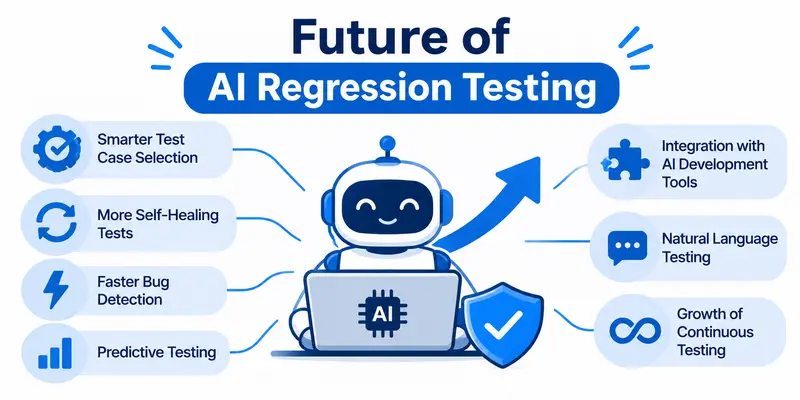
Future of AI Regression Testing
AI regression testing is becoming an important part of modern software development. As applications become more complex, software teams need faster and smarter ways to test updates and find bugs.
AI technology is expected to improve software testing by reducing manual work, improving test accuracy, and helping teams find problems earlier.
Here are some important trends that may shape the future of AI regression testing.
- Smarter Test Case Selection: AI will help teams select important test cases by analyzing code changes and past test results.
- More Self-Healing Tests: AI tools will better handle small software changes, reducing test maintenance and manual work.
- Faster Bug Detection: AI will improve test result analysis and help developers find bugs earlier.
- Predictive Testing: AI will use past data to identify high-risk features before software releases.
- Integration with AI Development Tools: AI testing tools will work more closely with coding assistants and development platforms to improve testing.
- Natural Language Testing: Testers will be able to create test cases using simple English instructions, even with limited coding skills.
- Growth of Continuous Testing: AI will help teams run tests regularly throughout software development and after code changes.
Conclusion
AI Regression Testing makes software testing faster, smarter, and easier. It helps teams find bugs, select important test cases, reduce manual work, and maintain software quality after updates. We also explored popular tools, real-world examples, key challenges, best practices, and future trends.
My recommendation is to choose an AI regression testing tool that fits your project and budget. Start with a small test project to understand its features. Combine AI automation with human testing to get more reliable results.
Ready to make your testing process better? Explore our other AI testing guides to discover useful tools and practical tips. Have you tried AI Regression Testing? Share your thoughts in the comments!
FAQs
Do you have questions about AI regression testing? This section covers common questions to help you understand how it works, its benefits, popular tools, and its role in software testing. Whether you are a beginner or a software tester, these answers will help you learn the basics.
AI regression testing uses artificial intelligence (AI) and machine learning to improve software regression testing. It helps teams select important test cases, detect unusual results, and manage test maintenance. It checks whether new code changes affect existing features and helps keep software working correctly after updates.
AI regression testing analyzes code changes, test history, and previous results to identify areas that may need testing. It can select relevant test cases, run automated tests, and study the results. Some AI tools can also detect patterns, identify possible bugs, and update test scripts when small changes occur.
Traditional regression testing checks existing features after software changes, often by running predefined test cases. AI regression testing uses AI to improve this process. It can help select test cases, analyze results, and maintain test scripts. Both methods aim to find bugs and protect existing software features.
AI can make regression testing faster and more efficient. It helps teams select important test cases, reduce repetitive work, detect unusual results, and maintain test scripts. It can also support frequent software updates and improve test coverage. However, human review remains important for accurate results.
Popular tools include Testim, Functionize, Applitools, Mabl, ACCELQ, Katalon, Testsigma, and Tricentis Tosca. These tools offer features such as automated test creation, visual testing, test maintenance, and result analysis. Each tool has different features, so choose one based on your project and testing needs.
Yes, AI can automate many parts of regression testing. It can help create test cases, select important tests, run test scripts, analyze results, and manage small changes. This reduces repetitive manual work and saves time. However, testers still need to review results and check complex software behavior.
AI regression testing can be faster and more useful for large projects with frequent updates. Manual testing is still valuable for checking user experience, complex workflows, and unexpected behavior. Neither approach is best for every situation. Many teams combine AI automation with manual testing for better results.
Self-healing test automation uses AI to detect and adjust test scripts when small changes occur in an application. For example, if a button’s name or location changes, the tool may find the updated button and continue the test. This can reduce test maintenance, but testers should review important changes.
Yes, beginners can learn AI regression testing with basic software testing knowledge. Start by understanding manual testing, regression testing, and test automation. Then learn how to use tools such as Testim, Katalon, or Testsigma. Practice with simple projects to build your skills and confidence.
No, AI is unlikely to replace software testers completely. It can handle repetitive tasks, analyze test results, and speed up testing. However, human testers still provide critical thinking, problem-solving, and user-focused judgment. AI will change testing jobs, but skilled testers who understand AI tools will remain valuable.

- Be Respectful
- Stay Relevant
- Stay Positive
- True Feedback
- Encourage Discussion
- Avoid Spamming
- No Fake News
- Don't Copy-Paste
- No Personal Attacks
- Be Respectful
- Stay Relevant
- Stay Positive
- True Feedback
- Encourage Discussion
- Avoid Spamming
- No Fake News
- Don't Copy-Paste
- No Personal Attacks
