AI Heuristic Search: A Beginner-Friendly Guide to How It Works
Published: 10 Nov 2026
Have you wondered how computers find the best solution to a problem without checking every possible option? This is where AI heuristic search comes in. It helps artificial intelligence systems solve problems faster by guiding them toward the most promising solutions. From finding the shortest route on a map to solving complex puzzles, heuristic search plays an important role in many AI applications.
You will learn what heuristic search is, how it works, and why AI systems use it. We will also explore its main types, common algorithms, real-life examples, advantages, and limitations. You will discover how heuristic search differs from other search methods and where it fits into modern AI technology.
Whether you are a student, beginner, or someone interested in artificial intelligence, this guide will make the concept easy to understand. By the end, you will have a clear understanding of AI heuristic search and how it helps AI systems find smart and efficient solutions.
What Is AI Heuristic Search?
AI heuristic search is a problem-solving method that helps artificial intelligence find good solutions faster. It uses simple rules, called heuristics, to guide the search toward the most promising option.
In simple words, heuristic search helps AI make smart choices instead of checking every possible solution. It uses available information to decide which path or option looks more useful.
For example, imagine you want to find the shortest route from your home to a shopping mall. A computer can check many possible roads. Heuristic search helps it choose a route that looks closer to the destination. This saves time and reduces unnecessary work.

How Does AI Heuristic Search Work?
AI heuristic search works by guiding an AI system toward the most promising solution. Instead of checking every possible option, it uses a special rule to estimate which choice may lead to the goal faster.
This rule is called a heuristic function. It helps AI compare different paths and decide which one to explore first.
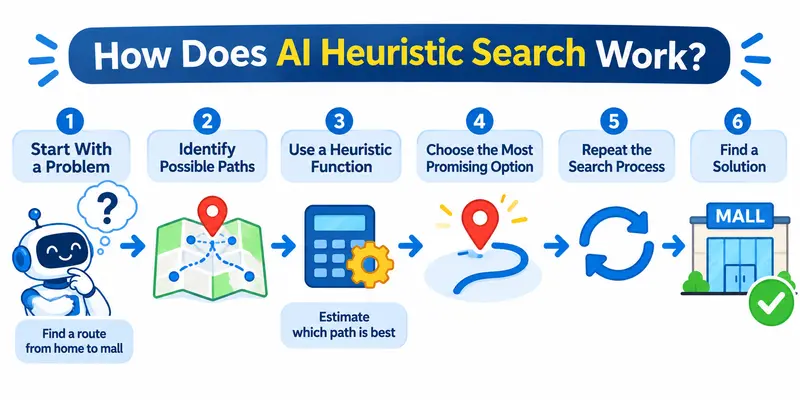
Let’s understand how the process works step by step.
1. Start With a Problem
First, the AI system receives a problem that needs a solution. It also identifies the starting point and the goal.
For example, imagine a navigation system that needs to find a route from your home to a shopping mall.
- Starting point: Your home.
- Goal: The shopping mall.
- Problem: Find a suitable route.
2. Identify Possible Paths
Next, the AI system looks at the available choices. In route planning, these choices are different roads that lead toward the destination.
The system creates possible paths and checks which options may help it reach the goal.
3. Use a Heuristic Function
Now, the AI system uses a heuristic function to estimate how close each option is to the goal.
For example, a navigation system may estimate the remaining distance between each location and the shopping mall.
A shorter estimated distance may make a path look more promising.
4. Choose the Most Promising Option
After comparing the available choices, the AI system selects an option that looks useful.
It does not waste time exploring every path at once. Instead, it focuses on choices that may lead to a solution.
5. Repeat the Search Process
The AI system continues checking new options and comparing their estimated costs.
It repeats this process until it reaches the goal or meets a search limit.
6. Find a Solution
Finally, the system returns a solution based on its search method.
For example, a route-finding system may suggest a path to the shopping mall. The quality of that path depends on the algorithm and heuristic function it uses.
What Is a Heuristic Function in AI?
A heuristic function in AI is a rule that helps an artificial intelligence system estimate how close it is to reaching a goal. It guides the system toward promising choices and helps it solve problems faster.
For example, imagine you want to travel from your home to a shopping mall. You have several roads to choose from. A navigation system can estimate the remaining distance for each road. It uses this information to explore a promising route.
Main Types of AI Heuristic Search Algorithms
AI heuristic search algorithms help artificial intelligence solve problems by exploring the most promising paths first. Each algorithm uses a different method to choose the next step and reach a goal.
Some algorithms focus on speed, while others focus on finding the best possible solution. The right choice depends on the type of problem.
Let’s explore the main types of AI heuristic search algorithms and how they work.
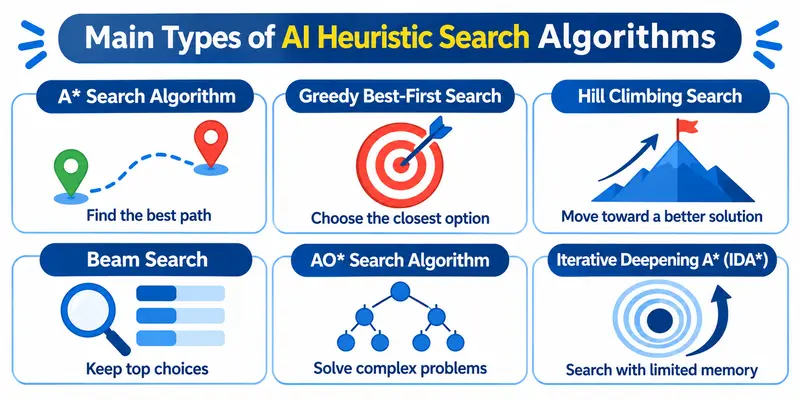
1. A* Search Algorithm
A* (A-star) is one of the most popular heuristic search algorithms. It uses two values to find a suitable path:
- Actual cost: The cost from the starting point to the current point.
- Estimated cost: The expected cost from the current point to the goal.
A* combines these values to decide which path to explore next.
Example: A GPS navigation system can use A* to find a suitable route between two locations.
Common uses:
- GPS navigation.
- Video games.
- Robot path planning.
- Puzzle solving.
2. Greedy Best-First Search
Greedy Best-First Search selects the option that appears closest to the goal. It uses a heuristic function to estimate which path looks best.
Unlike A*, it does not consider the full cost of the path already traveled.
Example: Imagine you want to reach a shopping mall. The algorithm chooses the road that appears closest to the mall based on estimated distance.
Common uses:
- Route finding.
- Game AI.
- Basic pathfinding problems.
- Search applications.
3. Hill Climbing Search
Hill climbing is a local search algorithm. It starts with an initial solution and moves toward a better option step by step.
It checks nearby choices and selects one that improves the current result. It continues until it cannot find a better nearby option.
Example: Imagine you want to find the highest point on a hill. You keep moving upward until no nearby step takes you higher.
Common uses:
- Optimization problems.
- Scheduling.
- Game strategies.
- Machine learning.
Limitation: Hill Climbing can get stuck at a local maximum. This means it may find a good solution without finding the best possible solution.
4. Beam Search
Beam Search is a heuristic search algorithm that explores a limited number of promising options at each level.
It keeps only the best choices and removes less promising ones. This helps reduce memory use and search time.
Example: Imagine an AI writing system that creates several possible next words. Beam Search keeps only a few promising sentence options at each step.
Common uses:
- Natural language processing.
- Machine translation.
- Speech recognition.
- Text generation.
Limitation: It may miss the best solution because it removes some options during the search.
5. AO* Search Algorithm
AO* is a heuristic search algorithm that works with AND-OR graphs. It helps AI break a complex problem into smaller parts.
- OR nodes: The system can choose one of several options.
- AND nodes: The system must complete all required parts.
Example: Imagine an AI system planning a journey. It may need to book a flight, arrange transport, and find accommodation. AO* can help organize these connected tasks.
Common uses:
- Problem reduction.
- Planning systems.
- Expert systems.
- Complex decision-making.
6. Iterative Deepening A* (IDA*) Search
IDA* combines ideas from A* and iterative deepening search. It uses a cost limit to control how far the search can go.
The algorithm starts with a cost limit and explores paths within that limit. It increases the limit when it cannot find a solution.
Example: An AI puzzle solver can use IDA* to explore possible moves without storing a large search tree in memory.
Common uses:
- Puzzle solving.
- Game search.
- Pathfinding.
- Problems with limited memory.
Difference Between Heuristic Search and Uninformed Search
Heuristic search and uninformed search are two common search methods used in artificial intelligence (AI). Both help AI find solutions to problems by exploring different paths. However, they use different approaches. Heuristic search uses a heuristic function to estimate the best path toward a goal, while uninformed search explores possible paths without using these estimates.
Key Differences Between Heuristic Search and Uninformed Search
| Feature | Heuristic Search | Uninformed Search |
| Meaning | Uses estimates to guide the search. | Searches without heuristic estimates. |
| Extra Knowledge | Uses a heuristic function. | Does not use a heuristic function. |
| Search Direction | Focuses on promising paths. | Follows a fixed search strategy. |
| Speed | Can be faster with a good heuristic. | May explore more paths. |
| Efficiency | Can reduce unnecessary exploration. | May require more time and resources. |
| Examples | A*, Greedy Best-First Search, Hill Climbing. | BFS, DFS, Uniform Cost Search. |
| Best Use | Complex problems with useful estimates. | Simple problems or problems without a useful heuristic. |
Advantages of AI Heuristic Search
AI heuristic search offers many benefits when solving complex problems. It uses estimates to guide the search process and helps AI focus on the most promising paths. This can save time, reduce unnecessary work, and improve search efficiency.
- Faster Problem Solving: Heuristic search can find solutions faster by exploring promising paths first. It avoids checking every possible option in many cases.
- Saves Time and Resources: A good heuristic reduces unnecessary searches. This helps AI use less time and fewer computing resources.
- Handles Complex Problems: Heuristic search can help solve problems with many possible choices. It is useful in route planning, games, robotics, and puzzle solving.
- Guides the Search Process: A heuristic function estimates how close a state is to the goal. This gives AI a clear direction during the search.
- Improves Search Efficiency: Heuristic search focuses on useful options instead of exploring paths randomly. This can make the problem-solving process more efficient.
- Supports Better Decision-Making: AI can compare different choices using heuristic values. This helps it select a promising option at each step.
Limitations of AI Heuristic Search
AI heuristic search helps solve complex problems, but it also has some limitations. These challenges can affect its speed, accuracy, and performance. Here are the main limitations:
- Poor Heuristic Quality: A weak heuristic can guide AI toward the wrong path. This may lead to poor results.
- No Best Solution Guarantee: Some algorithms may find a solution without finding the best possible one. This can affect the final result.
- Difficult to Design: Creating a good heuristic function takes time and effort. It also requires knowledge of the problem.
- High Computing Power: Large search spaces may need more memory and processing power. This can make the search slower.
- Local Solutions: Some methods, such as hill climbing, can get stuck at a local solution. They may miss a better solution elsewhere.
How to Choose the Right Heuristic Search Algorithm
Choosing the right heuristic search algorithm depends on your problem and goals. Each algorithm has a different purpose. Some focus on speed, while others focus on finding better solutions or saving memory.
The following table shows which algorithm is best for different tasks:
| Algorithm | Best Use |
| Greedy Best-First Search | Quickly exploring promising paths. |
| A* Search | Finding optimal paths with a suitable heuristic. |
| Hill Climbing | Improving a solution step by step. |
| Beam Search | Searching large spaces while using limited memory. |
Choose an algorithm based on your needs, such as speed, accuracy, and available resources.

Future of Heuristic Search in Artificial Intelligence
Heuristic search will continue to play an important role in artificial intelligence (AI). As AI technology grows, these methods can help solve more complex problems faster and more efficiently. Researchers are also working to improve heuristic functions and combine them with machine learning.
- Better AI Algorithms: Future algorithms may use smarter heuristics to find solutions faster and improve accuracy.
- Robotics and Automation: Heuristic search can help robots plan movements, avoid obstacles, and complete tasks.
- Smarter Game AI: It can help AI systems make better decisions in complex games and solve difficult challenges.
- Improved Route Planning: Future navigation systems can use advanced search methods to find better routes and avoid delays.
- Combination with Machine Learning: AI may combine heuristic search with machine learning to create better estimates and improve decision-making.
- Complex Problem Solving: Heuristic search can support advanced tasks in scheduling, planning, and resource management.
Conclusion
AI heuristic search is an important part of artificial intelligence. It helps AI solve problems by exploring promising paths instead of checking every possible option. Algorithms like A*, Greedy Best-First Search, Hill Climbing, and Beam Search support different problem-solving tasks.
In this article, we explored how AI heuristic search works, its main algorithms, advantages, limitations, and real-world applications. Each algorithm has its own strengths. My recommendation is to start with A* Search and Greedy Best-First Search to understand how heuristic methods guide AI toward solutions.
Want to learn more about AI? Explore our other AI Basics guides to build your knowledge step by step. You can also share this article with others who want to understand AI search techniques.
FAQs
Do you still have questions about AI Heuristic Search? These frequently asked questions cover common beginner concerns, explain important concepts, and provide practical learning tips. Explore the answers below to understand how heuristic search works and how you can use it in AI.
The main goal of AI heuristic search is to help AI find solutions more efficiently. It uses estimates to guide the search toward promising options. This can reduce unnecessary steps and save time when solving complex problems.
A heuristic helps AI estimate which option may lead closer to the goal.
- It evaluates possible choices.
- It gives each choice an estimated value.
- It helps AI select promising paths.
Yes, heuristic search is commonly known as informed search. Both terms describe methods that use extra knowledge, such as heuristic estimates, to guide the search process.
A* Search is a good starting point for beginners. It combines the cost of the path so far with an estimated cost to reach the goal. Greedy Best-First Search is another useful algorithm to learn because it focuses on estimated distance to the goal.
Yes, some heuristic algorithms can find the shortest path. A* Search can find an optimal path when it uses a suitable heuristic and meets the required conditions. However, not every heuristic algorithm guarantees the best result.
Heuristic search helps AI solve problems that have many possible choices. It guides the search process and can reduce unnecessary exploration. This makes it useful for planning, navigation, robotics, and games.
A heuristic function estimates how close a state is to the goal, while a search algorithm decides how to explore possible states.
Heuristic Function:
- Provides an estimated value.
- Guides the search process.
Search Algorithm:
- Explores possible paths.
- Uses rules to select the next step.
Use heuristic search when you have a useful estimate to guide the search. It works well for problems with many possible paths. Uninformed search can be a better choice when the problem is simple or no useful heuristic exists.
AI heuristic search supports many real-world tasks, including:
- Navigation: Finding promising routes between locations.
- Robotics: Planning movements and avoiding obstacles.
- Gaming: Choosing useful moves in games.
- Scheduling: Finding suitable times for tasks.
- Puzzle Solving: Exploring possible solutions to puzzles.
You can learn AI heuristic search by following a simple learning path:
- Understand basic AI search concepts.
- Learn how heuristic functions work.
- Study Greedy Best-First Search.
- Learn A* Search and its formula.
- Practice with simple puzzles and route-planning examples.
- Try implementing a search algorithm using Python.






- Be Respectful
- Stay Relevant
- Stay Positive
- True Feedback
- Encourage Discussion
- Avoid Spamming
- No Fake News
- Don't Copy-Paste
- No Personal Attacks
- Be Respectful
- Stay Relevant
- Stay Positive
- True Feedback
- Encourage Discussion
- Avoid Spamming
- No Fake News
- Don't Copy-Paste
- No Personal Attacks
