Train AI: How to Train Artificial Intelligence, Methods, Tools, and Benefits
Published: 12 Nov 2026
Have you wondered how artificial intelligence learns to think, answer questions, and make decisions? Behind every AI tool, there is a process that helps it learn from data and improve its results. This process is called training AI. It plays an important role in building smart systems that can solve problems and help people in daily life.
You will learn what AI training means, how it works, and why it matters. We will also explore different types of AI training, the steps involved, common tools, real-life examples, benefits, challenges, and career opportunities in this field.
Whether you are a student, beginner, or someone interested in AI careers, this article will help you understand the basics without confusion. By the end, you will have a clear idea of how to train AI, how AI learns from data, and how you can get started in this growing field.
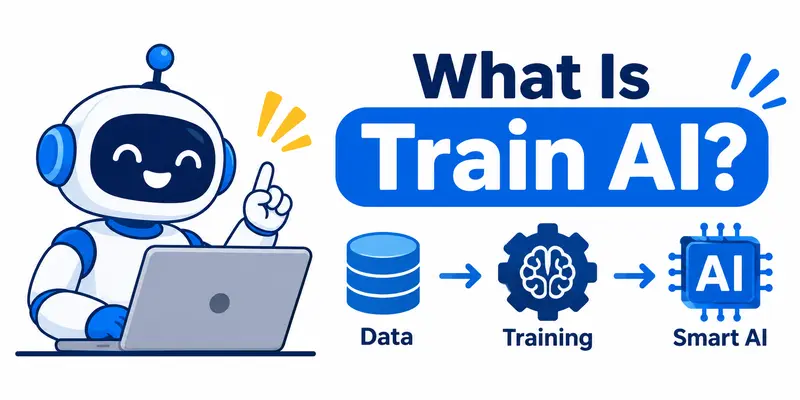
What Is Train AI?
Train AI refers to the process of teaching an artificial intelligence (AI) system how to perform tasks by using data, examples, and feedback. Just like humans learn new things through practice, AI systems learn by studying large amounts of information. This process helps them find patterns, understand information, and give useful answers.
For example, when you teach an AI chatbot to answer questions, you provide it with text, questions, and correct answers. The AI studies these examples and learns how to respond to similar questions. Over time, training helps the system improve its results and handle different tasks.
AI training also involves people who prepare data, check AI responses, fix mistakes, and give feedback. These tasks help AI systems become more useful and reliable. In simple words, “Train AI” means teaching AI systems to learn from data and improve their performance.
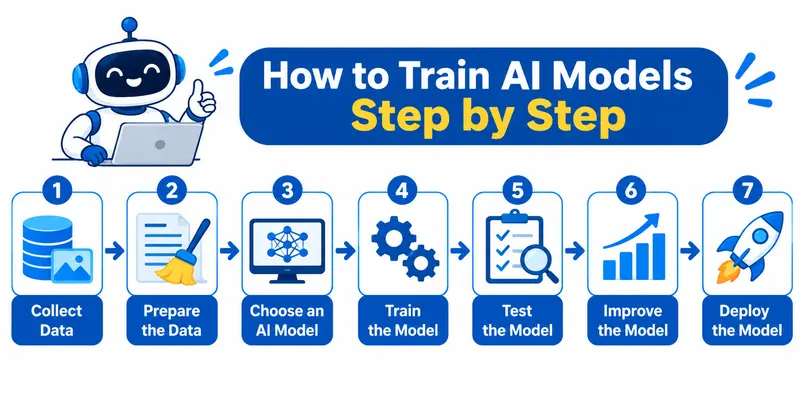
How to Train AI Models Step by Step
Training an AI model may sound difficult, but the process becomes easier when you break it into simple steps. You need the right data, a suitable model, and proper testing to get good results. Each step helps the AI learn and improve its performance.
Here are the seven basic steps to train an AI model.
- Collect Data: Gather useful data, such as text, images, videos, or numbers. AI models use this information to learn.
- Prepare the Data: Clean the data by removing errors, duplicate records, and incomplete information. This helps the model learn better.
- Choose an AI Model: Select a model that matches your task. For example, use an image recognition model to identify objects in pictures.
- Train the Model: Feed the prepared data into the model. It studies patterns and learns how to perform the task.
- Test the Model: Use new data to check how well the model works. Testing helps you find mistakes and measure accuracy.
- Improve the Model: Fix errors and adjust the model to improve its results. You may also add better data and train it again.
- Deploy the Model: Make the trained model available through an app, website, or software. People can now use it to complete real tasks.
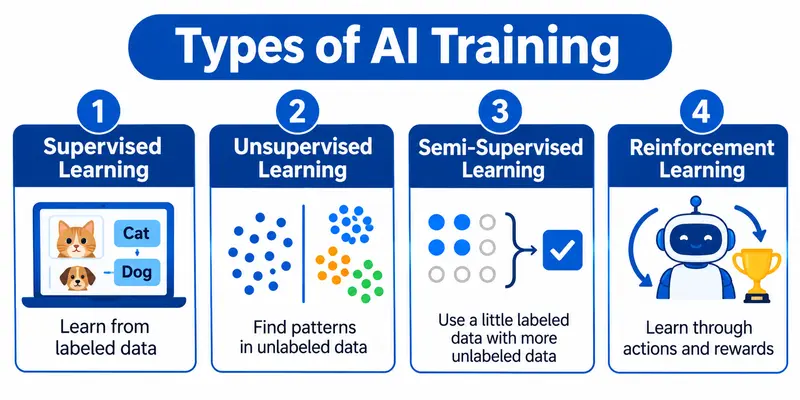
Different Types of AI Training
Artificial intelligence (AI) can learn in different ways. Some AI models learn from examples with correct answers, while others find hidden patterns in data. Some models also learn by trying different actions and receiving rewards or penalties.
Each training method helps AI solve a different type of problem. For example, businesses use AI to understand customers, doctors use it to study medical images, and game developers use it to build smart computer players.
There are four main types of AI training. Let’s explore each type with simple explanations and real-life examples.
1. Supervised Learning
Supervised learning is a type of AI training that uses labeled data. Labeled data means information that already has the correct answer. Humans prepare these examples so the AI model can learn from them.
During training, the model studies many examples and looks for patterns. It compares its predictions with the correct answers and adjusts its learning to reduce mistakes. After training, it can use what it has learned to make predictions about new data.
Example: Imagine you want to train an AI model to recognize cats and dogs. You provide thousands of animal pictures with labels such as “Cat” and “Dog.” The model studies their features, such as ears, faces, and body shapes. After training, it can look at a new picture and predict whether it shows a cat or a dog.
Common Uses of Supervised Learning:
- Email Spam Detection: AI learns to identify unwanted emails by studying examples of spam and normal messages.
- House Price Prediction: AI studies house prices, locations, sizes, and other details to estimate property values.
- Medical Image Detection: AI studies labeled medical images to help identify signs of certain diseases.
- Weather Prediction: AI uses past weather data to predict future conditions.
2. Unsupervised Learning
Unsupervised learning is a type of AI training that uses unlabeled data. This means the information does not contain ready-made answers. Instead, the AI model studies the data and finds patterns or groups on its own.
During training, the model looks for similarities, differences, and connections between different pieces of information. It then organizes the data into groups based on what it discovers. This method helps people understand large amounts of information.
Example: Imagine an online shopping store has thousands of customers. The store gives their shopping data to an AI model without adding customer groups. The AI studies their buying habits and finds similar customers. It may create groups for people who often buy clothes, electronics, or shoes.
Common Uses of Unsupervised Learning:
- Customer Grouping: Businesses group customers based on their shopping habits and interests.
- Fraud Detection: AI looks for unusual patterns in banking transactions.
- Product Recommendations: Shopping platforms study customer behavior to find similar products and interests.
- Data Organization: AI finds patterns in large datasets and organizes similar information into groups.
3. Semi-Supervised Learning
Semi-supervised learning combines supervised and unsupervised learning methods. It uses a small amount of labeled data and a large amount of unlabeled data.
In this method, humans label some examples and provide them to the AI model. The model learns from these examples and uses that knowledge to understand the remaining data. This approach can reduce the time and effort needed to prepare large datasets.
Example: Imagine you have 1,000 pictures of cats and dogs, but only 100 pictures have labels. You give these labeled pictures to an AI model for training. The model studies their features and uses what it learns to find patterns in the remaining 900 pictures.
Common Uses of Semi-Supervised Learning:
- Image Recognition: AI learns to identify objects using a small number of labeled pictures and many unlabeled pictures.
- Speech Recognition: AI uses labeled voice recordings and additional unlabeled audio to improve speech understanding.
- Medical Research: AI studies a small collection of labeled medical images and a larger collection of unlabeled images.
- Text Classification: AI learns to organize documents and messages using a limited number of labeled examples.
4. Reinforcement Learning
Reinforcement learning is a type of AI training that teaches a model through actions, rewards, and penalties. Instead of learning from ready-made answers, the AI tries different actions and learns from their results.
During training, the AI interacts with an environment. It takes an action and receives feedback based on the result. A good action earns a reward, while a poor action may receive a penalty. Over time, the model learns which actions can produce better results.
Example: Imagine an AI system learning to play a video game. At first, it makes random moves and often loses. The game gives it rewards for successful moves and penalties for mistakes. After many attempts, the AI learns better strategies and improves its chances of winning.
Common Uses of Reinforcement Learning:
- Video Games: AI learns different strategies to play games and complete challenges.
- Robotics: Robots learn how to move, pick up objects, and perform tasks.
- Self-Driving Cars: AI can learn driving decisions in simulated environments.
- Traffic Management: AI helps manage traffic signals to improve traffic flow.
Best Tools to Train AI Models
Training AI models requires the right tools and software. These tools help developers collect data, build models, train them, test results, and improve performance. Some tools are easy for beginners, while others offer advanced features for professional AI developers.
You do not need to use every tool. The best choice depends on your project, skills, and experience. Here are some popular tools used to train AI models.
1. TensorFlow
TensorFlow is an open-source tool developed by Google. It helps developers build, train, and test machine learning models.
Key features:
- Supports machine learning and deep learning.
- Helps train models with large datasets.
- Supports image recognition and language processing.
- Allows developers to build and deploy AI models.
Best for: Developers who want to build and train advanced AI models.
2. PyTorch
PyTorch is an open-source machine learning framework. It is widely used for deep learning, research, and AI development.
Key features:
- Works with the Python programming language.
- Supports neural networks and deep learning.
- Makes it easier to test and improve models.
- Offers flexible tools for AI experiments.
Best for: AI developers, researchers, and students learning deep learning.
3. Scikit-learn
Scikit-learn is a Python library used for machine learning. It helps users train models, study data, and make predictions.
Key features:
- Supports classification and prediction.
- Helps prepare and analyze data.
- Provides tools to test model performance.
- Offers simple methods for common machine learning tasks.
Best for: Beginners who want to learn traditional machine learning.
4. Google Colab
Google Colab is an online platform where users can write and run Python code in a web browser. It allows users to work on AI projects without setting up a local coding environment.
Key features:
- Runs Python code online.
- Supports popular AI libraries.
- Provides access to GPU resources, depending on availability and plan.
- Allows users to save and share notebooks.
Best for: Students and beginners who want to practice AI training.
5. Keras
Keras is a deep learning framework that makes it easier to build and train neural networks. It offers a simple way to create AI models with less code.
Key features:
- Provides a beginner-friendly interface.
- Supports neural network development.
- Helps train and test deep learning models.
- Works with different supported backends.
Best for: Beginners and developers who want to build deep learning models.
6. Hugging Face
Hugging Face provides tools, libraries, and pre-trained models for AI development. It is especially popular for natural language processing (NLP) and generative AI.
Key features:
- Provides access to pre-trained AI models.
- Supports language processing tasks.
- Helps developers fine-tune existing models.
- Offers tools for sharing and testing models.
Best for: Developers working on chatbots, language models, and generative AI.
Real-World Applications of AI Training
AI training is used in many areas of daily life. It helps machines learn from data, recognize patterns, and perform useful tasks. Many tools and services that people use every day depend on trained AI models.
Here are some common real-world applications of AI training.
- Healthcare: AI models study medical images and health data to help doctors detect diseases.
- Education: AI-powered tools help students learn, answer questions, and understand difficult topics.
- Banking and Finance: Banks use AI to detect unusual transactions and identify possible fraud.
- Self-Driving Cars: AI helps self-driving cars recognize roads, traffic lights, and pedestrians.
- Online Shopping: AI studies customer interests and suggests products they may like.
- Customer Support: AI chatbots answer customer questions and provide quick support.
- Agriculture: AI helps farmers monitor crops, study soil data, and detect plant diseases.
- Entertainment: AI recommends movies, music, and videos based on user interests.
- Language Translation: AI translates text between different languages.
- Cybersecurity: AI helps detect online threats and suspicious activities.
Benefits of Training AI
Training AI offers many benefits. It helps AI systems learn from data, improve their results, and perform tasks more effectively. It also helps businesses and individuals save time and solve problems.
Here are some important benefits of training AI.
- Improves Accuracy: AI training helps systems learn from examples and give more accurate results. Regular testing and feedback can also reduce errors.
- Saves Time and Effort: Trained AI models can handle repetitive tasks quickly. This helps people focus on more important work.
- Supports Better Decisions: AI studies data and finds useful patterns. Businesses can use these patterns to understand customers, predict sales, and make better decisions.
- Handles Large Amounts of Data: AI models can process large amounts of information much faster than people can do manually. This is useful in healthcare, banking, education, and other fields.
- Improves User Experience: Trained AI helps chatbots, voice assistants, and recommendation systems understand user needs. It can provide more useful answers and suggestions.
- Supports New Technology: AI training helps developers build smart tools for image recognition, language translation, medical research, self-driving systems, and many other tasks.
- Learns and Improves Over Time: AI models can be retrained with new data and feedback. This helps them adapt to changing information and improve their performance.
Challenges of Training AI
Training AI models offers many benefits, but it also comes with some challenges. Developers need good data, proper tools, and enough computing power to build reliable AI systems.
Here are some common challenges of training AI.
- Requires Large Amounts of Data: AI models need enough data to learn patterns and perform tasks. Collecting useful data can take time and effort.
- Poor Data Quality: Incorrect, incomplete, or outdated data can affect AI results. Developers must clean and prepare data before training a model.
- High Training Costs: Training large AI models can be expensive. It may require powerful computers, special hardware, and a lot of electricity.
- Takes Time: Some AI models need hours, days, or even weeks to train. Complex models and large datasets can make the process slower.
- Risk of Biased Results: AI models can learn bias from their training data. This may lead to unfair or incorrect results. Developers need to use balanced data and test models carefully.
- Requires Technical Skills: AI training often requires knowledge of programming, mathematics, data science, and machine learning. Beginners may find these topics difficult at first.
- Privacy and Security Risks: Training data may contain personal or sensitive information. Developers must protect this data and follow privacy rules when building AI models.
- Difficult to Test and Improve: An AI model may perform well during training but give poor results with new data. Developers need to test it regularly, find errors, and make improvements.
Future of AI Training
The future of AI training looks promising. AI technology is growing quickly, and new methods are making AI models smarter, faster, and more useful. In the coming years, AI training may become easier and more affordable for developers, businesses, and students.
Here are some important trends that may shape the future of AI training.
1. Faster AI Training
New hardware and improved training methods will help developers train AI models faster. This can save time and reduce computing costs.
2. Better AI Models
Future AI models may understand information more clearly and provide more accurate results. They may also handle complex tasks with fewer mistakes.
3. More Use of Automated Training
Automated machine learning tools can help developers prepare data, select models, and improve performance with less manual work. This can make AI training easier for beginners.
4. Growth of Small AI Models
Small AI models will become more useful for phones, computers, and other devices. They can perform tasks without always depending on large cloud systems.
5. Better Use of Human Feedback
Human feedback will continue to help improve AI models. People can review AI answers, identify mistakes, and guide models toward more useful results.
6. More Focus on Data Privacy
Companies will look for safer ways to train AI models while protecting personal information. Privacy-focused training methods may become more important.
7. Growth in AI Careers
As more companies use AI, the demand for people with AI skills may grow. Jobs related to machine learning, data science, AI development, and AI model training may offer new career opportunities.
Conclusion
Now you have a clear idea of how AI training works and why it is important. From collecting data and choosing the right tools to training, testing, and improving models, each step helps AI systems learn and perform better. You have also explored its benefits, challenges, future, and real-world applications.
If you want to learn how to train AI, start with the basics of machine learning and practice with beginner-friendly tools like Google Colab and Scikit-learn. Try a small project, work with simple datasets, and improve your skills step by step. Practical experience will help you understand AI training more easily.
AI is growing fast, and learning AI training can open new opportunities in the future. So, start your learning journey today! Explore more AI guides on our website, practice what you have learned, and share your questions or thoughts in the comments below.
Frequently Asked Questions About Train AI
Learning how to train AI can raise many questions, especially for beginners. You may wonder which tools to use, how much data you need, or whether you can train AI without coding. Here are some common questions and simple answers to help you understand AI training better.
Training an AI model means teaching a computer to perform tasks by using data and examples. The model studies this information, finds patterns, and learns how to produce useful results. For example, you can train an AI model to recognize pictures of cats and dogs.
Yes, beginners can learn AI training without advanced experience.
Start with these basic skills:
- Learn Python programming.
- Understand basic machine learning concepts.
- Practice with small datasets.
- Use beginner-friendly tools like Google Colab.
The amount of data depends on the task and model. A simple project may need only a small dataset, while a complex AI model may require millions of examples. Focus on collecting useful, accurate, and relevant data instead of just collecting more data.
Python is one of the best programming languages for AI training because it offers many useful libraries and tools.
Popular Python libraries include:
- TensorFlow
- PyTorch
- Scikit-learn
- Keras
AI training can take a few seconds, several hours, or even weeks. The time depends on the model size, dataset, computer hardware, and training method. Small projects usually take less time than large deep learning projects.
Yes, you can train some AI models without writing code. No-code platforms provide simple tools that help users upload data, select models, and start training. These platforms are useful for beginners who want to explore AI without learning programming first.
An AI model may give wrong answers because of poor training data, limited examples, or errors in its learning process.
Common reasons include:
- Incorrect or incomplete data.
- Biased training examples.
- Poor model selection.
- Not enough testing.
Better data and regular testing can help improve results.
Training and testing are two different steps in AI development.
Training:
- Teaches the model using training data.
- Helps the model learn patterns.
- Adjusts the model to improve its results.
Testing:
- Checks the model with new data.
- Measures how well it performs.
- Helps developers find errors and weaknesses.
Yes, you can train an existing AI model further through a process called fine-tuning. It helps the model adapt to a specific task by learning from additional data. For example, developers can fine-tune a language model to answer questions about a particular business.
AI training skills can help you explore several technology careers.
Some common options include:
- Machine Learning Engineer
- AI Engineer
- Data Scientist
- Data Annotator
- AI Trainer
- AI Research Assistant
Start by learning Python, machine learning, and data preparation. Then build small projects to gain practical experience.


- Be Respectful
- Stay Relevant
- Stay Positive
- True Feedback
- Encourage Discussion
- Avoid Spamming
- No Fake News
- Don't Copy-Paste
- No Personal Attacks
- Be Respectful
- Stay Relevant
- Stay Positive
- True Feedback
- Encourage Discussion
- Avoid Spamming
- No Fake News
- Don't Copy-Paste
- No Personal Attacks
