Types of Artificial Intelligence: Explained with Examples
Published: 17 Nov 2026
Artificial intelligence is becoming a part of our everyday lives. From voice assistants and chatbots to self-driving cars, AI can perform many tasks that once needed human intelligence. But did you know that AI comes in different types, and each type has its own abilities and uses? If you want to understand how they work and what makes them different, you are in the right place.
You will learn about the main types of artificial intelligence, how each type works, and how people use them in real life. We will also explore their key features, simple examples, and the difference between narrow AI, general AI, and super AI.
You will have a clear understanding of types of artificial intelligence and know how each type works, where people use it, and what role it may play in the future.
Types of AI Based on Capabilities
Based on their intelligence and abilities, AI systems have three main types. Each type represents a different level of intelligence, from performing specific tasks to potentially becoming smarter than humans. These types include narrow AI, general AI, and super AI.
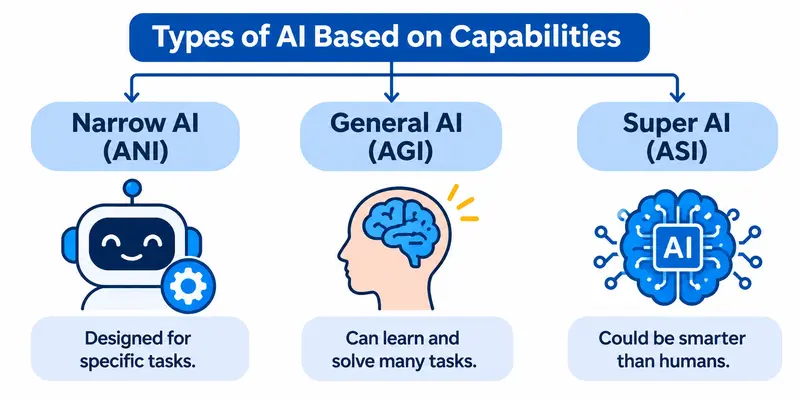
Let’s understand each type in detail.
Narrow AI (ANI)
Narrow AI, also called Artificial Narrow Intelligence (ANI), is designed to perform specific tasks. It can do one task or a group of related tasks, but it cannot think or work like a human in every situation. Most AI tools we use today belong to this category.
For example, Siri and Google Assistant can answer questions, while Netflix and YouTube use AI to suggest movies and videos. These systems work well for their assigned tasks, but they cannot perform every task that a human can do.
Key Features of Narrow AI:
- Performs specific tasks.
- Uses data to find patterns and give results.
- Works within its designed limits.
- Cannot think or understand like a human.
General AI (AGI)
General AI, also called Artificial General Intelligence (AGI), is a type of AI that could learn, think, and solve different problems like a human. It would not need a separate system for every task. Instead, it could use its knowledge to handle many different activities.
For example, a general AI system could write an article, solve a math problem, learn a new language, and help with scientific research. It could also use its past learning to understand new tasks.
Key Features of General AI:
- Could perform many different tasks.
- Could learn new skills and understand new information.
- Could solve problems in different fields.
- Could apply knowledge from one task to another.
Super AI (ASI)
Super AI, also called Artificial Superintelligence (ASI), is a theoretical type of AI that could become more intelligent than humans in almost every area. It could perform complex tasks, solve difficult problems, and make decisions faster than people.
For example, a Super AI system could discover new medicines, solve major scientific problems, and develop advanced technologies. It might also find solutions to problems that humans cannot solve easily.
Key Features of Super AI:
- Could exceed human intelligence.
- Could solve highly complex problems.
- Could learn and improve its abilities.
- Could perform tasks faster and better than humans.
Types of AI Based on Functionality
AI systems also have different types based on how they work, process information, and respond to situations. Experts divide them into four types: Reactive Machines, Limited Memory AI, Theory of Mind AI, and Self-Aware AI. Each type has different abilities, from responding to simple information to potentially understanding human emotions and having self-awareness.
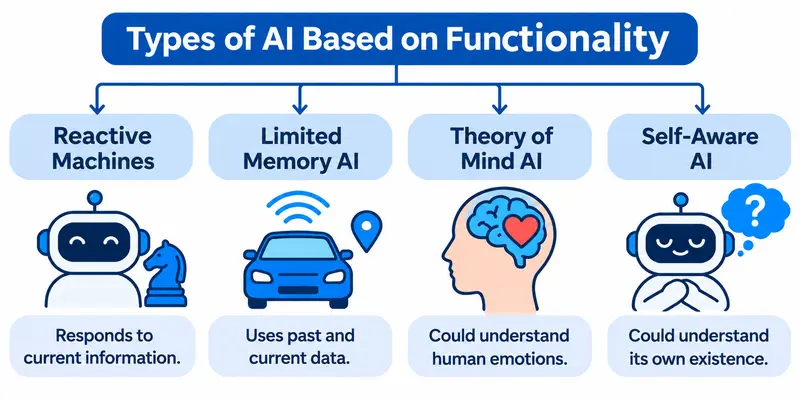
Let’s explore each type with simple explanations and examples.
Reactive Machines
Reactive machines are the simplest type of AI. They respond to current information and perform specific tasks. They do not store past experiences or use memories to make decisions.
Example: IBM Deep Blue is a famous example. It played chess by studying the current board and choosing the best move.
Key Features:
- Responds to current situations.
- Does not store memories.
- Cannot learn from past experiences.
- Performs specific tasks.
Limited Memory AI
Limited Memory AI uses past data and recent information to make decisions. It can learn from data and improve its results over time. Many modern AI systems use this type of functionality.
Example: Self-driving cars use cameras and sensors to study nearby vehicles, road signs, and traffic. They use this information to make driving decisions.
Key Features:
- Uses past and current information.
- Learns patterns from data.
- Makes decisions using available information.
- Supports many modern AI applications.
Theory of Mind AI
Theory of Mind AI is an advanced type of AI that could understand human emotions, feelings, beliefs, and intentions. It could use this understanding to respond to people in a more natural and human-like way.
Example: A future AI assistant could notice when someone feels sad or confused and change its response to offer better support.
Key Features:
- Could understand human emotions.
- Could recognize people’s feelings and intentions.
- Could respond to social situations.
- Could improve human-AI communication.
Self-Aware AI
Self-aware AI is a theoretical type of AI that could understand its own existence, feelings, and internal state. It would have awareness of itself, not just respond to information or follow instructions.
Example: A future self-aware AI might understand that it exists, recognize its own thoughts, and make decisions based on its awareness.
Key Features:
- Could understand its own existence.
- Could recognize its internal states.
- Could have self-awareness.
- Could make decisions based on its own awareness.
Types of AI Based on Technology and Applications
Artificial intelligence uses different technologies to perform tasks, understand information, and solve problems. These technologies help AI learn from data, create new content, understand human language, and recognize images. Some common AI technologies and applications include machine learning, deep learning, generative AI, predictive AI, natural language processing, and computer vision.
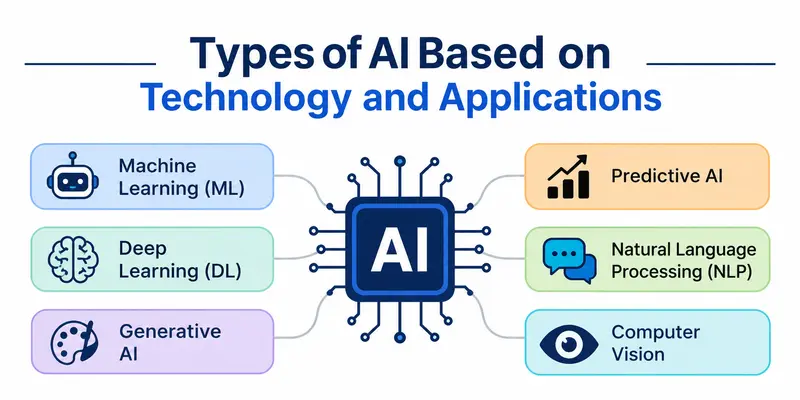
Let’s understand each one with simple explanations and real-life examples.
Machine Learning (ML)
Machine Learning is a branch of AI that allows computers to learn from data and improve their results without following instructions for every task. It finds patterns in data and uses them to make predictions or decisions.
Example: Email services use Machine Learning to identify spam messages and move them into the spam folder.
Key Features:
- Learns from data.
- Finds patterns and trends.
- Makes predictions and decisions.
- Improves results through training.
Deep Learning (DL)
Deep Learning is a part of Machine Learning that uses structures called neural networks. These networks work in a way that is loosely inspired by the human brain. They help AI understand complex data, such as images, videos, and speech.
Example: Face recognition on smartphones uses Deep Learning to identify a person’s face and unlock the device.
Key Features:
- Uses deep neural networks.
- Learns from large amounts of data.
- Recognizes complex patterns.
- Works with images, videos, and audio.
Generative AI
Generative AI is a type of AI that creates new content based on user instructions and learned patterns. It can generate text, images, videos, music, and computer code.
Example: ChatGPT can write articles, answer questions, and create ideas from simple text instructions.
Key Features:
- Creates new content.
- Responds to user prompts.
- Generates text, images, audio, and videos.
- Helps with writing, design, and creative tasks.
Predictive AI
Predictive AI uses past and current data to predict what may happen in the future. It studies patterns and trends to help people make better decisions.
Example: Online shopping websites use Predictive AI to suggest products you may want to buy based on your previous searches and purchases.
Key Features:
- Studies past and current data.
- Finds patterns and trends.
- Predicts possible future results.
- Supports planning and decision-making.
Natural Language Processing (NLP)
Natural Language Processing (NLP) is a branch of AI that helps computers understand, process, and respond to human language. It allows people to communicate with computers through text or speech.
Example: Google Translate uses NLP to translate text from one language into another.
Key Features:
- Understands human language.
- Processes text and speech.
- Supports language translation.
- Helps chatbots answer questions.
Computer Vision
Computer Vision is a branch of AI that helps computers understand and analyze images and videos. It allows AI systems to identify objects, recognize faces, and understand visual information.
Example: Security cameras use Computer Vision to detect people and identify movement in an area.
Key Features:
- Analyzes images and videos.
- Recognizes objects and faces.
- Detects movement and visual patterns.
- Supports facial recognition and image analysis.
Difference Between Different Types of AI
Different types of artificial intelligence have different abilities, features, and uses. Some AI systems perform specific tasks, while others focus on learning from data, creating content, or understanding images and language.
The main difference is how these AI systems work and what tasks they can perform. The following table compares the different types of AI to help you understand them easily.
| Type of AI | Main Purpose | Example |
| Narrow AI (ANI) | Performs specific tasks | Siri, Google Assistant |
| General AI (AGI) | Could perform tasks like humans | Not yet developed |
| Super AI (ASI) | Could exceed human intelligence | Theoretical concept |
| Reactive Machines | Responds to current information | IBM Deep Blue |
| Limited Memory AI | Uses past and current data | Self-driving cars |
| Theory of Mind AI | Could understand human emotions and intentions | Future AI assistants |
| Self-Aware AI | Could understand its own existence | Theoretical concept |
| Machine Learning | Learns patterns from data | Spam detection |
| Deep Learning | Learns complex patterns using neural networks | Face recognition |
| Generative AI | Creates new content | ChatGPT |
| Predictive AI | Predicts possible future results | Weather forecasting |
| Natural Language Processing | Understands human language | Google Translate |
| Computer Vision | Understands images and videos | Facial recognition |
Real-Life Examples of Artificial Intelligence
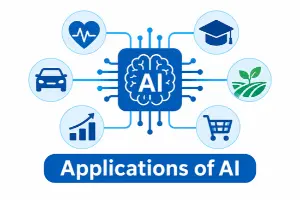
Artificial intelligence is now part of our everyday lives. We use AI when searching online, watching videos, shopping, using smartphones, and communicating with chatbots. It helps people complete tasks faster, find useful information, and make better decisions.
Here are some common real-life examples of artificial intelligence.
- Voice Assistants: Siri, Alexa, and Google Assistant use AI to understand voice commands and answer questions.
- Chatbots: ChatGPT and other chatbots use AI to answer questions, write content, and help users solve problems.
- Self-Driving Cars: AI helps self-driving cars recognize roads, detect other vehicles, and make driving decisions.
- Online Shopping: Amazon uses AI to recommend products based on customers’ interests and shopping history.
- Social Media: Facebook, Instagram, and TikTok use AI to recommend posts and videos based on user interests.
- Healthcare: AI helps doctors study medical images, detect possible diseases, and support medical research.
- Banking and Finance: Banks use AI to detect unusual transactions and identify possible fraud.
- Education: AI helps students learn new topics, practice questions, and understand difficult lessons.
- Maps and Navigation: Google Maps uses AI to study traffic and suggest faster routes.
- Translation Tools: Google Translate uses AI to translate text and speech into different languages.
Benefits of Artificial Intelligence
Artificial intelligence offers many benefits in our daily lives and workplaces. It helps people save time, reduce mistakes, complete tasks faster, and solve problems. AI also supports different industries, such as healthcare, education, banking, and transportation. Here are some important benefits of artificial intelligence.
- Saves Time: AI can complete many tasks in less time than humans. For example, AI tools can quickly search large amounts of information and prepare summaries.
- Reduces Human Errors: AI can help reduce mistakes in tasks that need careful work. For example, AI systems can check data and find errors in records.
- Works 24/7: AI systems can work day and night without needing breaks. For example, customer service chatbots can answer questions at any time.
- Improves Productivity: AI helps people complete more work in less time. For example, AI writing tools can help workers create drafts and organize ideas.
- Supports Better Decisions: AI can study large amounts of data and find useful patterns. Businesses can use this information to make better decisions.
- Improves Healthcare: AI helps doctors study medical images, find signs of diseases, and support treatment planning.
- Personalizes User Experience: AI studies user interests and suggests content, products, or services. For example, YouTube recommends videos based on what people watch.
- Handles Repetitive Tasks: AI can perform repeated tasks automatically. This allows people to focus on work that needs human thinking and creativity.
- Improves Safety: AI can help detect dangers and warn people about possible risks. For example, smart security systems can identify unusual activity.
- Supports Learning: AI tools can explain difficult topics, answer questions, and help students practice new skills.
Limitations and Risks of Artificial Intelligence
Artificial intelligence has many benefits, but it also has some limitations and risks. AI can make mistakes, affect jobs, create privacy problems, and produce false information. It also cannot fully replace human thinking, emotions, and creativity. Understanding these risks helps people use AI in a safe and responsible way.
- Job Loss: AI can perform many tasks that people do at work. This may reduce the need for workers in some jobs, especially those that involve repeated tasks.
- Privacy Risks: AI systems often use large amounts of personal data. Poor data protection can put people’s private information at risk.
- Biased Results: AI can produce unfair results if its training data contains bias. For example, an AI hiring system may unfairly favor some job applicants over others.
- Lack of Human Emotions: AI can understand words and respond to feelings, but it does not experience human emotions like people do.
- High Development Costs: Building and maintaining advanced AI systems can be expensive. It may require powerful computers, skilled workers, and large amounts of data.
- Wrong Information: AI tools can sometimes provide false or misleading answers. Users should check important information before trusting it.
- Security Risks: Criminals can misuse AI to create fake images, voice recordings, and scam messages. These activities can harm people and businesses.
- Overdependence on AI: Relying too much on AI can reduce people’s problem-solving and critical-thinking skills.
- Lack of Human Judgment: AI makes decisions based on data and patterns. It may not understand human values, social situations, or the full meaning of a problem.
- Limited Creativity and Understanding: AI can create text, images, and ideas, but it does not understand the world in the same way humans do.
Conclusion
Artificial intelligence is changing the way we live, work, and solve problems. Understanding the different types of artificial intelligence helps us see how AI works and where we use it in everyday life. From Narrow AI and Reactive Machines to Machine Learning and Generative AI, each type has its own abilities and purpose.
AI offers many benefits, such as saving time, improving productivity, and helping people make better decisions. However, it also has some risks, including privacy issues, job loss, biased results, and false information. My recommendation is to learn the basic types of AI and explore their real-life uses. This knowledge can help you understand AI better and use it responsibly.
Now it’s your turn to explore the world of AI! Start by trying beginner-friendly AI tools and see how they can help with your daily tasks. You can also explore our other AI guides to learn more about artificial intelligence, machine learning, and generative AI. Which type of artificial intelligence do you find most useful? Share your thoughts in the comments below!
Frequently Asked Questions (FAQs)
Do you still have questions about the different types of artificial intelligence? These frequently asked questions will help you understand AI concepts, explore its real-life uses, and learn how different AI systems work. Whether you are a beginner or simply want to
The main types of artificial intelligence fall into two common categories: based on capabilities and based on functionality. Capability-based AI includes narrow AI, general AI, and super AI. Functionality-based AI includes reactive machines, limited-memory AI, theory of mind AI, and self-aware AI. These categories help us understand AI’s abilities and how it works.
Narrow AI (ANI) is the most common type of AI used in daily life.
- Voice assistants like Siri and Alexa use Narrow AI.
- Netflix and YouTube use it to recommend content.
- Google Maps uses it to study traffic and suggest routes.
- Chatbots use it to answer questions.
No, General AI (AGI) does not exist yet. Researchers are still working toward AI that can learn, understand, and solve different problems like a human. Today’s AI tools can perform many tasks, but they do not have the full range of human intelligence.
AI, machine learning, and deep learning are related, but they have different meanings.
- Artificial Intelligence: The wider field of creating machines that perform tasks that normally need human intelligence.
- Machine Learning: A part of AI that helps computers learn patterns from data.
- Deep Learning: A part of machine learning that uses multi-layered neural networks to learn complex patterns.
In simple words, AI is the main field, machine learning is one part of AI, and deep learning is one part of machine learning.
You can identify AI by looking for technology that learns from data, recognizes patterns, makes predictions, or gives smart suggestions.
For example:
- A shopping app suggests products based on your interests.
- An email service moves unwanted messages into the spam folder.
- A phone unlocks by recognizing your face.
These features often use AI to make everyday tasks easier.
Experts divide artificial intelligence into different types to make its abilities and working methods easier to understand. These categories help researchers, students, and developers compare AI systems. They also make it easier to explain the difference between today’s AI and future AI ideas.
Yes, Super AI (ASI) is a theoretical idea in which AI could become more intelligent than humans in almost every area. However, Super AI does not exist today. Researchers still debate whether it will become possible and what risks it could bring.
Businesses can use AI when they want to save time, study data, improve customer service, or automate repeated tasks.
Useful areas for AI include:
- Customer support: Chatbots can answer common customer questions.
- Marketing: AI can help study customer interests and trends.
- Sales: AI can help predict demand and suggest products.
- Security: AI can help detect unusual activity and possible fraud.
Businesses should choose AI tools based on their goals, budget, and data safety needs.
You can use AI more safely by protecting your personal information and checking important answers before using them.
Here are some simple tips:
- Avoid sharing passwords, bank details, or private information.
- Check important facts from trusted sources.
- Review AI-generated work before publishing or sharing it.
- Use trusted AI tools and check their privacy settings.
- Do not depend on AI alone for important medical, legal, or financial decisions.
Beginners should start with Narrow AI because it is the most common type of AI in everyday life. Learn how voice assistants, chatbots, and recommendation systems work. After that, explore machine learning, deep learning, and generative AI. This learning path will help you understand more advanced AI concepts step by step.

- Be Respectful
- Stay Relevant
- Stay Positive
- True Feedback
- Encourage Discussion
- Avoid Spamming
- No Fake News
- Don't Copy-Paste
- No Personal Attacks
- Be Respectful
- Stay Relevant
- Stay Positive
- True Feedback
- Encourage Discussion
- Avoid Spamming
- No Fake News
- Don't Copy-Paste
- No Personal Attacks
