Why Is Artificial Intelligence Important? Benefits, Uses, and Future of AI
Published: 24 Nov 2026
Artificial intelligence (AI) is changing how we work, learn, communicate, and solve everyday problems. From voice assistants and online shopping to healthcare and education, AI has become a part of our daily lives. But why is this technology so important, and how does it make life easier for people and businesses? Understanding AI can help you see how it shapes the world around us and creates new opportunities.
AI helps people save time, handle tasks faster, make better decisions, and solve problems more easily. Many businesses use AI to improve customer service, study data, automate routine work, and develop new ideas. It also helps doctors, teachers, students, and workers in different fields. In this guide, we will explore the key benefits of AI, its real-world applications, its role in business and daily life, and the opportunities it creates for the future.
Whether you are a student, a business owner, or simply curious about AI, this guide will help you understand its value without confusing technical terms. You will discover how AI works in different areas, why people rely on it, and how to use its benefits wisely. By the end, you will have a clear understanding of why artificial intelligence is important and how it is shaping our future.
What Is Artificial Intelligence?
Artificial Intelligence (AI) is a technology that helps computers and machines perform tasks that usually require human intelligence. It allows machines to learn from data, solve problems, understand language, and make decisions. To understand this technology better, explore the different types of artificial intelligence and their real-world uses.
Today, AI is part of many everyday activities. For example, voice assistants answer questions, map apps suggest faster routes, and shopping websites recommend products based on your interests.
But what exactly is AI, and how does it work? Let’s understand its basic meaning.
For a broader explanation, you can also read the OECD definition of an AI system.
How Does Artificial Intelligence Work?
Artificial Intelligence works by using data, algorithms, and computer programs to perform different tasks. It studies large amounts of information, finds patterns, and uses those patterns to produce results.But how does this process happen?
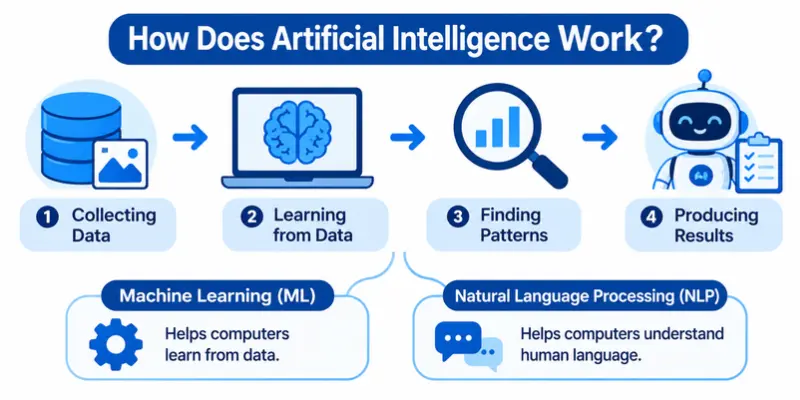
Let’s break it down into simple steps.
- Collecting Data: AI systems collect information from different sources, such as text, images, videos, and numbers.
- Learning from Data: AI studies this information to find patterns and understand how things work.
- Finding Patterns: AI uses the patterns it finds to understand information and make predictions.
- Producing Results: AI uses what it has learned to answer questions, recognize images, suggest products, or solve problems.
For example, when you ask a voice assistant about the weather, it processes your question, understands what you need, and provides a suitable answer.
Two important technologies help AI perform these tasks:
Machine Learning (ML): Machine learning is a part of AI that helps computers learn from data and improve their results without following every instruction manually. For example, Netflix uses machine learning to suggest movies and shows based on your viewing history.
Natural Language Processing (NLP): NLP helps computers understand, process, and respond to human language. For example, chatbots use NLP to understand your questions and provide helpful answers.
Together, these technologies help AI systems understand information, learn from experience, and perform tasks more effectively.
Why Is Artificial Intelligence Important?
Artificial Intelligence (AI) is important because it makes many daily tasks faster, easier, and more efficient. It helps people save time, solve problems, make better decisions, and complete work with less effort.
Today, AI plays an important role in many areas, including education, healthcare, business, transportation, and communication. It helps students learn new things, doctors study medical reports, and businesses serve their customers.
For example, AI-powered tools like ChatGPT can answer questions, explain difficult topics, and help people create content. Similarly, navigation apps use AI to find faster routes and avoid traffic.
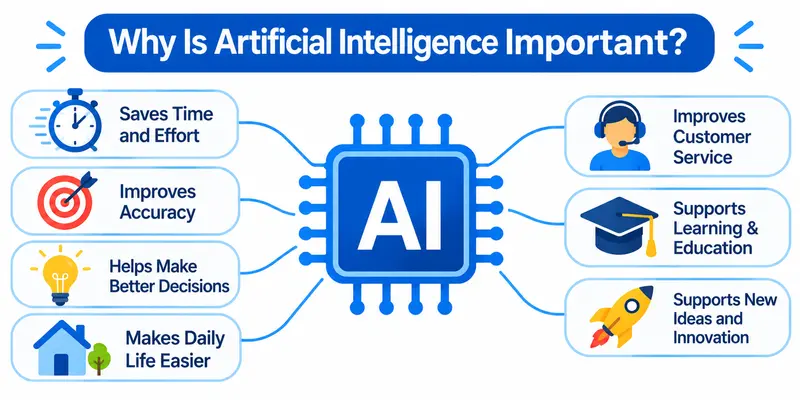
Here are some key reasons why artificial intelligence is important:
1. Saves Time and Effort
Artificial Intelligence helps people complete daily tasks faster and with less effort. It can handle repeated tasks, organize information, write emails, answer questions, and create content. This allows people to spend more time on important work instead of doing the same tasks again and again. Businesses can also use AI automation to handle repetitive tasks and improve productivity.
AI also helps businesses manage their daily activities. For example, companies use AI tools to sort customer messages, prepare reports, and manage large amounts of information. This makes work easier and saves valuable time.
Example: AI writing tools like ChatGPT help students and content writers create article drafts, write emails, and generate new ideas. They can then edit the results and add their own thoughts.
2. Improves Accuracy
AI can study large amounts of data and find patterns that people might miss. It helps reduce human errors in tasks that need careful attention. This makes it useful in areas such as healthcare, banking, education, and manufacturing.
AI tools can also check information, identify unusual activities, and support people when they need accurate results. However, AI can still make mistakes, so people should check important results before using them.
Example: Doctors use AI-powered tools to study medical images, such as X-rays and MRI scans. These tools can help identify signs of certain diseases and support doctors in making medical decisions.
3. Helps Make Better Decisions
Making good decisions often requires time, information, and careful thinking. AI helps people and businesses study data and find useful patterns. It can also make predictions and provide suggestions based on available information.
Businesses use AI to understand customer needs, study market trends, manage costs, and plan future activities. This information helps business owners make more informed decisions.
Example: Online shopping websites use AI to study customers’ search history, previous purchases, and interests. Based on this information, they recommend products that customers may want to buy.
4. Makes Daily Life Easier
AI has become a part of many everyday activities. It works behind the scenes in smartphones, social media apps, shopping websites, and navigation systems. These tools help people find information, communicate, travel, and complete daily tasks more easily.
AI also makes many digital services more personal. It learns from user activity and provides suggestions based on their interests and needs.
Example: Voice assistants like Siri and Google Assistant use AI to understand voice commands. You can ask them to set reminders, play music, check the weather, or search for information. Similarly, Google Maps uses traffic data to suggest better routes.
5. Improves Customer Service
AI helps businesses provide faster customer support. Many companies use AI chatbots to answer common questions, share product information, and guide customers through simple tasks.
Unlike human support teams, AI chatbots can handle many basic questions at the same time. They can also provide support outside normal business hours. This helps customers get quick answers without waiting for a human agent.
Example: An online shopping website may use an AI chatbot to answer questions about product prices, delivery times, payment methods, and order status. Customers can get basic information without calling customer support.
6. Supports Learning and Education
AI makes learning easier by helping students understand difficult topics and practice new skills. It can explain lessons in simple words, answer questions, create quizzes, and suggest learning materials.
Teachers can also use AI tools to prepare lesson plans, create practice questions, and organize learning activities. Students can use these tools to study at their own pace and focus on topics they find difficult.
Example: A student who struggles with mathematics can use ChatGPT to understand a difficult problem step by step. AI language tools can also help students practice English, improve grammar, and learn new words.
7. Supports New Ideas and Innovation
AI helps people explore new ideas and create things in less time. It supports creative work in areas such as writing, graphic design, music, video editing, and product development.
Businesses and researchers also use AI to test ideas, study information, and develop new solutions. It can handle time-consuming tasks and help people focus on creativity and problem-solving.
Example: Graphic designers use AI image generators to create artwork, explore different design styles, and develop ideas for websites and advertisements. They can use these images as starting points for their own creative work.
Importance of Artificial Intelligence in Different Industries
Artificial Intelligence (AI) is changing how different industries work. It helps businesses save time, reduce costs, improve services, and complete tasks more efficiently. Many industries use AI to solve problems, manage information, and make better decisions.
From healthcare and education to banking and transportation, AI offers useful solutions for everyday challenges. It also helps workers handle repeated tasks so they can focus on more important work. Explore more applications of AI to understand how this technology is changing different industries.
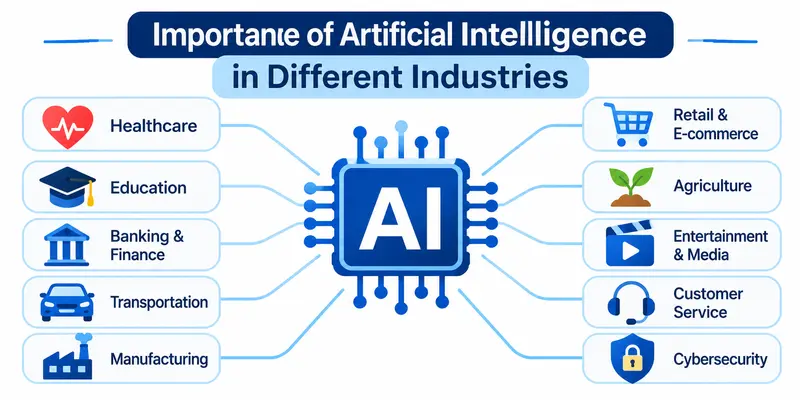
Let’s explore the importance of artificial intelligence in different industries and see how it helps people and businesses.
1. Healthcare Industry
Artificial Intelligence is making healthcare services faster and more effective. Doctors and medical teams use AI tools to study medical reports, examine images, and identify possible health problems. AI can also help hospitals manage patient records, organize appointments, and support medical research.
AI systems can study large amounts of medical information and find patterns that may be difficult to notice. This helps doctors understand a patient’s condition and make better medical decisions. However, doctors must always review AI results before making treatment decisions.
Example: AI-powered medical tools can study X-rays and MRI scans to help doctors find signs of diseases. These tools support early detection and help doctors plan the next steps for patient care.
For more information, read the World Health Organization’s guidance on AI in healthcare. It discusses the benefits, risks, and responsible use of AI in health services.
2. Education Industry
AI is changing how students learn and how teachers prepare lessons. It helps students understand difficult topics, practice new skills, and find useful study materials. Some AI learning tools can also adjust lessons based on a student’s learning needs.
Teachers can use AI to prepare lesson plans, create quizzes, check basic assignments, and organize classroom activities. This saves time and allows teachers to focus more on helping students.
Example: A student can use ChatGPT to understand a difficult science topic. It can explain the lesson in simple words, provide examples, and answer follow-up questions. This makes learning easier and more interesting.
You can also explore UNESCO’s guidance on generative AI in education and research to learn how AI can support learning while keeping human involvement important.
3. Banking and Finance Industry
The banking and finance industry uses AI to manage financial information, detect unusual activities, and improve customer services. AI systems can study thousands of transactions and identify patterns that may indicate fraud.
Banks also use AI chatbots to answer customer questions, provide basic account information, and guide users through banking services. These tools help banks respond to customers faster and manage daily operations.
Example: If someone uses your bank card for an unusual purchase, an AI-powered security system may detect the activity and alert the bank. This helps the bank investigate possible fraud and protect customer accounts.
4. Transportation Industry
AI helps make transportation safer, smarter, and more efficient. It helps navigation apps study traffic conditions, suggest better routes, and estimate travel times. Transport companies also use AI to plan delivery routes, manage vehicles, and improve traffic systems.
AI technology also supports self-driving vehicle development. These systems use cameras, sensors, and computer programs to recognize roads, detect objects, and respond to traffic conditions.
Example: Google Maps uses traffic information to suggest faster routes. If a road has heavy traffic, it may recommend another route to help you reach your destination sooner.
5. Manufacturing Industry
AI plays an important role in modern factories and manufacturing businesses. It helps companies automate repeated tasks, check product quality, and monitor machines. This makes production faster and helps reduce mistakes.
AI systems can also study machine performance and detect early signs of problems. This helps factory workers repair equipment before a major breakdown happens. As a result, businesses can reduce delays and manage production more effectively.
Example: A car factory may use AI-powered robots to assemble vehicle parts, check product quality, and complete repeated production tasks. This helps the factory produce vehicles more efficiently.
6. Retail and E-commerce Industry
AI helps online stores understand customer interests and improve the shopping experience. It studies information such as search history, previous purchases, and product views. Based on this information, it recommends products that customers may like.
Retail businesses also use AI to manage stock, predict customer demand, set suitable prices, and answer common questions through chatbots. These tools help stores manage their products and provide better customer service.
Example: Amazon uses AI-powered recommendation systems to suggest products based on customer interests and shopping activity. This helps customers discover products they may want to buy.
7. Agriculture Industry
AI is helping farmers improve crop production and manage their fields more effectively. AI-powered tools can study weather information, soil conditions, and crop images. This helps farmers understand what their crops need.
Farmers can also use AI-powered drones and sensors to monitor fields, identify crop problems, and manage water use. These tools help save resources and support better farming decisions.
Example: A farmer can use a drone with AI technology to examine crop fields. The system can help identify areas where plants show signs of disease or need more water. This allows farmers to take action before the problem spreads.
8. Entertainment and Media Industry
AI is changing how people create, watch, and enjoy digital content. Streaming platforms use AI to recommend movies, music, and videos based on user interests. Content creators also use AI tools to edit videos, create images, write scripts, and generate new ideas.
AI helps media companies understand audience interests and suggest content that people may enjoy. It also saves time by helping creators complete some editing and content tasks.
Example: Netflix uses AI-powered recommendation systems to suggest movies and TV shows based on viewing history and user preferences. This helps viewers find content they may enjoy.
9. Customer Service Industry
AI helps companies improve customer support and respond to questions quickly. Many businesses use AI chatbots and virtual assistants to handle common customer requests. These tools can provide information about products, payments, bookings, and delivery services.
AI can also help customer service teams organize messages and find useful information from customer conversations. This allows human agents to focus on difficult problems that need personal attention.
Example: An airline may use an AI chatbot to help passengers check flight information, understand baggage rules, and find booking details. Customers can get basic answers without waiting for a customer service agent.
10. Cybersecurity Industry
AI helps businesses protect their computers, networks, and important information from online threats. It can study network activity, identify unusual behavior, and alert security teams about possible attacks.
Cybersecurity teams use AI tools to detect suspicious login attempts, harmful software, and unusual data activity. These tools help them find security problems and respond more quickly.
Example: If someone tries to access a company account from an unusual location, an AI security system may identify the activity as suspicious and alert the security team. This helps the company protect its accounts and information.
Benefits of Artificial Intelligence
Artificial Intelligence (AI) offers many benefits by making daily tasks easier, faster, and more efficient.
- Saves Time: AI completes tasks quickly and reduces manual work.
- Improves Accuracy: AI helps reduce human errors and provides accurate results.
- Automates Tasks: AI handles repetitive tasks without constant human effort.
- Increases Productivity: AI helps people and businesses complete more work in less time.
- Supports Better Decisions: AI analyzes data and helps people make informed decisions.
- Works 24/7: AI systems can work day and night without taking breaks.
- Improves Healthcare: AI helps doctors detect diseases and support patient care.
- Personalizes Experiences: AI suggests products, videos, and services based on user interests.
- Enhances Learning: AI provides personalized lessons and helps students understand difficult topics.
- Boosts Customer Service: AI chatbots answer customer questions quickly and provide support.
Challenges and Limitations of Artificial Intelligence
Although Artificial Intelligence offers many benefits, it also has some challenges and limitations that can affect people and businesses. Learn more about the advantages and disadvantages of AI to understand its benefits and possible risks.
- High Costs: Developing and maintaining AI systems can be expensive.
- Job Displacement: AI automation may replace some jobs and reduce the need for human workers.
- Lack of Human Emotions: AI cannot understand human feelings and emotions like people do.
- Data Privacy Risks: AI systems may collect and process personal information, which can create privacy concerns.
- Security Risks: AI systems can be misused for scams, cyberattacks, and other harmful activities.
- Biased Results: AI may produce unfair results if it learns from biased or incomplete data.
- Dependence on Technology: Too much reliance on AI can reduce human problem-solving and critical-thinking skills.
- Limited Creativity: AI can generate ideas and content, but it does not think or create like humans.
- Lack of Human Judgment: AI may struggle with situations that require human understanding, experience, and common sense.
- Incorrect Information: AI can sometimes provide wrong or misleading answers.
To understand how organizations can identify and manage these risks, explore the NIST AI Risk Management Framework.
How Can We Use Artificial Intelligence Responsibly?
We can use Artificial Intelligence responsibly by following safe practices, protecting personal information, and keeping human judgment involved in important decisions.
- Protect Personal Information: Avoid sharing sensitive details, passwords, or private information with AI tools.
- Check AI-Generated Information: Always verify AI answers before using or sharing them.
- Avoid Misuse: Do not use AI to create fake news, scams, or harmful content.
- Respect Copyright: Use AI-generated content responsibly and respect the rights of others.
- Keep Human Control: Make sure humans review important decisions instead of depending entirely on AI.
- Use AI Fairly: Avoid using AI in ways that create discrimination or unfair treatment.
- Understand AI Limitations: Remember that AI can make mistakes and may not always provide correct answers.
- Be Transparent: Clearly mention when AI is used to create content or support important work.
- Protect Data Privacy: Choose trusted AI tools that handle personal information safely.
- Use AI for Good Purposes: Use AI to support education, healthcare, business, and other positive activities.
The OECD AI Principles provide guidance on trustworthy AI, including fairness, transparency, safety, and accountability. You can also read UNESCO’s recommendations on AI ethics to understand why human rights, privacy, and human oversight matter when using AI.
What Is the Future of Artificial Intelligence?
The future of Artificial Intelligence looks promising. AI may continue to change how people live, work, learn, and solve problems. As technology improves, AI tools may become more advanced and useful in different industries.
More Advanced AI Tools
AI tools are becoming more powerful and easier to use. In the future, they may handle more complex tasks and help people save time.
- AI tools may become smarter and more capable.
- More everyday tasks may be automated.
- AI assistants may provide better support at home and work.
- People may use AI to solve problems more easily.
Growth in Healthcare and Education
AI may bring major improvements to healthcare and education. It can help doctors, teachers, and students work more effectively.
- AI may provide more personalized learning experiences.
- AI tools may support medical research and disease detection.
- Healthcare systems may use AI to improve patient care.
- Students may use AI assistants to understand difficult topics.
More AI-Powered Businesses
Businesses may use AI more often to improve their services and manage daily activities. AI can help companies save time, reduce costs, and make better decisions.
- More workplace tasks may be automated.
- AI chatbots may provide faster customer support.
- Businesses may use AI to plan their activities.
- AI may help companies understand customer needs.
New Career Opportunities
The growth of AI may create new career opportunities in different industries. People with AI-related skills may find more ways to work and grow professionally.
- Demand for AI-related skills may increase.
- New jobs may develop in AI development and management.
- Companies may need AI experts and data specialists.
- AI education and training may become more important.
For more information, explore the IMF’s research on AI and the future of work. It discusses how AI is changing workplace skills and creating new opportunities.
Conclusion
Artificial Intelligence is becoming an important part of our daily lives. It helps us save time, improve accuracy, automate tasks, and make better decisions. From healthcare and education to business and communication, AI makes many everyday activities easier and faster.
Understanding why Artificial Intelligence is important helps us see how this technology can improve our lives and shape the future. I recommend exploring different AI tools, learning how they work, and using them responsibly to get the best results.
Want to learn more about AI? Explore our other AI guides to discover useful tools, understand new technologies, and find practical ways to use AI in your daily life. Start learning today and take your first step toward a smarter future!
Frequently Asked Questions (FAQs)
Here are some common questions about Artificial Intelligence, its importance, uses, and future.
The main purpose of Artificial Intelligence is to help machines perform tasks that usually require human intelligence. It allows computers to learn from data, solve problems, understand language, and make decisions. AI helps people complete tasks faster and handle complex work more easily.
Artificial Intelligence is important because it makes everyday activities easier and more convenient. People use AI when they search online, follow map directions, use voice assistants, and receive product recommendations. It also helps save time and improve daily productivity.
Many industries benefit from Artificial Intelligence, especially those that handle large amounts of data or repetitive tasks.
Some common examples include:
- Healthcare: Helps doctors analyze medical information.
- Education: Supports personalized learning.
- Finance: Helps detect unusual transactions.
- Transportation: Supports traffic management and route planning.
- Manufacturing: Helps monitor machines and improve production.
- Retail: Provides product recommendations and customer support.
Artificial Intelligence may become more advanced and play a bigger role in everyday life over the next 10 years. It may improve healthcare services, support personalized education, automate more business tasks, and create new career opportunities. However, responsible use, data privacy, and human control will remain important as AI technology develops.
Yes, we can live without Artificial Intelligence, but many daily tasks would become slower and less convenient. AI helps people and businesses save time and improve efficiency.
Without AI:
- Online searches may take longer.
- Businesses may need more manual work.
- Customer support may become slower.
- Healthcare services may lose useful AI tools.
- Navigation apps may provide less accurate traffic updates.
AI helps students learn faster, understand difficult topics, improve writing, and find information for research. It also supports skill development and personalized learning.
AI helps students:
- Understand complex topics.
- Improve writing skills.
- Support research.
- Practice new skills.
Artificial Intelligence helps society by improving healthcare, education, transportation, and public services. It supports doctors, helps students learn, improves traffic management, and makes everyday services faster and easier.
Artificial Intelligence makes modern life easier, faster, and more convenient. It helps people with daily tasks such as online searches, navigation, shopping, communication, and learning. AI also saves time and improves productivity.

- Be Respectful
- Stay Relevant
- Stay Positive
- True Feedback
- Encourage Discussion
- Avoid Spamming
- No Fake News
- Don't Copy-Paste
- No Personal Attacks
- Be Respectful
- Stay Relevant
- Stay Positive
- True Feedback
- Encourage Discussion
- Avoid Spamming
- No Fake News
- Don't Copy-Paste
- No Personal Attacks
