Pros and Cons of AI: Benefits, Disadvantages, and Real-Life Examples
Published: 16 Nov 2026
Is Artificial Intelligence the future, or does it bring more problems than benefits? This is a common question among students, job seekers, business owners, and people who want to learn new skills. AI offers many useful features, but it also creates risks that everyone should understand.
I will break down the pros and cons of AI in a simple way. You will learn how AI saves time, reduces manual work, supports better decisions, and creates new opportunities. At the same time, you will discover its challenges, such as job changes, privacy risks, high costs, and incorrect results.
We will cover the major benefits of AI, its main drawbacks, who should learn this skill, and whether it is worth learning in today’s world. I will also share practical examples that connect AI with everyday life.
After reading this guide, you will understand the good and bad sides of AI. You will also be able to decide whether this skill fits your needs, interests, and future plans.
Let’s explore the pros and cons of AI to make a well-informed decision.
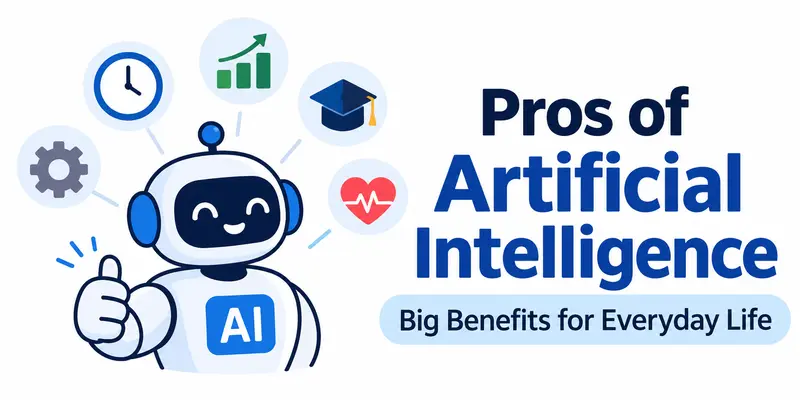
Pros of Artificial Intelligence
AI offers many benefits that make our daily lives and work easier. It helps people save time, finish tasks faster, reduce effort, and discover new career opportunities. But what makes AI so useful?
- Saves Time and Improves Productivity
- Reduces Human Errors
- Automates Repetitive Tasks
- Improves Decision-Making
- Works 24/7 Without Breaks
- Handles Large Amounts of Data
- Improves Education and Learning
- Creates New Career Opportunities
- Supports Healthcare and Medical Services
- Improves Customer Service
- Increases Business Efficiency
- Encourages Creativity and Innovation
Let’s explore the biggest pros of AI and see how they can help you.
Saves Time and Improves Productivity
One of the biggest pros of AI is that it helps people save time and get more work done. Many daily tasks take hours to complete, but AI can finish some of them in just a few minutes. For example, you can use AI to write emails, create reports, summarize long documents, and organize your work. This gives you more time to focus on important tasks.
AI also helps students, workers, and business owners improve their productivity. You can use it to plan your day, find information, and complete simple tasks faster. Instead of spending hours on repeated work, you can focus on learning new skills and reaching your goals.
Key Benefits:
- Saves time by completing tasks faster.
- Reduces manual work in daily activities.
- Improves productivity at school, work, and business.
- Helps manage tasks and daily schedules.
- Gives you more free time for important activities.
Reduces Human Errors
Another important pros of AI is its ability to reduce human errors. People sometimes make mistakes when they handle large amounts of information or repeat the same task many times. AI can check data, find missing details, and spot unusual patterns. This helps people complete many tasks with better accuracy.
For example, Businesses also use AI regression testing to identify software problems and check whether applications work correctly. Doctors can also use AI tools to help review medical images and test results. However, AI can still make mistakes, so people should always review important results before using them.
Key Benefits:
- Reduces common mistakes in repeated tasks.
- Checks information with greater consistency.
- Finds missing details in large records.
- Improves data accuracy in business activities.
- Supports better results in important tasks.
Automates Repetitive Tasks
One of the most useful pros of AI is task automation. Many people spend hours doing the same tasks every day. These tasks can include answering common questions, sorting emails, entering data, and preparing reports. AI can handle many of these activities with less manual effort.
For example, an online store can use AI to answer common customer questions, send order updates, and organize customer messages. This allows workers to spend more time helping customers and growing the business. AI automation also helps beginners manage simple tasks without doing everything by hand.
Key Benefits:
- Automates daily tasks and repeated activities.
- Reduces manual effort for workers.
- Handles customer questions automatically.
- Speeds up business operations and workflows.
- Allows workers to focus on more important tasks.
Improves Decision-Making
Making the right decision can sometimes feel difficult, especially when you have a lot of information to review. AI helps people understand data, compare different options, and find useful patterns. It can also provide suggestions that support better decisions. This makes it one of the valuable pros of AI for individuals and businesses.
For example, This process is closely related to machine learning, which helps computer systems learn patterns from data.This information can help the owner plan stock and understand customer needs. However, AI does not always give the right answer, so you should use your own knowledge and judgment before making a final decision.
Key Benefits:
- Analyzes large amounts of data quickly.
- Finds useful patterns in information.
- Compares different options to support decisions.
- Helps businesses understand customer needs.
- Supports better planning for future activities.
Works 24/7 Without Breaks
Another major pros of AI is that it can work around the clock without taking breaks. Unlike people, AI systems do not need sleep, holidays, or rest periods. They can handle tasks at any time of the day or night. This makes AI useful for businesses and services that need to support people all day.
For example, an online store can use an AI chatbot to answer customer questions at midnight, even when its staff are not available. Students can also use AI learning tools whenever they need help with a topic. However, AI services may still stop working because of technical problems, internet issues, or system maintenance.
Key Benefits:
- Provides support 24/7 without regular breaks.
- Answers customer questions at any time.
- Helps users anytime they need information.
- Supports global businesses across different time zones.
- Keeps routine services running outside normal working hours.
Improves Customer Service
One major pros of AI is that it helps businesses provide better customer service. AI chatbots can answer common questions, guide customers, and provide quick support. Customers do not need to wait for a staff member to answer every simple question. This makes the support process faster and easier.
For example, an online shopping website can use an AI chatbot to help customers track orders, check product details, and understand return policies. This allows customer service teams to focus on more difficult problems and give personal attention when needed.
Key Benefits:
- Provides quick answers to common customer questions.
- Reduces waiting time for customers.
- Offers support 24/7 through AI chatbots.
- Handles many requests at the same time.
- Improves customer experience and business support.
Supports Better Learning and Education
AI makes learning easier by helping students understand difficult topics. It can explain lessons in simple words, create practice questions, and help students find useful information. You can also use AI tools to improve your writing, learn new skills, and prepare for exams. This makes AI a helpful learning partner for beginners.
For example, a student who struggles with mathematics can ask an AI tool to explain a question step by step. The student can also request extra examples and practice questions. However, students should use AI to understand topics instead of copying answers without learning.
Key Benefits:
- Explains difficult topics in simple words.
- Creates practice questions for students.
- Supports self-learning at any time.
- Helps improve writing and language skills.
- Provides learning support based on individual needs.
Helps Businesses Reduce Costs
Another useful pros of AI is that it can help businesses reduce some operating costs. AI can automate routine work, manage customer questions, and process large amounts of data. This can reduce the need for manual work on certain tasks. Businesses can then use their time and resources more effectively.
For example, a small online store can use an AI chatbot to answer common questions instead of asking staff to handle every message. A business can also use AI to organize records and prepare basic reports. However, AI tools may require payment, setup, and regular maintenance.
Key Benefits:
- Reduces manual work in daily operations.
- Saves time and resources on routine tasks.
- Automates common activities in business.
- Helps manage customer support more efficiently.
- Supports better use of business resources.
Improves Healthcare Services
AI is also changing how healthcare workers provide medical services. It can help doctors review medical images, study health records, and find patterns in patient data. These tools can support medical teams and help them manage information more quickly. However, doctors must use their training and judgment when they make medical decisions.
For example, some AI systems can help doctors examine X-rays and MRI scans for signs of possible health problems. AI can also help hospitals organize patient records and manage appointments. It supports healthcare workers, but it does not replace professional medical care.
Key Benefits:
- Helps review medical images and health data.
- Supports early detection of possible health problems.
- Organizes patient information more efficiently.
- Helps hospitals manage daily tasks.
- Supports doctors during medical assessments.
Creates New Career Opportunities
One of the biggest pros of AI is that it creates new career opportunities. As more businesses use AI, they need people who can build, manage, test, and work with AI tools. This creates demand for skills in areas such as machine learning, data analysis, AI development, and automation. You do not need to master everything at once. You can start with basic knowledge and improve your skills step by step.
For example, beginners can explore AI content tools, data annotation, AI testing, or basic automation. People with strong technical skills can also work toward roles such as AI engineer or machine learning engineer. The right path depends on your interests, education, and learning goals.
Key Benefits:
- Creates new job roles in the technology industry.
- Offers freelance opportunities in AI-related work.
- Supports career growth in different fields.
- Encourages new skills and continuous learning.
- Opens new business opportunities for skilled people.
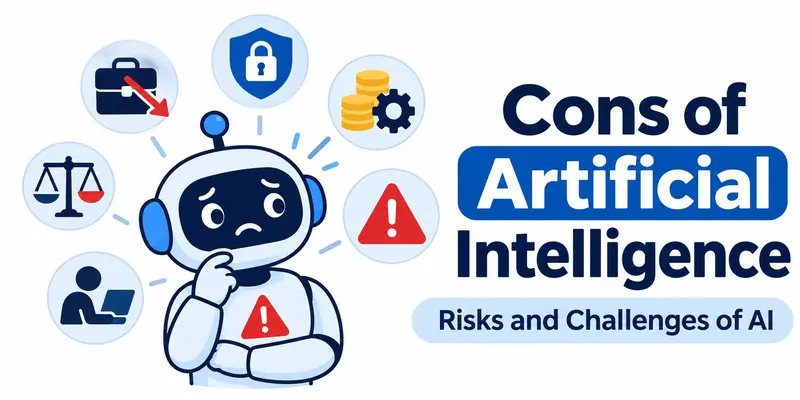
Cons of Artificial Intelligence
Every technology has two sides, and AI is no exception. It can make work easier, improve productivity, and support learning. However, it can also create problems in daily life and the workplace. So, what are the negative sides of this technology?
- Job Loss and Unemployment
- High Development and Maintenance Costs
- Privacy and Data Security Risks
- Dependence on Technology
- Biased and Unfair Results
- Limited Human Judgment
- Risk of Wrong Information
- Security Threats and Cybercrime
- Lack of Transparency
- Ethical and Legal Issues
Let’s discover the most important disadvantages of AI.
Job Loss and Unemployment
One of the major cons of AI is that it can reduce the need for human workers in some jobs. Many businesses now use machines and computer programs to complete tasks that people once handled. This change can affect beginners who want to start their careers in fields like customer service, data entry, and basic office work. When a company automates these tasks, it may need fewer employees. As a result, some workers may lose their jobs or struggle to find new opportunities.
AI can also change the skills that employers expect from workers. Some jobs may disappear, while new roles may require technical knowledge and training. For example, a company may use a chatbot to answer common customer questions instead of hiring more support staff. This does not mean AI will replace every worker, but it does mean people need to keep learning and improving their skills.
Key Points:
- Reduces job opportunities in some industries.
- Replaces certain routine tasks that people once performed.
- Creates challenges for beginners entering the job market.
- Changes workplace skills and employer requirements.
- Increases the need for learning and career development.
High Development and Maintenance Costs
Another important cons of AI is its high cost. Building an AI system often requires skilled developers, powerful computers, special software, and large amounts of data. Small businesses and beginners may find these costs difficult to manage. They may not have enough money or technical knowledge to build and operate their own systems. This can make it harder for them to use advanced technology.
The costs do not stop after development. Businesses also need to update their systems, fix technical problems, protect data, and pay for ongoing services. For example, a small online store may want to use an advanced AI customer service system, but the setup and monthly fees may exceed its budget. Before choosing an AI solution, businesses should compare its cost with the value it can provide.
Key Points:
- Requires expensive equipment and computing resources.
- Involves development costs for skilled professionals.
- Needs regular updates and technical support.
- Creates extra expenses for small businesses.
- May require paid services and monthly subscriptions.
Privacy and Data Security Risks
One serious cons of AI is the risk to personal information. Many AI tools collect and process data to provide useful results. This data may include names, email addresses, photos, business records, and other private details. If people share sensitive information without checking how a tool handles it, they may put their privacy at risk. Beginners should understand these risks before using AI tools for personal or professional tasks.
Data security also matters because criminals may target systems that store private information. A security breach can expose customer details, financial records, or company information. For example, an employee may upload private customer records to an online tool without permission. This can create serious problems for both the business and its customers. Always check a tool’s privacy policy and avoid sharing sensitive information unless you have permission and understand how the service protects it.
Key Points:
- Puts personal information at risk when users share it carelessly.
- Creates data security concerns for individuals and businesses.
- May expose private records during a security breach.
- Requires careful data handling and strong security rules.
- Needs user awareness about privacy settings and permissions.
Dependence on Technology
Another common cons of AI is that people may become too dependent on technology. Many users rely on AI tools to write, solve problems, find information, and complete daily tasks. This can reduce their effort to think independently and develop their own skills. Beginners may also struggle when they use AI to complete every task instead of learning how to do the work themselves. Over time, this habit can affect their confidence and problem-solving ability.
Technology can also create problems when systems stop working. For example, a business that depends completely on an automated system may struggle during an internet outage or technical failure. Students may also face difficulties when they cannot access the tools they normally use. We should treat AI as a helpful assistant, not as a replacement for our own knowledge and abilities.
Key Points:
- Reduces independent thinking when people rely on tools too much.
- Weakens learning habits if users avoid practicing skills.
- Creates problems when systems stop working.
- Increases reliance on internet access and digital services.
- Can reduce confidence in completing tasks without technology.
Biased and Unfair Results
One major cons of AI is that it can produce biased or unfair results. AI systems learn from data that people collect and provide. If that data contains unfair patterns or missing information, the system may repeat those problems. This can lead to decisions that treat some people unfairly. Beginners should understand that AI results do not always provide a fair or balanced answer.
For example, The quality of training data plays an important role in AI results. Data annotation helps prepare and label data for AI training. If the system learns from past hiring data that favors certain groups, it may unfairly rank other qualified applicants lower. This can create problems in hiring, education, banking, and other important areas. People should check AI decisions carefully and make sure human judgment plays an important role.
Key Points:
- Produces unfair results when training data contains bias.
- Repeats human biases found in existing information.
- Can affect hiring decisions and other important choices.
- May treat people differently based on incomplete or unfair data.
- Needs human review to identify and correct unfair results.
Limited Human Judgment
One important cons of AI is that it cannot use human judgment in the same way people do. AI systems follow patterns, rules, and information from their training data. They can process information and suggest possible solutions, but they may not fully understand human feelings, personal situations, or complex problems. This can create difficulties for beginners who trust every suggestion without checking it. Some decisions need human understanding, experience, and common sense.
For example, an AI customer service tool may give the same answer to every customer, even when someone needs special help. A human worker can listen to the customer’s situation and choose a more suitable response. AI can support decision-making, but people should make the final choice in situations that require care, understanding, or personal judgment.
Key Points:
- Lacks human understanding of feelings and personal situations.
- May miss important details in complex problems.
- Cannot replace human experience in every situation.
- May give unsuitable suggestions for special cases.
- Needs human guidance for important decisions.
Risk of Wrong Information
Another serious cons of AI is that it can provide incorrect information. AI tools sometimes create answers that sound clear and confident but contain mistakes. Beginners may find it difficult to notice these errors, especially when they do not know much about the topic. This can lead people to trust information that does not match the facts. So, you should never treat every AI answer as correct.
For example, a student may ask an AI tool to explain a science topic and receive an answer with incorrect facts. A business owner may also use an AI-generated report without checking its details. These mistakes can cause confusion and poor decisions. Always compare important information with trusted sources before you use it in your studies, work, or business.
Key Points:
- Provides incorrect answers on some topics.
- Creates misleading information that sounds believable.
- Confuses beginners who cannot easily check the facts.
- Can affect important decisions in education and business.
- Requires fact-checking before people use its answers.
Security Threats and Cybercrime
One of the serious cons of AI is that criminals can misuse it for harmful activities. They may use AI tools to create fake messages, copy someone’s voice, or produce realistic images and videos. These tricks can make online scams harder to recognize. Beginners may struggle to identify fake content because it can look or sound real. This creates new risks for individuals, businesses, and online users.
For example, a criminal may create a fake voice message that sounds like a family member and ask someone to send money. Criminals can also use automated messages to target many people with scams. We should stay careful when we receive unusual requests, even when a message seems to come from someone we know. Always verify a person’s identity before sharing money or private information.
Key Points:
- Creates realistic fake content that criminals can misuse.
- Supports online scams through fake messages and voices.
- Increases phishing risks for individuals and businesses.
- Makes fraud harder to identify in some situations.
- Requires stronger security awareness from online users.
Lack of Transparency
Another major cons of AI is its lack of transparency. Some AI systems make decisions without clearly explaining how they reach their results. This can make it difficult for users to understand why a system gives a particular answer or recommendation. Beginners may find this confusing because they cannot always see which information influenced the result. This creates a problem when people need clear reasons behind important decisions.
For example, a bank may use an AI system to review loan applications. If the system rejects an application without giving a clear reason, the customer may not understand what went wrong. This can also make it harder for people to find and correct mistakes. Businesses should choose systems that provide clear explanations and allow people to review important decisions.
Key Points:
- Makes some decisions difficult to understand.
- Does not always explain how it reaches a result.
- Creates confusion when users cannot find clear reasons.
- Makes errors harder to identify in some systems.
- Requires clear explanations for important decisions.
Ethical and Legal Issues
One important cons of AI is that it can create ethical and legal problems. People and businesses may use AI in ways that harm others or break rules. For example, someone may create fake images of another person without permission or use private information in an unfair way. These actions can affect people’s rights, safety, and reputation. Beginners should understand that using AI tools also comes with responsibility.
AI can also create questions about ownership, copyright, fairness, and responsibility. For example, a business may use AI-generated content without checking whether it copies protected work. Another problem may occur when an AI system makes a harmful decision and people disagree about who should take responsibility. Users and businesses should follow relevant laws, respect privacy, and use AI in an honest way.
Key Points:
- Creates privacy and copyright concerns when people misuse information.
- Raises questions about ownership of AI-generated content.
- Can support unfair practices in different industries.
- Creates responsibility issues when systems cause harm.
- Requires responsible use and respect for laws and people’s rights.
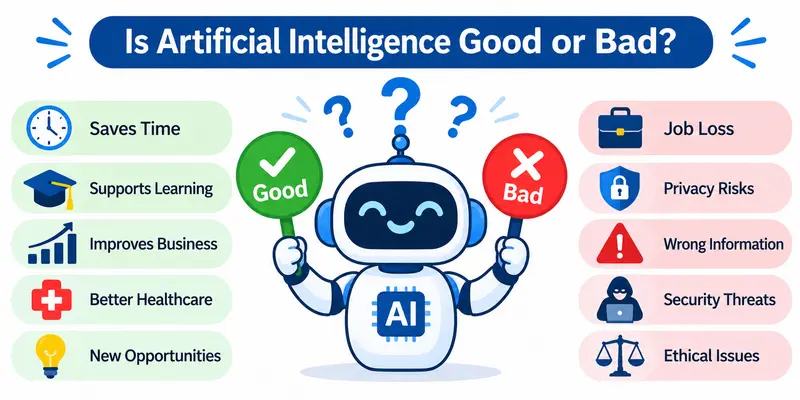
Is Artificial Intelligence Good or Bad?
After learning about the pros and cons of AI, you may wonder whether artificial intelligence is good or bad. The truth is that AI has both positive and negative sides. It can make our daily lives easier, help us learn new skills, and improve our work. However, it can also create problems such as job loss, privacy risks, and wrong information. Let’s look at both sides to understand it better.
- AI Makes Daily Tasks Easier: It helps people save time and complete everyday activities with less effort.
- AI Supports Learning: Students can use it to understand difficult topics, practice questions, and learn new skills.
- AI Improves Business Work: Businesses can use it to manage tasks, serve customers, and study useful information.
- AI Creates Job Challenges: Some companies may use machines and software instead of hiring people for certain tasks.
- AI Can Share Wrong Information: It may provide incorrect answers, so people should check important facts.
- AI Can Affect Privacy: Sharing personal or sensitive information with online tools can create privacy risks.
- AI Supports Better Healthcare: It can help medical teams review information and support patient care.
- AI Can Create Security Problems: Criminals may use it to create fake messages, images, and voices.
- AI Needs Human Control: People must review important results and make decisions with their own judgment.
- AI Creates New Opportunities: It can open new career paths for people who learn useful skills and use technology responsibly.
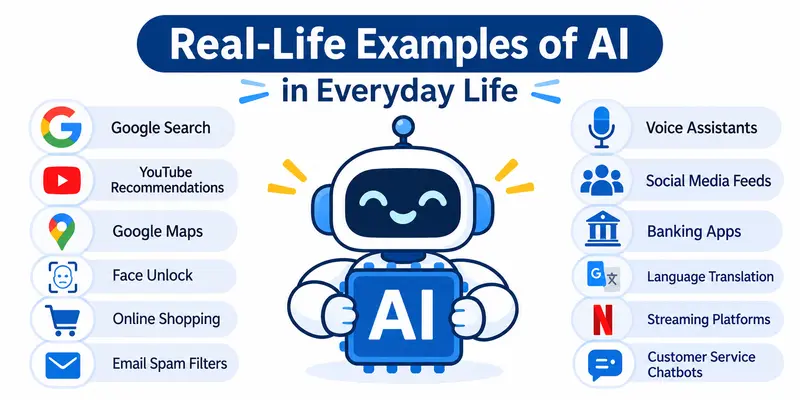
Real-Life Examples of AI in Everyday Life
You may use AI every day without even realizing it. From searching for information to watching videos and shopping online, AI plays a role in many daily activities. It helps apps understand what you need and makes different tasks easier. You do not need special knowledge to see its benefits because many common apps already use it. To understand the technology behind these examples, read our guide on how AI works. Let’s look at some simple real-life examples of AI in everyday life.
- Google Search: Helps you find useful information by understanding your search words and showing relevant results.
- YouTube Recommendations: Suggests videos based on your viewing history and interests.
- Google Maps: Checks traffic conditions and suggests suitable routes to help you reach your destination.
- Smartphone Face Unlock: Uses facial recognition to identify your face and unlock your phone.
- Online Shopping: Recommends products based on your searches, interests, and previous purchases.
- Email Spam Filters: Detect unwanted emails and move many of them into your spam folder.
- Voice Assistants: Tools like Siri and Google Assistant respond to voice commands and help you perform simple tasks.
- Social Media Feeds: Shows posts, videos, and content based on your activity and interests.
- Banking Apps: Help banks detect unusual transactions and identify possible fraud.
- Language Translation: Tools like Google Translate help you understand words and sentences in different languages.
- Streaming Platforms: Netflix and other services suggest movies and shows based on your viewing habits.
- Customer Service Chatbots: Answer common questions and help customers find information without waiting for a support agent.
The Future of Artificial Intelligence
Artificial intelligence is growing fast and changing how people live, work, and learn. In the coming years, AI may become an even bigger part of our daily lives. Businesses, schools, hospitals, and many other industries will continue to explore new ways to use it. This growth may create exciting opportunities, but it may also bring new challenges. Let’s explore what the future of artificial intelligence may look like.
- More AI in Daily Life: People may use AI more often for shopping, communication, learning, and everyday tasks.
- Changes in Jobs: AI may automate more routine tasks, while businesses may create new roles that require different skills.
- Better Healthcare: AI may help medical teams study health information, support research, and improve patient care.
- Smarter Education: Students may get more personalized learning support based on their needs and progress.
- Growth in Business: Companies may use AI to improve customer service, manage work, and make better decisions.
- Self-Driving Technology: More companies may develop vehicles that use AI to understand roads and respond to traffic.
- Stronger Security Systems: AI may help detect online threats, identify unusual activity, and protect digital information.
- New Career Opportunities: People with skills in AI, data analysis, automation, and software development may find new career paths.
- More Privacy Concerns: The growing use of AI may increase the need for stronger data protection and clear privacy rules.
- Responsible AI Use: Governments and businesses may create better rules to reduce harmful uses and protect people’s rights.
Conclusion
We’ve explored the Pros and Cons of AI and how it affects our daily lives. AI helps us save time, improve productivity, reduce mistakes, and complete many tasks more easily. It also creates challenges such as job loss, privacy risks, wrong information, and security problems. Understanding both sides helps us make better decisions about using this technology.
In my opinion, AI is worth learning if you enjoy technology, want to improve your skills, or hope to explore new career opportunities. You do not need to become an expert overnight. Start with basic concepts, practice with simple tools, and focus on skills that match your goals. Most importantly, stay consistent and always use AI with care and good judgment.
Do not stop learning here! Explore more beginner-friendly AI guides on our website and put your knowledge into practice. If you have any questions or thoughts about the benefits and challenges of AI, share them in the comments. We’d love to hear your opinion!
FAQs
Do you still have questions about the pros and cons of AI? You are not alone. Many beginners want to know how AI works, how it affects jobs, and whether it is safe to use. We have answered some common questions below to help you understand AI better and make informed decisions.
The main pros of AI include saving time, improving productivity, reducing mistakes, and helping people learn new skills. However, AI also has cons, such as job loss, privacy risks, high costs, and wrong information. Both sides matter when we decide how to use this technology.
Beginners can start learning AI by understanding basic concepts and trying simple tools. You do not need advanced technical skills at the beginning.
Here are a few simple steps:
- Learn what AI is and how it works.
- Explore beginner-friendly AI tools.
- Practice with small daily tasks.
- Learn basic skills like data analysis or coding as you progress.
AI is important because it helps people and businesses complete many tasks faster and more easily. It supports areas such as education, healthcare, banking, shopping, and customer service. Many people also use AI tools to find information, write content, and solve everyday problems.
No, AI cannot replace every human job. It can handle some repeated tasks, but many jobs still need human judgment, communication, creativity, and problem-solving skills.
People can prepare for workplace changes by:
- Learning useful digital skills.
- Improving communication and problem-solving.
- Understanding how to use AI tools.
- Building skills that need human judgment.
Businesses should use AI when it can solve a clear problem, save time, or improve daily work. It can help with customer support, data analysis, marketing, and repeated tasks.
Before choosing a tool, businesses should check its cost, accuracy, privacy features, and value. They should also let people review important results.
The biggest risks include privacy problems, wrong information, unfair results, job changes, and online security threats. These problems can affect both individuals and businesses.
People should check important information, protect personal data, and avoid trusting every result without review. Responsible use can help reduce these risks.
We can use AI responsibly by checking its results, protecting private information, and keeping human judgment in important decisions.
Follow these simple practices:
- Check facts before using the information.
- Avoid sharing sensitive details.
- Respect other people’s privacy and work.
- Review important decisions yourself.
- Follow the rules of the tools you use.
Yes, AI can be a good career choice if you enjoy technology, problem-solving, and continuous learning. It offers different paths, such as AI development, data analysis, machine learning, and AI testing.
Start with basic computer skills and learn one area at a time. Choose a path that matches your interests, practice regularly, and build small projects to improve your skills.
AI tools may create privacy risks when you share personal information. Always protect your private details.
- Never share passwords or bank details.
- Avoid uploading private documents.
- Check the tool’s privacy policy.
- Review your privacy settings.
Healthcare, education, banking, retail, and transport benefit from AI in different ways.
- Healthcare: Supports doctors.
- Education: Helps students learn.
- Banking: Detects unusual transactions.
- Retail: Recommends products.
- Transport: Helps plan routes.

- Be Respectful
- Stay Relevant
- Stay Positive
- True Feedback
- Encourage Discussion
- Avoid Spamming
- No Fake News
- Don't Copy-Paste
- No Personal Attacks
- Be Respectful
- Stay Relevant
- Stay Positive
- True Feedback
- Encourage Discussion
- Avoid Spamming
- No Fake News
- Don't Copy-Paste
- No Personal Attacks
