Supervised Learning vs Unsupervised Learning: What Is the Difference?
Published: 19 Nov 2026
Have you ever read about machine learning and felt confused about its different learning methods? You are not alone. Many beginners ask, what is the difference between supervised learning vs unsupervised learning? Both methods help computers learn from data, but they work in different ways.
Understanding supervised learning vs unsupervised learning can help you choose the right method for a task. It can also help you understand how AI tools make predictions, discover patterns, and solve problems. In this guide, we compare both methods using 10 important factors, real-life examples, common algorithms, and beginner-friendly explanations.
Let’s start with the basics to understand supervised learning vs unsupervised learning more clearly.
What Is Supervised Learning?
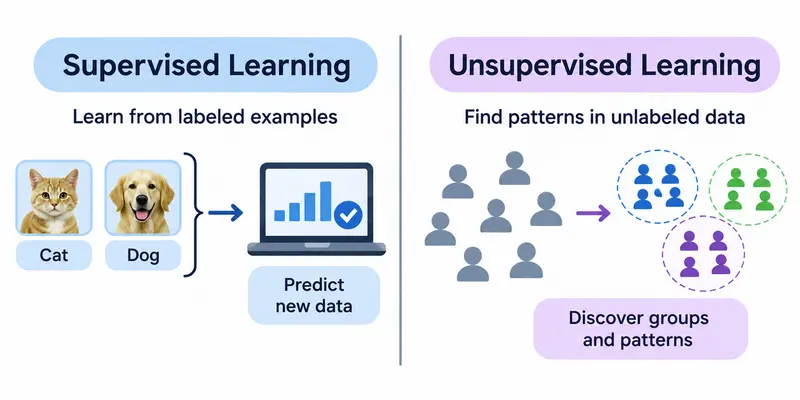
Supervised learning teaches a computer using examples that already have correct answers. We call those answers labels. For example, a photo of a cat can carry the label “cat.”
The goal is to predict the right answer for new data. A spam filter is a common example. It learns from emails marked as spam or not spam and uses that knowledge to identify new messages.
Supervised learning is useful when you have labeled data and want to predict a specific result.
What Is Unsupervised Learning?
Unsupervised learning gives a computer data without correct answers or labels. The computer studies the data and looks for patterns, similarities, or groups.
For example, a store can use unsupervised learning to group shoppers who buy similar products. It does not need pre-defined customer groups. The model finds similarities in the data.
Unsupervised learning is useful when you want to explore data and discover patterns you may not know about.
Key Differences Between Supervised Learning vs Unsupervised Learning
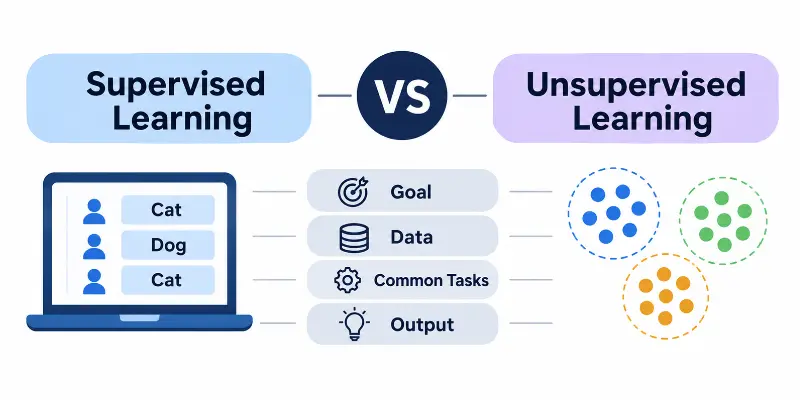
Supervised learning and unsupervised learning both help computers learn from data. However, they use different approaches. Understanding supervised learning vs unsupervised learning becomes easier when you compare their learning process, data, goals, tasks, and results.
We will compare both methods using these 10 factors:
- Learning Process
- Type of Data
- Main Goal
- Human Effort
- Common Tasks
- Checking Results
- Common Algorithms
- Ease for Beginners
- Type of Output
- Common Challenges
Let’s examine each factor to understand supervised learning vs unsupervised learning in detail.
Learning Process
The learning process explains how a computer learns from data and improves its results. Supervised learning and unsupervised learning follow different learning processes.
This is one of the most important differences in supervised learning vs unsupervised learning because it explains how each method learns.
Supervised Learning
Supervised learning learns by comparing its predictions with correct answers.
- Learns from answers: The computer receives examples with correct labels.
- Checks its guesses: It compares predicted answers with actual answers.
- Corrects mistakes: It adjusts its model to improve future predictions.
- Follows a clear target: The correct answer is known before training starts.
Unsupervised Learning
Unsupervised learning learns by studying the data itself.
- Learns without answers: The data has no labels.
- Finds patterns: It looks for similar items and repeated structures.
- Has no answer sheet: It does not receive correct answers during training.
- Needs human interpretation: People often decide what the discovered patterns mean.
What Makes Them Different?
Supervised learning learns from known answers, while unsupervised learning discovers patterns without labeled answers. In supervised learning vs unsupervised learning, the main difference is how the model receives information during training.
Type of Data
Data is the information a computer uses to learn. It can include numbers, words, images, sounds, or records. The type of data often determines which machine learning method you can use.
Data is an important part of supervised learning vs unsupervised learning because one method needs labeled data while the other can work with unlabeled data.
Supervised Learning
Supervised learning needs data that includes correct answers.
- Labeled data: Each example has a label, such as “spam” or a house price.
- Input and output pairs: The computer receives information and its correct answer.
- Labels come from people or records: Someone must label the data or collect existing results.
- Data quality matters: Incorrect labels can teach the model incorrect patterns.
Unsupervised Learning
Unsupervised learning works with data that has no answers attached.
- Unlabeled data: Raw data goes into the model without labels.
- Inputs only: There are no matching answers.
- Often easier to collect: Raw data may already exist without a labeling process.
- Data quality still matters: Missing or messy data can affect the discovered patterns.
What Makes Them Different?
Supervised learning uses labeled data, while unsupervised learning uses unlabeled data. When comparing supervised learning vs unsupervised learning, check your data first. If you already have labels, supervised learning may be a good choice. If you have raw data, unsupervised learning may help you explore it.
Main Goal
Every machine learning project needs a clear goal. Some projects predict future results, while others explore data to discover useful information.
The main goal helps explain supervised learning vs unsupervised learning and why both methods are useful for different problems.
Supervised Learning
Supervised learning aims to predict a known answer.
- Predicts outcomes: It guesses results for new data.
- Sorts items into classes: It can identify spam or non-spam emails.
- Estimates numbers: It can predict house prices or temperatures.
- Answers a defined question: You know what you want to predict before training.
Unsupervised Learning
Unsupervised learning aims to discover patterns and structure in data.
- Finds hidden groups: It places similar items together.
- Reveals patterns: It discovers relationships between different records.
- Simplifies data: It can reduce complex information into fewer features.
- Supports open questions: It helps explore data when the answer is not already known.
What Makes Them Different?
Supervised learning predicts known answers, while unsupervised learning discovers hidden patterns. The difference between supervised learning vs unsupervised learning becomes clear when you look at the purpose of a project. One predicts a result, while the other explores information.
Human Effort
People play an important role in machine learning projects. They prepare data, choose models, and review results. However, supervised learning and unsupervised learning require different types of human effort.
Human effort is another important factor in supervised learning vs unsupervised learning because it can affect the time, cost, and work required to complete a project.
Supervised Learning
Supervised learning often needs human effort before training begins.
- Labeling takes work: Someone must tag the training examples.
- Experts may be needed: Some labels require special knowledge, such as medical information.
- Existing records can help: Past sales or results may already contain answers.
- Labels need care: Incorrect labels can lead to poor predictions.
Unsupervised Learning
Unsupervised learning often requires human effort after the model runs.
- No labeling step: You do not need to tag every example.
- Results need reviewing: A person must study the groups and patterns.
- Naming takes judgment: People decide what each group represents.
- Topic knowledge helps: Understanding the subject helps identify useful patterns.
What Makes Them Different?
Supervised learning often requires people to label data before training. Unsupervised learning often requires people to interpret results after training. In supervised learning vs unsupervised learning, human effort depends on the type of work each method needs.
Common Tasks
Machine learning models perform different tasks depending on the problem. Some models classify information, others predict numbers, and some discover groups.
Understanding common tasks makes supervised learning vs unsupervised learning easier to understand.
Supervised Learning
Supervised learning performs tasks that predict labels or numbers.
- Classification: The model predicts a category, such as spam or not spam.
- Regression: The model predicts a number, such as a house price.
- Forecasting: The model uses past information to predict future results.
- Probability scoring: The model estimates how likely an item belongs to a category.
Unsupervised Learning
Unsupervised learning performs tasks that discover patterns and relationships.
- Clustering: The model groups similar items.
- Association: The model finds items that often appear together.
- Dimensionality reduction: The model reduces the number of data features while keeping important information.
- Anomaly detection: The model identifies unusual data points.
What Makes Them Different?
Supervised learning predicts labels or numbers, while unsupervised learning groups, connects, or simplifies data. When studying supervised learning vs unsupervised learning, remember that their tasks depend on the type of problem you want to solve.
Checking Results
Checking results helps you understand whether a machine learning model performs well. You need a way to measure its performance and identify mistakes.
The way you check results is another difference between supervised learning vs unsupervised learning.
Supervised Learning
Supervised learning has known answers, so checking results is more direct.
- Compare with known answers: You test predictions against actual results.
- Use clear scores: Accuracy measures classification performance, while error measures help evaluate numerical predictions.
- Spot weak areas: You can identify the types of mistakes the model makes.
- Track progress: You can compare different models using the same measures.
Unsupervised Learning
Unsupervised learning has no answer key, so checking results requires more thought.
- No simple right answer: You cannot always count correct predictions.
- Use group quality measures: Some measures help evaluate how well groups are separated.
- Check whether results make sense: People judge whether discovered patterns are useful.
- Test in practice: You can see whether the patterns support real decisions.
What Makes Them Different?
Supervised learning checks predictions against known answers, while unsupervised learning uses quality measures and human judgment. In supervised learning vs unsupervised learning, the evaluation process depends on whether correct answers are available.
Common Algorithms
An algorithm is a set of steps a computer follows to solve a problem. Machine learning algorithms use different approaches to learn from data.
Algorithms help explain supervised learning vs unsupervised learning because each method uses algorithms designed for different tasks.
Supervised Learning
Supervised learning uses several well-known algorithms.
- Linear regression: Predicts numbers using relationships between variables.
- Logistic regression: Predicts categories, such as yes or no.
- Decision trees: Use a series of questions to reach a prediction.
- Support vector machines: Find boundaries that separate different categories.
Unsupervised Learning
Unsupervised learning also uses several well-known algorithms.
- K-means clustering: Divides data into a chosen number of groups.
- Hierarchical clustering: Creates groups through a step-by-step process.
- Principal component analysis (PCA): Reduces data to its most important features.
- Apriori: Finds items that frequently appear together.
What Makes Them Different?
Supervised algorithms learn from labeled examples, while unsupervised algorithms learn from patterns and structure in the data. Understanding algorithms is useful when learning supervised learning vs unsupervised learning because it helps you choose the right model for your task.
Ease for Beginners
Many beginners want to know which machine learning method is easier to learn. Both methods can be beginner-friendly, but they offer different learning experiences.
Ease of learning is another factor in supervised learning vs unsupervised learning because beginners may prefer clear feedback or simple data exploration.
Supervised Learning
Supervised learning often feels easier to understand at the beginning.
- Clear goal: You know what the model should predict.
- Clear feedback: Performance scores show how well it works.
- Practice data is available: Many labeled datasets exist for beginners.
- Extra preparation: Labeling and cleaning data can take time.
Unsupervised Learning
Unsupervised learning can be easy to run but harder to understand.
- Easy to start: You can run clustering algorithms on raw data.
- Fewer labeling steps: You do not need to label every example.
- Harder to judge: There is no answer key to check predictions.
- Needs more judgment: You must interpret and explain the discovered patterns.
What Makes Them Different?
Supervised learning provides clearer feedback, while unsupervised learning can explore data without labels. When comparing supervised learning vs unsupervised learning as a beginner, supervised learning may be easier to follow because its results are easier to measure.
Type of Output
Output is the result a machine learning model produces. It can be a label, a number, a group, or a pattern.
The type of output helps explain supervised learning vs unsupervised learning and how you can use each model in a real application.
Supervised Learning
Supervised learning provides predictions for individual data points.
- A label: It identifies the category of an item.
- A number: It predicts a value, such as a price.
- A score: It may estimate how likely a prediction is correct.
- Ready for action: Its predictions can support applications such as email filters.
Unsupervised Learning
Unsupervised learning provides information about the structure of data.
- Groups: It shows which items are similar.
- Patterns: It reveals relationships between data points.
- Simplified data: It can provide a smaller representation of complex information.
- Needs human interpretation: People often decide what the discovered patterns mean.
What Makes Them Different?
Supervised learning gives predictions for individual items, while unsupervised learning reveals the structure of a dataset. In supervised learning vs unsupervised learning, the output depends on whether you need a prediction or an understanding of your data.
Common Challenges
Every machine learning method has challenges. Problems can come from data quality, model performance, time, or the way people interpret results.
Understanding these challenges can help you make better decisions when choosing supervised learning vs unsupervised learning.
Supervised Learning
Supervised learning faces several common challenges.
- Labeling cost: Preparing labeled data can take time and money.
- Biased or incorrect labels: The model may learn mistakes from its training data.
- Overfitting: The model may memorize training examples and perform poorly on new data.
- Need for fresh data: Changing conditions may require new labeled examples.
Unsupervised Learning
Unsupervised learning faces its own challenges.
- Hard to judge: There is no simple answer key.
- Unclear results: Discovered groups may not have useful real-life meaning.
- Sensitive to setup: Model settings can change the results.
- Data quality problems: Noisy or incomplete data can create misleading patterns.
What Makes Them Different?
Supervised learning often struggles with labeling costs and prediction errors, while unsupervised learning can struggle with unclear or difficult-to-interpret patterns. The challenges of supervised learning vs unsupervised learning depend on the data, model, and project goals.
Supervised Learning vs Unsupervised Learning: Comparison Table
The following table summarizes the main differences between supervised learning vs unsupervised learning. Use it as a quick reference to understand both methods.
| Comparison Factor | Supervised Learning | Unsupervised Learning | Main Difference |
| Learning Process | Learns from known answers | Finds patterns | Answers vs patterns |
| Type of Data | Labeled data | Unlabeled data | With vs without labels |
| Main Goal | Predict a known answer | Discover structure | Predict vs explore |
| Human Effort | Labeling before training | Reviewing results after training | Early vs later effort |
| Common Tasks | Classification, regression | Clustering, association | Predict vs group |
| Checking Results | Compare with answers | Measures and judgment | Clear scores vs judgment |
| Common Algorithms | Decision trees, linear regression | K-means, PCA | Label-based vs pattern-based |
| Ease for Beginners | Clear feedback, more preparation | Easy to run, harder to judge | Clear scores vs exploration |
| Type of Output | Labels, numbers, scores | Groups, patterns | Predictions vs structure |
| Common Challenges | Labeling cost, overfitting | Unclear results | Cost vs interpretation |
How Supervised and Unsupervised Learning Work
You can also learn how AI works to understand how computers process information and use it to produce results.
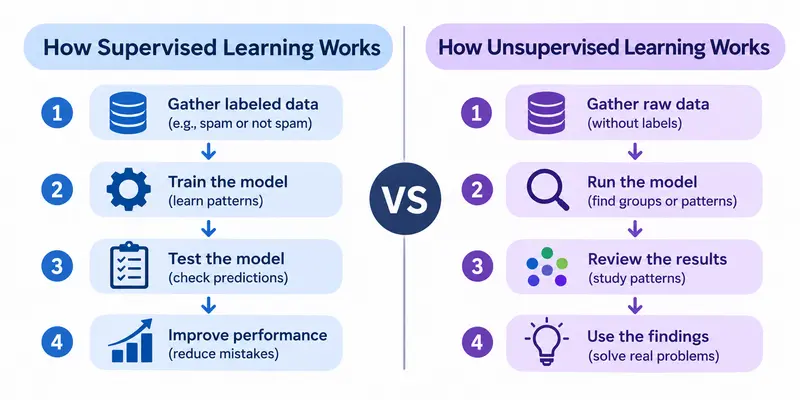
How Supervised Learning Works
- Gather labeled data: Collect examples with correct answers, such as emails marked as spam or not spam.
- Train the model: The model studies the examples and learns patterns.
- Test the model: Check how well it predicts answers using new data.
- Improve performance: Adjust the model to reduce mistakes.
How Unsupervised Learning Works
- Gather raw data: Collect information without labels, such as customer shopping records.
- Run the model: The model searches for groups, similarities, or patterns.
- Review the results: Study the discovered groups or patterns.
- Use the findings: Apply useful discoveries to real problems.
Both methods follow different steps, which is another reason supervised learning vs unsupervised learning matters when planning a machine learning project.
Real-Life Examples of Supervised Learning vs Unsupervised Learning
Real-life examples make machine learning easier to understand. Here are some examples that show supervised learning vs unsupervised learning in everyday situations.
Supervised Learning Examples
- Spam filter: Emails marked as spam teach the model to identify new spam messages.
- House price prediction: Past sales with prices help the model estimate new house prices.
- Handwriting recognition: Images of digits with labels help the model recognize handwritten numbers.
- Weather prediction: Past weather information helps predict future conditions.
Unsupervised Learning Examples
- Customer grouping: A store groups customers with similar shopping habits.
- Product recommendations: A shop discovers products that customers often buy together.
- Unusual activity detection: A system finds records that look different from normal patterns.
- Data exploration: A researcher discovers hidden relationships in a large dataset.
Machine learning is also used in many industries, including the beauty industry, healthcare, education, and retail.
Which Learning Method Is Better?
Neither method is better in every situation. The right choice depends on your data, goals, and the problem you want to solve.
When choosing between supervised learning vs unsupervised learning, consider these points:
- Start with your question: If you want to predict something, supervised learning may fit. If you want to discover patterns, unsupervised learning may be better.
- Check your labels: Supervised learning needs labeled training data.
- Think about your time: Labeling data can take time, while exploring raw data can start sooner.
- Consider your results: Supervised learning often provides clearer performance scores.
- Remember you can use both: some projects combine supervised and unsupervised learning.
- Try a small project: Test a small dataset before starting a larger project.
Choosing between supervised learning vs unsupervised learning is easier when you understand your goal and the data you have available.
Final Note
Supervised learning and unsupervised learning are two important machine learning methods. Supervised learning uses labeled data to predict answers, while unsupervised learning uses unlabeled data to discover patterns.
Understanding supervised learning vs unsupervised learning helps you choose the right approach for different problems. Use supervised learning when you have labeled data and need predictions. Use unsupervised learning when you want to explore raw data and discover hidden patterns.
If you want to learn more, read our guide on what machine learning is to build a strong foundation in AI. Keep practicing, explore new algorithms, and learn how machine learning solves real-world problems. Explore our other related blog posts to keep learning.
Frequently Asked Questions
Here are some common questions about supervised learning vs unsupervised learning.
Supervised learning uses labeled data to predict answers. Unsupervised learning uses unlabeled data to discover patterns and groups. The main difference is the type of data and the learning process.
Neither method is always better. Supervised learning works well for prediction tasks, while unsupervised learning helps discover patterns. The right choice depends on your data and goal.
Clustering is an unsupervised learning task. It groups similar items without using labeled data. A store can use clustering to group customers based on their buying habits.
Labeled data contains examples with correct answers. For example, a picture of a dog may have the label “dog.” Supervised learning uses these labels to learn and make predictions.
Unlabeled data contains information without predefined answers. Unsupervised learning studies this data to find similarities, groups, and patterns.
Yes. A project can use unsupervised learning to discover groups or patterns. It can then use supervised learning to predict results based on labeled data.
Supervised learning commonly uses linear regression, logistic regression, decision trees, and support vector machines.
Unsupervised learning commonly uses K-means clustering, hierarchical clustering, principal component analysis (PCA), and Apriori.
Not necessarily. Both methods solve different problems. Supervised learning can be evaluated using known answers. Unsupervised learning is often evaluated based on pattern quality, usefulness, and interpretation.
Deep learning can use supervised or unsupervised learning approaches. Deep learning describes models with multiple layers, while supervised and unsupervised learning describe how models learn from data.
Many beginners start with supervised learning because it provides clear answers and feedback. After learning the basics, you can explore unsupervised learning to understand how computers discover patterns in raw data.



- Be Respectful
- Stay Relevant
- Stay Positive
- True Feedback
- Encourage Discussion
- Avoid Spamming
- No Fake News
- Don't Copy-Paste
- No Personal Attacks
- Be Respectful
- Stay Relevant
- Stay Positive
- True Feedback
- Encourage Discussion
- Avoid Spamming
- No Fake News
- Don't Copy-Paste
- No Personal Attacks
