AI Computing vs Traditional Computing: What Is the Difference?
Published: 20 Nov 2026
AI computing and traditional computing may sound similar, but they serve different purposes. Both help computers process data, run programs, and solve problems. However, they use different methods to handle tasks. Understanding AI Computing vs Traditional Computing can help you choose the right technology for your studies, work, business, or daily life. In this article, we compare both types of computing based on how they work, speed, hardware, data, cost, uses, benefits, and limitations.
AI computing and traditional computing are two ways computers handle information and complete tasks. Both rely on hardware, software, and data, but their methods and goals can differ. Understanding AI and traditional computer systems starts with knowing what each type does.
AI Computing vs Traditional Computing
AI computing and traditional computing are two ways computers handle information and complete tasks. Both rely on hardware, software, and data, but their methods and goals can differ.
What Is AI Computing?
AI computing uses computer systems designed to support artificial intelligence tasks, such as learning from data, making predictions, recognizing patterns, and creating content. It often uses special hardware, such as GPUs, to handle many calculations at the same time. AI computing supports tools like chatbots, image recognition systems, voice assistants, and recommendation systems. It can work with text, images, audio, video, and other types of data. Developers, researchers, businesses, and everyday users rely on AI computing to solve problems that can be difficult to handle with fixed instructions alone.
What Is Traditional Computing?
Traditional computing uses computers to follow programmed instructions and complete defined tasks. It commonly relies on CPUs to run software, manage files, process data, and perform calculations. Traditional computing powers websites, office software, databases, banking systems, operating systems, and many everyday applications. It works well when a task has clear rules and expected results. Students, office workers, businesses, developers, and individuals use traditional computing for daily work and routine tasks.
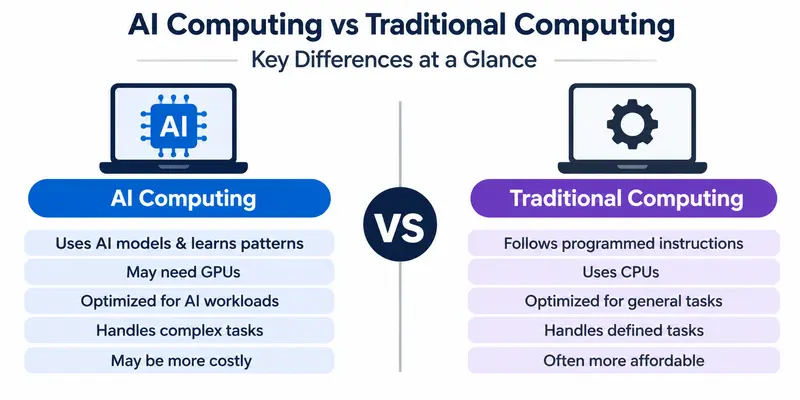
Key Differences Between AI Computing and Traditional Computing
The main differences between AI computing and traditional computing relate to how they process information, use hardware, and complete tasks. In this AI computing vs traditional computing comparison, we will use the same factors to understand where each approach works best.
Factors Used to Compare AI Computing and Traditional Computing
- Working method
- Hardware requirements
- Processing speed and performance
- Data requirements
- Learning and adaptability
- Accuracy and reliability
- Energy use
- Cost
- Applications and real-life uses
- Security and privacy
Let’s explore each factor in detail to understand AI Computing vs Traditional Computing more clearly.
1. Working Method
The working method explains how a computer handles a task and produces a result. It helps you understand what happens behind the screen when you use software, websites, or digital tools. Some tasks need clear instructions, while others involve finding patterns in information. The working method also affects how developers build and manage computer systems. Understanding this factor helps you see which approach suits a particular task.
AI Computing
AI computing handles tasks using AI models, algorithms, and data.
- Pattern recognition: AI uses machine learning to find patterns in text, images, numbers, and other data.
- Data-based results: It uses learned patterns to make predictions or produce answers.
- Flexible tasks: It can handle tasks such as language understanding and image recognition.
- Model-based processing: AI systems use trained models to perform certain tasks.
Traditional Computing
Traditional computing handles tasks using programmed rules and instructions.
- Fixed instructions: It follows instructions written by developers.
- Rule-based results: It produces results based on the logic and rules of a program.
- Defined tasks: It works well with tasks that have clear steps and expected outcomes.
- Program-based processing: Software tells the computer what to do and how to handle inputs.
What Makes Them Different?
In AI Computing vs Traditional Computing, AI uses learned patterns to handle some tasks, while traditional computing follows predefined instructions; AI is often suitable for tasks involving patterns, while traditional computing is useful for predictable processes.
2. Hardware Requirements
Hardware means the physical parts of a computer, such as processors, memory, storage, and graphics cards. Hardware plays a major role in how well a computer handles different workloads. Some tasks need only basic computing power, while others require more powerful components. The right hardware can improve performance and help reduce unnecessary costs. Knowing your hardware needs can help you make better buying and upgrade decisions.
AI Computing
AI computing may require powerful hardware for demanding AI workloads.
- GPUs: Graphics processing units can handle many calculations in parallel, which helps with many AI workloads.
- AI accelerators: Specialized chips can support AI training and processing.
- Memory needs: Large AI models may require substantial memory to run efficiently.
- Hardware flexibility: Smaller AI tasks can also run on ordinary computers, phones, and other devices.
Traditional Computing
Traditional computing commonly uses general-purpose computer hardware.
- CPUs: Central processing units handle general computing tasks and instructions.
- Standard memory: RAM supports applications, operating systems, and active tasks.
- Storage devices: SSDs and hard drives store programs, files, and operating systems.
- General hardware: Many traditional applications run on everyday laptops, desktops, and servers.
What Makes Them Different?
In AI Computing vs Traditional Computing, AI computing may need GPUs or specialized accelerators for demanding workloads, while traditional computing often works well with general-purpose hardware; everyday users may not need AI-specific hardware for basic tasks.
3. Processing Speed and Performance
Processing speed describes how quickly a computer completes a task. Performance depends on the workload, hardware, software, and system design. A computer that works quickly on one task may perform poorly on another. You should not judge a computer only by its processor or speed rating. The best system depends on what you want it to do.
AI Computing
AI computing is designed to support demanding AI processing.
- Parallel calculations: GPUs can perform many calculations at the same time.
- Large workloads: AI hardware can help process large datasets and model operations.
- Task-dependent speed: AI hardware may speed up AI tasks, but not every application benefits.
- Processing efficiency: The right AI hardware and software can reduce the time needed for certain AI workloads.
Traditional Computing
Traditional computing supports general-purpose processing and everyday workloads.
- Sequential processing: CPUs handle instructions and tasks using their processing methods, including sequential and parallel execution.
- Routine performance: It works well for office software, browsing, file management, and many business applications.
- Task optimization: Software and hardware improvements can make traditional tasks faster.
- Consistent workloads: It is suitable for many predictable operations that do not require AI models.
What Makes Them Different?
In AI Computing vs Traditional Computing, AI computing can offer better performance for certain AI workloads, while traditional computing performs well for everyday software and general-purpose tasks; your workload determines which is faster.
4. Data Requirements
Data is information that a computer uses, stores, or processes. It can include numbers, text, images, audio, videos, and records. The amount and type of data can affect hardware, software, and storage needs. Some tasks use only a small amount of information, while others depend on large datasets. Understanding data requirements helps you choose the right computing approach.
AI Computing
AI computing often depends on data to train or run AI models.
- Large datasets: Training many AI models requires large amounts of data.
- Different data types: AI can work with text, images, audio, video, and numerical data.
- Data quality: Poor or incomplete data can affect model results.
- Data processing: AI workloads may require data cleaning, preparation, and data annotation before use.
Traditional Computing
Traditional computing uses data to run programs and complete defined tasks.
- Structured data: It commonly works with organized data, such as tables and records.
- Defined inputs: Programs process information according to their instructions.
- Data storage: It stores files, databases, documents, and other information.
- Predictable processing: It can process data without training an AI model for the task.
What Makes Them Different?
In AI Computing vs Traditional Computing, AI computing often uses data to train models or generate results from learned patterns, while traditional computing processes data according to programmed logic; traditional systems are suitable for many tasks that do not need AI.
5. Learning and Adaptability
Learning and adaptability describe how a system handles new information or changing situations. These features matter when tasks involve changing patterns, different inputs, or new information. Some computer systems can improve their behavior through training. Other systems depend on developers changing their instructions. This difference can affect how software is developed and maintained.
AI Computing
AI computing supports systems that learn from data through AI models.
- Machine learning: Some AI models learn patterns from training data.
- Pattern improvement: Developers can train models with new or improved data to support AI automation.
- Adaptable tasks: AI can handle different inputs, such as questions, images, or speech.
- Model updates: Developers may update or retrain models to improve results or address problems.
Traditional Computing
Traditional computing does not normally learn from data by itself.
- Fixed logic: Programs follow the instructions developers create.
- Manual updates: Developers usually change the program to add new rules or features.
- Predictable behavior: It can produce consistent results when inputs and conditions remain the same.
- Rule changes: Developers can modify software to handle new requirements.
What Makes Them Different?
In AI Computing vs Traditional Computing, AI computing can learn patterns through training, while traditional computing depends on programmed logic; AI may suit changing pattern-based tasks, while traditional computing is useful when rules remain clear.
6. Accuracy and Reliability
Accuracy means how correct a system’s results are. Reliability means how consistently a system performs as expected. Both matter when you use technology for work, study, business, or important decisions. A fast computer is not always an accurate computer. You need to consider the software, inputs, system design, and possible errors.
AI Computing
AI computing can produce useful results, but its output may not always be correct.
- Probabilistic results: Some AI models generate answers based on learned patterns rather than fixed rules.
- Data influence: Poor training data can lead to incorrect or biased results.
- Verification: Users may need to check AI-generated information.
- Model testing: Developers test AI models to measure performance and find errors.
Traditional Computing
Traditional computing can produce reliable results when software and inputs work as expected.
- Rule-based accuracy: Programs can perform calculations using defined rules.
- Consistent results: The same inputs and conditions often produce the same results.
- Testing: Developers can test software against expected outputs.
- Input errors: Incorrect inputs, software bugs, or hardware problems can still produce wrong results.
What Makes Them Different?
In AI Computing vs Traditional Computing, AI computing can handle complex pattern-based tasks but may produce uncertain results, while traditional computing can provide predictable results for well-defined tasks; both need testing and checks.
7. Energy Use
Energy use refers to the electricity a computer system needs to operate. It depends on the hardware, workload, software, and how long the system runs. Some tasks require only a small amount of processing power, while others demand more resources. Energy use also affects operating costs and the heat a system produces. Choosing the right hardware can help avoid unnecessary energy use.
AI Computing
AI computing can use more energy for demanding workloads.
- Heavy processing: Training large AI models can require substantial computing resources.
- Powerful hardware: GPUs and AI accelerators consume electricity during operation.
- Workload differences: Smaller AI tasks may use much less energy than large training workloads.
- Efficient hardware: Modern AI hardware and optimized software can help reduce energy use for some tasks.
Traditional Computing
Traditional computing uses energy based on its hardware and workload.
- General workloads: Everyday applications may require less processing power than demanding AI workloads.
- Hardware differences: Desktop computers, laptops, and servers have different power needs.
- Idle power: Computers can still use electricity when they are not actively completing tasks.
- Workload efficiency: Efficient software and hardware can reduce power consumption.
What Makes Them Different?
In AI Computing vs Traditional Computing, demanding AI workloads may use more energy than many everyday computing tasks, while traditional computing can be more energy-efficient for simple workloads; the actual energy use depends on the system and task.
8. Cost
Cost includes the money you spend on hardware, software, electricity, maintenance, and other resources. The initial purchase price is only one part of the total cost. Your workload, usage time, and future needs can affect how much you spend. A more powerful computer is not always the best financial choice. Comparing costs helps you avoid buying hardware you do not need.
AI Computing
AI computing can involve additional costs for demanding AI workloads.
- Specialized hardware: GPUs and AI accelerators can increase hardware costs.
- Cloud services: Users may pay for cloud-based AI processing instead of buying hardware.
- Training costs: Developing and training some AI models can require significant resources.
- Small AI tasks: Many AI tools can be used through existing devices or online services without buying dedicated hardware.
Traditional Computing
Traditional computing can be affordable for many everyday tasks.
- Standard hardware: Many tasks work on ordinary laptops and desktop computers.
- Software costs: Some programs are free, while others require subscriptions or licenses.
- Maintenance: Computers may need upgrades, repairs, and software updates.
- Scalable choices: Users can select hardware based on their workload and budget.
What Makes Them Different?
In AI Computing vs Traditional Computing, AI computing may cost more when specialized hardware or large AI workloads are involved, while traditional computing is often affordable for general tasks; your budget and needs should guide your choice.
9. Applications and Real-Life Uses
Applications are the tasks and activities that computer systems support. They help you understand how technology fits into daily life, education, work, and business. Different applications require different levels of processing, data, and software. Some tasks use AI to recognize patterns or generate information. Other tasks rely on clear instructions and standard software.
AI Computing
AI computing supports applications that use AI models.
- Chatbots: AI tools can answer questions and help users write or summarize text.
- Software testing: AI can help developers automate software checks through AI regression testing.
- Recommendations: AI systems can suggest products, videos, or content.
- Healthcare support: AI can help professionals analyze medical images or other information, with appropriate human oversight.
Traditional Computing
Traditional computing supports everyday applications and business operations.
- Office work: It runs word processors, spreadsheets, presentation tools, and email software.
- Websites: It supports website servers, browsers, and web applications.
- Banking systems: It helps process transactions and manage financial records.
- Education: It supports online classes, documents, research, and learning software.
What Makes Them Different?
In AI Computing vs Traditional Computing, AI computing supports tasks that involve predictions, recognition, and content generation, while traditional computing handles many defined operations and everyday applications; both can support education, business, and other activities.
10. Security and Privacy
Security protects computers, software, and data from threats such as unauthorized access, malware, and misuse. Privacy focuses on how personal and sensitive information is collected, stored, and used. Both matter when you use computers for personal activities, school, or business. The risks depend on the software, system design, data handling, and security practices. You should consider these issues before using any technology.
AI Computing
AI computing can create additional security and privacy concerns.
- Sensitive data: AI tools may process personal, business, or confidential information.
- Data handling: Users should understand how an AI service stores and uses their data.
- AI-specific risks: AI systems can face threats such as data poisoning or prompt injection.
- Security controls: Developers and organizations need suitable access controls, testing, and monitoring.
Traditional Computing
Traditional computing also needs strong security and privacy controls.
- Data protection: Systems need protection for files, databases, and personal information.
- Access controls: Passwords, permissions, and authentication help limit unauthorized access.
- Software vulnerabilities: Bugs and outdated software can create security risks.
- Safe practices: Updates, backups, and security tools help protect systems.
What Makes Them Different?
In AI Computing vs Traditional Computing, AI computing can introduce AI-specific risks related to models and data, while traditional computing faces common software and infrastructure risks; both need strong security and responsible data handling.
AI Computing vs Traditional Computing
The following table summarizes AI Computing vs Traditional Computing across all 10 comparison factors. It helps you quickly understand which approach may suit different tasks.
| Comparison Factor | AI Computing | Traditional Computing | Main Difference |
| Working method | Uses AI models and learned patterns | Follows programmed instructions | Learning-based vs rule-based processing |
| Hardware requirements | May use GPUs and AI accelerators | Commonly uses CPUs and general hardware | Specialized vs general-purpose hardware |
| Processing speed and performance | Optimized for many AI workloads | Optimized for general tasks | Performance depends on the workload |
| Data requirements | Often uses data for training and AI processing | Processes data based on program logic | Data may train AI models or serve as input |
| Learning and adaptability | Can learn patterns through training | Depends on programmed rules | Learning vs manual changes |
| Accuracy and reliability | May produce uncertain results | Can produce predictable results for defined tasks | Different methods of producing results |
| Energy use | Demanding workloads may use more energy | Many everyday tasks need less processing power | Energy depends on workload and hardware |
| Cost | May require specialized hardware or AI services | Often uses standard hardware and software | Costs depend on requirements |
| Applications and real-life uses | Chatbots, image recognition, predictions | Office software, websites, databases | Different types of tasks |
| Security and privacy | Includes AI and data-related risks | Includes common software and system risks | Both need protection and responsible use |
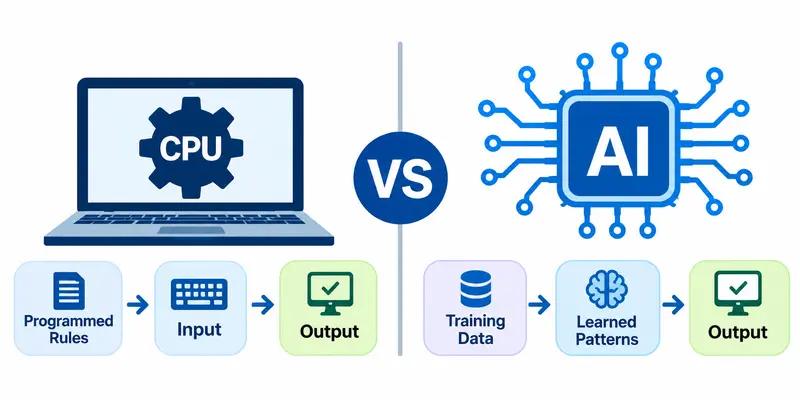
How AI and Traditional Computing Work Differently
AI computing and traditional computing follow different approaches to solving problems. Both use software and hardware, but their processing methods depend on the task. This is one of the simplest ways to understand AI Computing vs Traditional Computing.
- Traditional computing process: A developer writes instructions, and the computer follows them to complete a task.
- AI computing process: Developers train an AI model using data, and the model learns patterns that help it handle tasks.
- Traditional input: A user enters information, and the program processes it according to its rules.
- AI input: A user provides information, and an AI model uses learned patterns to generate an output.
- Result: Traditional systems often follow defined logic, while AI systems can produce predictions, classifications, or generated content.
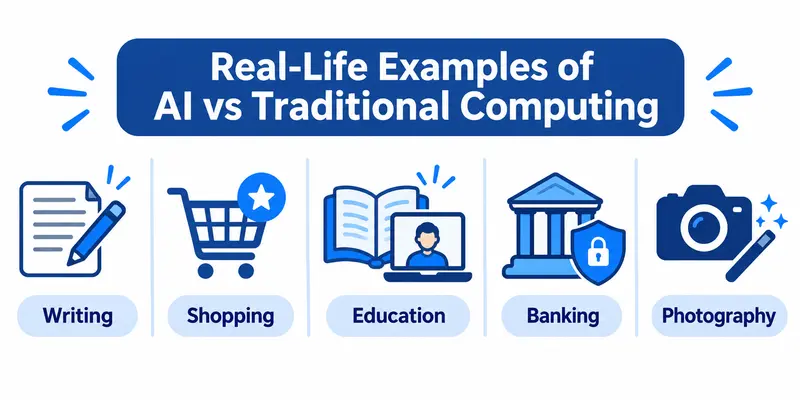
Real-Life Examples of AI vs Traditional Computing
You already use traditional computing and AI computing in many areas of daily life. Sometimes both approaches work together in the same application. These examples make AI Computing vs Traditional Computing easier to understand.
- Writing: A traditional word processor lets you type and edit text. An AI writing assistant can suggest sentences, summarize text, or help you rewrite content.
- Online shopping: Traditional systems store orders and process payments. AI systems can recommend products based on user activity.
- Education: Traditional learning software displays lessons and quizzes. AI tools can explain topics, generate practice questions, or provide personalized learning support.
- Banking: Traditional systems process transactions according to banking rules. AI systems can help identify unusual transaction patterns.
- Beauty and photography: Traditional software lets you edit images using defined tools, while AI in the beauty industry can help users analyze skin, recommend products, and explore virtual makeup.
Advantages of Traditional Computing
Traditional computing remains useful because it supports many everyday tasks without requiring AI models. It offers practical benefits for individuals, students, developers, and businesses.
- Simple tasks: It handles routine work such as typing, calculations, file management, and browsing.
- Predictable results: Programs can produce consistent outputs when inputs and conditions remain the same.
- Affordable options: Many everyday computing tasks work on standard computers.
- Control: Developers can define rules and logic for specific tasks.
- Wide support: Many existing software applications, websites, and business systems rely on traditional computing.
Advantages of AI Computing
AI computing helps people handle tasks that involve patterns, predictions, and complex information. It can support different activities in education, business, research, and daily life.
- Pattern recognition: AI can identify patterns in data that may be difficult to detect manually.
- Automation: It can automate some tasks, such as text classification and image recognition.
- Content generation: AI tools can create drafts, summaries, images, and other content.
- Data analysis: AI can help analyze large amounts of information.
- Flexible applications: AI supports tasks involving language, images, speech, predictions, and recommendations.
Limitations of AI and Traditional Computing
Both types of computing have limitations. Understanding these problems can help you choose the right tools and avoid unrealistic expectations.
- AI computing limitations: AI models may produce incorrect answers, require large amounts of data, or need powerful hardware.
- Traditional computing limitations: Traditional programs may struggle with tasks that require understanding complex patterns unless developers create suitable logic.
- AI maintenance: AI models may need testing, monitoring, updates, and retraining.
- Traditional maintenance: Traditional software may need manual updates when requirements or rules change.
- Shared risks: Both approaches can face security problems, hardware failures, software bugs, and data-related issues.
Final Note
Understanding AI Computing vs Traditional Computing helps you make smarter technology choices. AI computing is useful for tasks that involve learning, predictions, pattern recognition, and content generation. Traditional computing remains a reliable choice for routine tasks, fixed instructions, calculations, and everyday software. The right option depends on what you need to do, not simply which technology is newer.
Both technologies offer valuable benefits, and you do not always need to choose just one. Traditional computing can handle everyday tasks, while AI computing can help automate complex work, analyze data, and solve problems faster. Using both together can help individuals, students, and businesses improve productivity and get better results.
Want to learn more about AI and how it works in real life? Explore more guides on AIGuideTest to discover AI tools, technologies, practical applications, and beginner-friendly explanations. Keep learning, explore new technologies, and find ways to use AI to make your work easier and smarter.
Frequently Asked Questions
Here are some of the most frequently asked questions related to AI Computing vs Traditional Computing.
AI computing supports artificial intelligence tasks using AI models. These models can learn patterns from data. Traditional computing follows programmed instructions to complete tasks. The main difference is how they handle information and solve problems.
AI computing can be faster for certain AI workloads. GPUs help process many calculations at the same time. Traditional computing can be faster or more efficient for many everyday tasks. The actual speed depends on the hardware, software, and workload.
Some AI workloads need powerful hardware. Large AI models may require GPUs, extra memory, or specialized chips. However, many AI tools work through online services. You can use them without buying a powerful computer.
Yes, some traditional computers can run AI software and smaller AI models. Their performance depends on the hardware and software requirements.
- Basic AI tools: Some AI applications run on ordinary computers.
- Cloud AI services: You can use online AI tools through a browser.
- Small models: Some AI models can run locally on standard hardware.
- Hardware limits: Larger models may need more memory or specialized hardware.
AI computing can cost more when it requires specialized hardware or large computing resources. However, the cost depends on the task and how you use the technology.
- Hardware costs: AI accelerators can increase the cost of a computer.
- Cloud costs: AI services may charge based on usage or subscription plans.
- Traditional systems: Standard computers can handle many tasks at a lower hardware cost.
- Budget choices: Compare your actual needs before buying new equipment.
Yes, traditional computing remains essential for many everyday tasks and business operations. It supports many applications that do not need AI.
- Office tasks: It runs word processors, spreadsheets, and presentation software.
- Business systems: It supports databases, websites, and many business applications.
- Routine processing: It handles defined calculations and tasks.
- AI infrastructure: Traditional computing components also support many AI systems.
AI computing cannot replace every traditional computing task. Many programs need clear rules and predictable results. AI systems also depend on hardware, software, and computing infrastructure. Both approaches can work together to support different needs.
Traditional computing remains useful for routine operations, databases, and standard software. AI computing adds support for tasks involving patterns, predictions, and generated content.
Both are useful for students. Traditional computing supports research, assignments, presentations, programming, and online classes. AI computing can help explain topics, summarize information, and generate practice questions. Students can use both to improve their learning.
Traditional computing provides the basic tools students need for daily study. AI computing can add extra learning support, but students should check AI-generated answers.
Yes, many computer systems use both approaches. Traditional computing handles routine tasks, data storage, software operations, and system management. AI computing supports tasks such as predictions, recommendations, and pattern recognition. Developers can combine both approaches in the same application.
For example, an online shopping website can use traditional computing to process orders and payments. It can also use AI computing to recommend products to customers.
Choose AI computing for tasks involving predictions, pattern recognition, AI models, and content generation. Choose traditional computing for routine tasks, office work, standard software, and defined processes. Both can support your work, studies, or business. The best option depends on what you need to accomplish.
Practical tip: Start with your task and budget, then choose the hardware and software that meet your needs.


https:aitoolified.com/